Google+
Showing posts with label Health Canada. Show all posts

Friday, January 13, 2017

Arsenic in Canadian Chicken, Round 2

It has been 4.5 years since Canada banned farmers from adding poisonous arsenic to their chicken feed.  Arsenic addition was primarily done by CAFO factory farms of the Supply Management Overlords (ie. The Chicken Mafia) to artificially increase their profits and reduce their personal risk..

I have previously made many posts and inquiries of government authorities about this barbaric practice of adding a known carcinogen and acute poison to feed animals that will eventually become human food (see Arsenic In Canada's Chicken ).

On Nov. 8, 2013 I emailed a number of questions to Health Canada about their surveillance of CAFO chicken to ensure that CAFO chicken farmers actually implemented the arsenic ban, versus ignored it and continued with their evil practice as if the ban didn't exist.

I never got a response from Health Canada, in spite of a few reminders.

I received a comment a while ago on my previous Blog postings about arsenic, asking if there has been any update.  I decided to try once more to get some straight answers out of Health Canada.  Perhaps with the new Liberal Government under Justin, Health Canada would be more inclined to answer.

Therefore, I copied the Nov. 8, 2013 email and sent it off again to Health Canada's Veterinarian Drug Directorate ("VDD") who is in charge of these things.

So far, I have received VDD's apology for their tardiness in answering the 2013 email.  Good first step.  I was told the answering of the email has been assigned to one or more of VDD's "experts".

Agri007 picked up on my renewed effort to get arsenic answers.  This cross posting prompted some additional questions about the arcane historic practice of arsenic additions to chicken feed:

  1. Has there been any anecdotal evidence, or formal scientific study that Canadians arsenic loading (ie. food, air, dermal, or water born arsenic intake) has been affected because of the arsenic ban?  Is a study of this issue planned in the future?  If not, why not?

  2. Has there been any anecdotal evidence, or formal scientific study that Canadian human health has been affected (pro or con) because of the arsenic ban?  Is a study of this issue planned in the future?  If not, why not?

  3. Has there been any anecdotal evidence, or formal study of the health status of CAFO chicken flocks (ie. farms that previously used arsenic in the feed) has been affected by the arsenic ban? Is a study of this issue planned in the future?  If not, why not?

Stay tuned.  It will be interesting to see if there is a "Trudeau II" effect on openness, transparency, and accountability by the Federal Government.

Any bets?

Sunday, October 12, 2014

2.7 Canadians Die Each Year from SM's Contaminated Chicken

Based on scientific, objective evidence, we can reasonably conclude that approximately 2.7 Canadians are killed each year by contaminated chicken purchased in Canada.  Since the Supply Management system has about 99.96% market share, this government regulated, approved system run by the #ChickenMafia can (and should) be held fully responsible for those needless deaths.

This follows on my previous Blog posting "Deadly Canadian Chicken" which explored food-borne illness, and how poultry has been in the top 3 sources of food poisoning for decades.

The calculation of 2.7 Canadian deaths per year from SM poultry is based on the following data from objective scientific sources:

  1. The deaths from foodborne illness are not always the direct cause of death.  Sometimes people die from the complications caused or contributed to by the food poisoning.  For example, one 26 year old man died of a heart attack that resulted from a severe bout of Salmonella Heidelberg food poisoning (Ref. 1).  However, there is no mistaking the signs that this was food poisoning that started the problems.
     
  2. There are 35.54 million Canadians as of 2014 (Ref. 2)
  3. There is no readily available statistics on salmonella foodborne illnesses in Canada, but we can use US data as a proxy until Canada can produce our own data.  The US data says there are 0.9 cases per year of salmonella per 100,000 population, of which 71% are hospitalized and 5% died. (Ref. 3)
     
  4. US Centre of Disease Control has tracked cases of foodborne illness from 1998 to 2008, and found that between 10.1% to 29.2% of all cases of Salmonella poisoning were caused by contaminated poultry (Ref. 4)
  5. The geometric mean of the range 10.1 to 29.2 is 17.17%
  6. The calculation is as follows:   (35.54 Million)/(100,000)*(0.05)*(0.1717)=3.05 Canadians killed each year from poultry contaminated by Salmonella.
  7. Canadians consume 4.2 kg/yr/person of turkey, and 31.2 kg/yr/person of chicken.  Therefore chicken represents 88.14% of the poultry marketshare on a weighted average.  Therefore Canadian chicken is responsible for 2.7 deaths each year from Salmonella poisoning and/or the resulting complications.
  8. Since the SM #ChickenMafia has over 99% marketshare, and their chicken is 10 times more contaminated than the chicken raised by Small Flockers and processed on the farm for personal consumption (see Blog posting Hope for the Mega Meat Manufacturers? where I compare the chicken factory 3,600 CFU vs. the Small Flocker on-farm result of 133 CFU) , it seems reasonable to attribute at least 99% of these deaths to the #ChickenMafia.  On a weighted average CFU count, #ChickenMafia puts out 99.99852% of the total contamination into the marketplace, just 0.001478% by Small Flockers.
  9. Therefore Canada's #ChickenMafia (Chicken Farmers of Canada, Chicken Farmers of Ontario, and all the other provincial boards) are fully responsible for 2.7 deaths per year from chicken contaminated with Salmonella.
  10. Note that chicken is contaminated by many more pathogens than just Salmonella, so the real problem is much worse than what has been calculated here.
So what is the government going to do about an approved, highly regulated system that kills 2.7 Canadians each year?

I previously raised the issue of contaminated food, contrary to Canada's Food & Drug Act, but the Federal bureaucrats ignored the issue (see Blog posting "If It's Contaminated, Is It Food?").

Does it make it any easier or better now that we have reasonably estimated that 2.7 Canadians per year lose their life while both the Federal and Provincial bureaucrats fiddle?

If it was one of your family members killed by contaminated chicken knowingly sold in Canada, would that be OK with you?


Monday, May 5, 2014

If it's Contaminated, Is It Food?

Why no answers from CFIA or Health Canada about contaminated chicken being sold as food, contrary to Canada's Food & Drug Act?

I asked the following 4 questions of Health Canada on 2013-09-03 13:38 PM (see below).

The Web support team of Health Canada quickly acknowledged receipt of my questions, then forwarded the questions to Health Canada's Food‐Aliment <Food‐Aliment@hc‐sc.gc.ca>  Department on 2013‐09‐03 2:04 PM saying:
For appropriate action, please and thank you!
Food Directorate
Health Products and Food Branch
Health Canada

So far, I have received nothing back from them.  I have now requested the answer again, and an answer on why the delay, with copies to the Minister of Agriculture & Agri-Foods, and the Minister of Health (who share responsibilities for CFIA).

Here are my questions, still without answers:

Unanswered Questions from CFIA and Health Canada

I understand that Canada's Food and Drugs Act, Article 4 states:
No person shall sell an article of food that:
(a) has in or on it any poisonous or harmful substance;
(b) is unfit for human consumption;
(c) consists in whole or in part any filthy, putrid, disgusting rotten, decomposed or diseased animal or vegetable substance;
(d) is adulterated; or
(e) was manufactured, prepared, preserved, packaged or stored under
unsanitary conditions.

I also understand from http://www.hc‐sc.gc.ca/fn‐an/legislation/acts‐lois/act‐loi_reg‐eng.php
that:
"All health and safety standards under the Food and Drug Regulations are enforced by the Canadian Food Inspection Agency. The Agency is also responsible for the administration of non‐health and safety regulations concerning food packaging, labelling and advertising."
I also understand from http://www.ncbi.nlm.nih.gov/pubmed/22221353
J Food Prot. 2012 Jan;75(1):34‐40. doi: 10.4315/0362‐028X.JFP‐11‐206.
Campylobacter, Salmonella, Listeria monocytogenes, verotoxigenic Escherichia coli, and Escherichia coli prevalence, enumeration, and subtypes on retail chicken breasts with and without skin; Cook A, Odumeru J, Lee S, Pollari F. Source: Laboratory for Foodborne Zoonoses, Public Health Agency of Canada, 255 Woodlawn Road West, Unit 120, Guelph, Ontario, Canada N1H 8J1.   angela.cook@phac‐aspc.gc.ca
and other similar studies that between 30% to 80% of all raw chicken meat sold in Canada is contaminated with E. Coli, Salmonella, Campylobacter, and/or other human pathogen.

I therefore have the following questions:

1. Are E. Coli, Salmonella, Campylobacter, and/or other human pathogen considered by CFIA to meet the definitions of one or more prohibited substances or processes as defined by Article 4 of Canada's Food & Drug Act? If yes, which ones? If no, please fully describe and justify CFIA's position.

2. Is there strict liability for Article 4? In other words, if someone takes "reasonable precautions" to avoid all of these prohibited conditions or processes, is that good enough to avoid prosecution and conviction, even if somebody dies from resulting food poisoning? Is mens rea required to be proved in CFIA's opinion?  If someone knew, or ought to have known that an article of food for sale (or sold) was contaminated, is that sufficient to prosecute and obtain conviction in CFIA's opinion?

3. Is CFIA directly (or indirectly through contractors or delegated authority/responsibility to others) doing any surveillance of raw chicken at chicken producers (ie. farms), slaughter plants, further processing plants, wholesale distribution channels, or at retail stores for contamination of raw chicken with E. Coli, Salmonella, Campylobacter, and/or other human pathogen? If yes, please describe CFIA's sampling inspection plan (including but not limited to sampling frequency, sample size, sampling stratification, sample randomization, sample selection protocols, sample testing), and % of samples found to be contaminated (ie. non‐compliant to Article 4) for the past 5 years. What traceability system for samples does CFIA use so as to determine the source, brand, lot code, meat plant's CFIA or provincial registration number, distribution chain, and sampling point that is associated with samples subsequently found to be contaminated? When contaminated raw chicken has been identified, what subsequent action(s) has CFIA taken to quarantine, condemn, and/or lay charges under Article 4 or other Acts & Regulations (please provide % frequency of each outcome taken by CFIA)? If CFIA has not laid charges in all cases of contaminated raw chicken, please describe why not?

4. I understand that CFIA has recently developed meat plant procedures that will allow unlimited line speeds for the slaughtering of chicken. See MPIP (Modernized Poultry Inspection Program) Inspection ‐ No cap on the line speed. It is unlimited speed as long as process is under control. Some establishments run at >200/minute http://www.inspection.gc.ca/english/fssa/meavia/man/ch19/19‐6‐2e.shtml   Does CFIA consider that the risk of contamination to significantly increase with rising line speeds on some proportional, linear, or exponential function relationship? If a CFIA Inspector suspects or determines that chicken carcass contamination has occurred at some point on the production line in a chicken slaughter plant, what is CFIA's
policy (ie. automatically declared contaminated until proven otherwise, assumed to be OK, or some other designation) concerning all the chicken on the slaughter line that is: a) between the last known good point on the line and the moment that the Inspector first suspects or knows a carcass contamination occurs; b) between the first carcass that the Inspector suspects or knows is contaminated and the first carcass subsequently processed that is again known to have been restored to acceptable quality, all while the line is operating in a stable and statistically predictable manner for an adequate period of time;

Thanking you in advance for your prompt and comprehensive answers to these three questions, I remain,

Yours truly,

Glenn Black
Small Flock Poultry Farmers of Canada

Friday, October 4, 2013

Small Flockers are Exempt ? ! ?

On behalf of farm gate egg sellers all across Canada, I questioned and complained to Health Canada about their upcoming Guidelines which are poised to strike Canadians in Dec. 2013. See our prior Blog posting:   Help, we're under attack!

Health Canada quickly responded.  I was shocked by HC's response.  Their initial response is that small flockers and farm gate egg sales are exempt from the new Guideline.

What ??

Yes, that's what Health Canada said.  Small flockers are exempt.  Small flockers can continue selling their eggs at the farm gate.

You may not be, but I'm totally confused.  Here is what Health Canada said on this alleged exemption:

"Section 2.11 of the guidance document defines table eggs as follows:

    A shell egg offered for sale to consumers (including retail environments, restaurants, bakeries, and other foodservice and institutional settings) for the purposes of consumption.

Eggs that are offered for sale at farm gates are excluded from the scope of the document. Please be advised that the guidance document does not recommend a ban on farm gate egg sales.  Therefore, the issues that you raised related to farm gate sales of eggs are not expected to occur."
Later on in their email, HC also states:

"The guidance document [focusses sic.] the recommendations on table eggs originating from regulated flocks, since these eggs represent the majority of eggs offered for sale on the table market." 
That makes sense to me, because this table egg source is more than 90% of the total eggs consumed.  Since I doubt there is a 100 fold higher probability of contaminated eggs with small flocker farm gateeggs, HC seems to be focusing their action on the overall risk to consumers.

Health Canada continues in the same paragraph:

However, there are numerous practices in place in the regulated sector that reduce the risk of S. Enteritidis in grade A table eggs, which do not necessarily extend to eggs originating from sources outside of the regulated sector. For this reason, sources of table eggs outside of the regulated sector may represent an increased risk to consumers.
Note that HC says "may represent an increased risk".  Is there proof, or is it enough to convict small flockers with just mere suspicions?

HC continues:

After the consultation, Health Canada sought additional evidence to support the increased risk of S. Enteritidis associated with eggs originating from sources other than the regulated flocks and has presented this information in section 8.3 of the revised guidance document. Two SE outbreak investigations in Canada, in 2010 and 2012, provide evidence supporting the hypothesis that table eggs originating from sources outside the regulated sector may represent an increased public health risk. The weight of scientific evidence supports that any laying flock, regardless of size, may put consumers at risk by supplying eggs for the table market from a flock infected with S. Enteritidis, and that eggs that are not stored or handled in a way that minimizes the S. Enteritidis hazard, may put consumers at risk.
The consultation referenced above seems to be the one held from Nov. 9 through Dec. 21, 2011.  This was before SFPFC (Small Flock Poultry Farmers of Canada) existed, so it seems somebody else was helping defend our interests back then.  Whomever it was, thank-you for caring and taking the effort.

CFIA now has evidence that the regulated egg producers are confirmed at having up to 11% defects (ie. dirty, cracked, expired, under sized, etc.) in their egg cartons delivered to retail stores.  The defects were alleged by other egg producers to have been purposefully done so as to punish competitive egg producers, or to obtain extra profits.  I wonder if HC included this risk in their calculations?  Can they still say that small flockers are more risky?

Even then, I'm not sure HC is talking about small flockers in the above paragraph.  Who else could they be speaking about, these "sources outside the regulated sector".  If that isn't small flockers that HC is speaking about, then exactly who do they refer to indirectly?

In Section 8.3 HC's draft Guideline refers to the use of ungraded eggs in food service establishments in British Columbia that may have caused illnesses in 2007 - 2010.  They also refer to an non-regulated egg producer who sold dirty eggs to a food service establishment.  That food service establishment had poor food handling techniques, and didn't refrigerate the dirty eggs between when they were delivered, and when they were prepared and served; resulting in 91 illnesses.

It would seem that both regulated and non-regulated egg producers could supply Salmonella contaminated eggs.  This risk can be compounded by dirty, cracked, and unrefrigerated eggs.  Either way, it puts consumers at risk. Then why does HC say small flockers and farm gate eggs are exempt from the new Guidelines? I believe it is a matter of degree of risk from these two different egg sources.  I also believe there are different expectations by consumers for these two different sources. 
 
My email response to Health Canada's current position on the alleged small flock table egg exemption was as follows:

"Thanks for the detailed response.

 I understand that HC excludes the sale and consumption of ungraded farm gate egg sales from your "table egg" definition.  That is hard to understand, as I see no justification for that, neither in the definition nor the report.  Please explain this exemption in the greatest detail possible.

For example, how does HC compare and contrast the sale of ungraded eggs at the farm gate to consumers ( eg. non-resident family members, neighbours, community members, etc.), or sale at Farmers Markets, or the sale to local convenience store who sells them to the public, or a roadside stand on the highway near but not on the farmer's farm?

Am I and other small flockers able to sufficiently rely upon the statements you make on behalf of HC, sufficient to avoid subsequent regulatory action for following your advice and statements?  In other words, what is your authority and expertise on these issues?

The other issues and comments may be moot based on the final definitive answer to the above statement."
I wouldn't rush out to make a major investment in small flock egg sales at the farm gate based on this preliminary and non-verified response.  Perhaps it was a typo by HC.  Perhaps it's a cruel joke to jerk our chain.

Hopefully Health Canada will soon clarify and justify this secret or mysterious position of exempting small flock egg sales at the farm gate.
 

Friday, September 27, 2013

Small Flock Egg Producers in Canada & the World

Following in Todmorden's footsteps, I'd like to form a Google Map showing all Canadians where and how they can get locally produced farm-fresh eggs in Canada.

For those who are afraid of the Chicken Police or the Egg Police (the ex-military and ex-police henchmen of the Egg & Chicken Mafia), you may want to fly under the radar, continue to produce in secret for a select few who buy your production.

For those who are brave (or foolish) like myself, you can declare to the world your chosen path to produce eggs for your community, come what may.  Realize that you will be making it easy for the Health Canada Secret Police and their Provincial/Territorial henchmen to find you and hunt you down when their new regulations come into effect.

I have chosen to declare my operation.  I think they already have my photo and all other info up on their bulletin board and in their database.  I'm actually surprized that this Blog hasn't already prompted them to raid my farm long ago.

The form below will allow you to enter your info.  Once you click "Submit", your data will be stored in a spreadsheet on a Google Drive.  Everybody in the world will be able to see that database of self-declared Small Flock Egg Producers here.

The data can be sen in Google Maps by clicking on this link. Each of the small flock egg producers will be a red dot on the map under the tab "Map of Small Flock Eggs".  Click on one of the red dots to open up a detailed listing of the data for that small flocker, but the long description of their eggs is not viewable on the map. The "Cards" tab will give a nice, compact view of all data for each small flock farm.

Currently, the map updates only by my re-building it manually.  I'm trying to get it to be dynamic (rebuilds automatically), but miracles take longer.  If you feel we need more info collected about each of the small flockers, let me know.

You should be able to update or change your own info later on.  If you have a problem, let me know, and I'll try and figure it out (I'm new to Google Docs too).

In the form below, it asks you for your Latitude and Longitude, in decimal degree notation.  You can get that from Google Maps.  Click on the map near where you are located to zoom in.  Keep zooming in so you get an accurate placement for people who don't know the local area.  Once you can clearly see your exact location on Google Maps, place the cursor over your location and right-click the location, then select What's here?. The coordinates will appear in the search box.  Copy those latitude & longitude co-ordinates into the form below.

While this is meant for Canadian Small Flockers, I know there are many readers of this Blog from around the world.  There is no other system for finding Small Flock Egg Producers, except for Todmorden's map, so anybody else is welcome to use this form and map too.

Once you are done, you can see your data (and everybody else here in the Google Doc database spreadsheet for Small Flock Egg Producers in Canada & the World

May the customers come and help defend you, and the Egg Police stay away.

Local Egg Production via Incredible Edibles

Health Canada wants to shut down the small flock and backyard egg producers throughout Canada who provide eggs for their local community.

I disagree with both the need, and the methods that Health Canada has used in this misguided witch hunt against small flockers.

Is there an alternative to Health Canada's tyrannical plan?

Todmorden, a small market town in northern England
which has transformed itself with local food production.
Let's take a look at some citizens in Todmorden England.  Pam Warhurst spoke at TEDSalon in London UK, May 2012 about their town's initiative for local, sustainable food production, linking local food to the local education system, and local businesses.  Incredible Edibles was born.

In 5 short years, Todmorden is now considered to be the first town in England that has achieved food self-sufficiency.

One of the programs that they launched was "Every Egg Counts", trying to encourage local citizens to raise chickens to provide eggs for themselves, as well as a few of their neighbours.

Campaign brochure for "Every Egg Matters", saying
"Truly Fresh, Truly Local, Truly Free Range"

Every Egg Counts was eventually able to convince local farmers that the townspeople were serious, and were truly interested in partnering with the farmers and rural citizens.

Incredible Edible Todmorden produced a map to show locals and visitors where they could go to get farm fresh eggs.

Map of Todmorden showing where local, farm fresh eggs
can be purchased.
When Todmorden first produced their map, there were only 4 egg producers in the area.  Within 3 years, they had 64 local egg producers on their map.  People are now going into the local shops seeking to buy local eggs in preference to the mass produced egg shipped in from far, far away.

The Incredible Edible Todmorden was formed on some simple principles:
  • Invented around a kitchen table by 3 people
  • No consultant
  • No study or strategy document
  • No permission asked
  • No government grant desired or needed
  • Local actions can make a difference
  • People can rally around food, "If you eat, you're in."
  • All done as an experiment
  • All done with volunteers
49% of local food producers have reported that their bottom line has improved through Incredible Edibles.

Today, there are 49 towns and cities in England who are implementing Incredible Edible, 19 sites in Canada, and hundreds of sites world-wide.  Todmorden has graciously shared their success with others so that followers don't have to re-invent the wheel.

Congratulations and thank-you to the people of Todmorden for their insight, hard work, courage, and altruism.


View Incredible Edibles and World Interest in a larger map  

Do you think that Health Canada should re-consider their unholy alliance with the Egg Mafia?

Unfortunately, it doesn't matter what you think.  You're not in charge.

The Egg Mafia is in charge, and Health Canada is dancing to their tune.


Tuesday, September 24, 2013

Help! We're under attack.

Man all battle stations!  We're under attack.

Without provocation, a surprise attack against Canadian small flockers has been launched, from coast to coast to coast.

Unfortunately, this attack has opened battle lines on a second front simultaneous with our ongoing right to grow local, affordable chickens for food.  Small flockers have fought bravely against superior enemy forces who have attacked with neither mercy nor just cause.  A summary of the enemy's attack on Sept. 9th 2013 can be found here.

Secret Report

The diabolical public relations propaganda of the enemy has kept the fully detailed report on their vicious attack secret.

However, secret agents of the freedom fighting SFPFC (Small Flock Poultry Farmers of Canada) have infiltrated the enemy's intelligence centre, and like WikiLeaks, SFPFC has posted the full report on the enemy's war crimes. The full report on the enemy's atrocities is posted here for the world to see and witness.

It is all summed up by the scurrilous Section 7.3.3 of the enemy's new Guidelines, where we find:

"Table eggs from unregulated flocks not complying with the recommendations in this guidance document should not be supplied for the table market, but should be diverted for further processing."


By "table eggs", they mean fresh, in the shell, raw eggs sold to consumers.

By "unregulated flocks" they mean farm gate (or backyard) sale of eggs by small flock chicken farmers who are currently allowed 99 or less laying chickens in Ontario (limits vary by Province/Territory).
By "complying with the recommendations" they mean no more re-using of egg cartons, implementing HACCP (Hazard Analysis Critical Control Point) and passing your annual re-certification audit, implementing Start Clean- Stay Clean and passing your annual re-certification audit, proper egg washing in an approved manner, using (or building your own) a CFIA-approved egg grading station, testing and/or vaccinating against Salmonella, biosecurity separation between meat and egg birds as well as all possible contact with wild animals and birds, collecting eggs multiple times per day, temperature & time control throughout the egg's life,  labeling and traceability (forward & backward), lifetime ban from table egg sales for all layers exposed to Salmonella, and many more recommendations.
By "diverted for further processing", they mean sending 100% of your egg production for use as animal feed, or bulk eggs that get pasteurized (which sell for less than $0.566 per dozen as NR18), etc.; not enough $ to recoup the cost of the chicken feed consumed by the layers.
Unjustified Attack on the Innocent

How does the enemy try to justify their unjustifiable attack on small flock owners?  They try to use a risk assessment, and "advice" from industry experts from the monopolist millionaire egg producers who have quota.  Obviously, there is a significant conflict of interest when the quota-based monopolists Chicken Mafia advises Health Canada on the eradication of their competition, the quota-exempt small flock egg producers.

Warning Signs of their Planned Attack

There were warning signs dating from Oct. 2011 which happened long before the formation of the small flocker's resistance force, SFPFC (Small Flock Poultry Farmers of Canada).  SFPFC's forward scouts alerted SFPFC's command headquarters as soon as these plans and preparations by the enemy combatants were discovered.

Plea for Help

This plea for help will hopefully alert all friendly forces to our tenuous plight.  We pray that reinforcements will soon arrive to aid our cause.

To buy time so that SFPFC's reinforcements can get mobilized and into position, a desperate salvo against the attacking barbarians was launched yesterday.  Details of this return fire against SFPFC's attackers can be seen here.

Hopefully the war mongering aggressors don't realize the current weakness in SFPFC's defenses at this time.  Will reinforcements arrive in time, so as to adequately defend us against all subsequent waves of unrelenting attacks that are soon to strike?

As your leader of SFPFC's main forces for our ongoing battle for small flock meat birds, I am unable to single handedly defend our interests on both fronts simultaneously (ie. both farm gate/backyard eggs, and poultry meats).

I need your help.

Will somebody come to the aid of SFPFC's cause by defending against this sneal attack on our flank?

I believe new leaders will spontaneously appear once they see the desperate need, and find the courage to act.

If not you as the new leader, then who will you encourage to step up to be a new leader with you as their ready follower?


Wednesday, September 4, 2013

Contaminated Chicken

We're surrounded by contaminated chicken, and may need to surrender.

Nobody thinks they will fall victim to food poisoning, until it's too late.

Studies have shown that 30% to 80% of the chicken sold at retail are significantly contaminated by E. Coli, Salmonella, Campylobacter, Listeria, and/or other human pathogen.

How could this be allowed to happen?  Why have we allowed it to continue, so that contaminated chicken has now become the new "standard of quality" ?

Canada's Food and Drugs Act, Article 4 states:

No person shall sell an article of food that
(a) has in or on it any poisonous or harmful substance;
(b) is unfit for human consumption;
(c) consists in whole or in part any filthy, putrid, disgusting rotten, decomposed or diseased animal or vegetable substance;
(d) is adulterated; or
(e) was manufactured, prepared, preserved, packaged or stored under unsanitary conditions.

I also understand from http://www.hc-sc.gc.ca/fn-an/legislation/acts-lois/act-loi_reg-eng.php that:
"All health and safety standards under the Food and Drug Regulations are enforced by the  Canadian Food Inspection Agency. The Agency is also responsible for the administration of non-health and safety regulations concerning food packaging, labelling and advertising."

I therefore have some burning questions for government authorities about the risky and ridiculous situation they have allowed Canadians to be preyed upon by the Chicken Mafia.
They condemn and prohibit small flock farmers from processing their fowl at their farm gate, yet allow the current system to run amock.

If that isn't bad enough, CFIA has plans for allowing unlimited chicken slaughter plant line speeds.  Some of these chicken abattoirs now run at over 200 birds per minute.  That gives the CFIA Inspector just 0.3 seconds per bird to inspect (ie. 3 birds per second whizzing by the CFIA Inspector), haplessly and hopelessly trying to ensure the birds are healthy and not contaminated.

I have worked as a Quality Assurance Manager and a consultant in high volume automotive parts manufacturing plants and electronic circuit board manufacturing plants that used similar line speeds.  I tested our quality inspectors to see what they could consistently achieve at those speeds.  Generally, the inspector was mentally fatigued and no longer effective after 10 minutes to 2 hours on-the-job; depending on the individual inspector, lighting, number of possible defects, defect rates, and ambient conditions.  To ensure consistent quality, we had to build it in at source (ie. prevent the defect from occurring, so it doesn't need to be inspected for later), and relieve (or rotate) the inspectors faster than their capabilities deteriorated.

Has CFIA done similar, statistically valid tests for all of their Inspectors and determined their proven capabilities? If not, why not?

Hint to CFIA:   Conduct an R&R (Repeatability & Reproducibility) Study, long method (3 Inspectors, 3 trials, 10 samples= 90 measurements), or some other statistically valid AOQL (Average Outgoing Quality Level) inspection plan.  Prove to Canadians that CFIA can consistently achieve less than 10% R&R error at the line speeds and environmental conditions each CFIA Inspector is forced to work under.  If you are unwilling or unable to do so, feel free to submit your resignation so as to make room for somebody who can and will.

How many people have to be killed or made seriously ill (perhaps with effects lasting decades, if not forever) by contaminated chicken before Health Canada, CFIA, and provincial governments will rein in the Chicken Mafia?

To get answers, I have sent an email to the CFIA and a few MP's and MPP's.  We will have to wait until they respond to get the important answers Canadians need and deserve.

Raw Chicken Buying & Handling Instructions
Until we get answers and solutions, you will need to keep yourself and your family safe.  Here are a few tips.

Studies have shown that the outer surface of raw chicken wrapper film is likely to be contaminated too.  Therefore, at the grocery store meat counter, get a new plastic bag from the store's meat counter (or fresh vegetables Dept.), open it up, put it over your hand as a glove, then grab hold of the packaged chicken with your bagged hand.  Carefully turn the bag inside-out over the chicken, tie the bag, and place it in your grocery cart at the opposite end of the cart, well away from ready-to-eat foods and those eaten raw.
Download and print it off, then glue copies
to all sides of the shopping bag
you use to transport raw chicken.
If you use permanent grocery bags when you go shopping, get one that is a totally different colour (or mark a bag so it is obvious), and use it to carry for all radioactive and/or contaminated foods that you buy (eg. raw chicken). That way, you minimize cross-contamination potential between chicken and raw vegetables, or between this shopping trip and the next one.

When you get home and want to refrigerate your prized chicken, keep the chicken double wrapped, yet assume it will leak, so watch out below because the fresh veggies are usually at the bottom of the fridge in harm's way (who designed fridges with fresh veggies in a crisper at the bottom of the fridge ???).  Placing the chicken in a bowl may be a better idea.  Check the grocery bag for leaks, and if found, launder or throw it out.

Remember, DO NOT WASH your raw chicken carcass after you take it out of its plastic bag.  Studies have found that the micro-drops splashed from the chicken can have sufficient contamination to make someone sick, and the splashing can travel up to 5 ft. radius from the sink; contaminating counter tops, cutting boards, and any foodstuffs sitting there.  If you can't bear the idea of cooking your bird complete with all the ooze you paid for at the store, go ahead and rinse the chicken, but be sure to do a major decontamination of your kitchen.  See HAZMAT suit below.

When you want to cook the chicken, find a counter that you can readily disinfect after you are done. Carefully grab the chicken out of the refrigerated bowl by the outer bag and hold it over the roasting pan.  Undo the outer bag, and use scissors to cut open the inner bag, then place the used scissors into the chicken bowl.  Slowly and carefully, allow the chicken to slide out of the bag into the roasting pan.  Place the bags into the chicken bowl for drip-free transport to the garbage.  Throw out all plastic bags so they cannot be re-used nor touched by some unsuspecting person who could be subsequently contaminated (even somebody pushing down on the garbage to create more room, or placing something else into the garbage).
Season and cook fully, using a meat thermometer set for 82.5 °C (temperature at which most pathogens are killed or denatured)
Use soap and water to wash and rinse your hands and arms (most contamination potential), then all the counters and surfaces near where you were working. You may want to use a disinfectant as well. Check the fridge for drips, and wash the shelf when the chicken sat.  Rinse the bowl carefully.  Most household hot water systems operate at 60°C or cooler, so it won't kill Salmonella or other pathogens at that temperature, so you may want to use the electric heat cycle on a dishwasher to be sure.

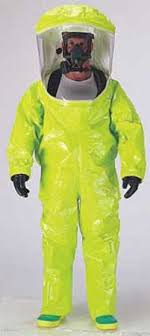
For those who are somewhat accident prone or afraid, you may want to invest in a HAZMAT suit to protect you from your raw chicken.

Once the chicken thermometer reads 71°C, you can get out of your HAZMAT suit and get ready to eat some delicious Canadian chicken, courtesy of the Chicken Mafia.

If you can consistently do all the above, then congratulations.  You are now fully qualified to handle contaminated Canadian chicken, and/or handle spent nuclear fuel rods at your friendly neighbourhood nuclear power plant.

Be sure to put that on your resume.