Google+
Showing posts with label eggs. Show all posts

Tuesday, September 15, 2015

Backyard Chickens for Canada's Municipalities

Connie Murray's 3 backyard chickens are threatened by the powerful Municipality of Minto (see Blog "Backyard Eggs for Minto").

This scene has repeated itself all across Canada.  Fortunately, some enlightened Municipalities have allowed backyard chickens to exist again, as they have for the last 350 years in Canada.

Gord Hume, former Mayor of London ON said in his book 10 Trends For Smarter Communities

"Municipalities have this tsunami of change coming at them, yet we have Councillors fretting about chickens in backyards."

Today, we present a draft Municipal By-law that Connie and all others can use to help their Municipality to also see the light.

SFPFC's Draft Municipal By-law for Backyard Chickens (MS Word Version)

SFPFC's Draft Municipal By-law for Backyard Chickens (Adobe Acrobat pdf Version)

I have also sent a link for this Blog posting to Municipal World, a magazine and reference source for all Canadian municipalities, including providing most municipalities with draft By-laws.

Hopefully Municipal World will help you and your Municipality to better understand the terrible squeeze that Canadians suffer for safe, nutritious, sustainable, self-enabling, & affordable food.

Sunday, August 23, 2015

Ag Fair Enlightenment

Yesterday, having my animals on display at the Providence Bay Fair and talking to the public lead me to another enlightenment.  Many people still have no clue about food, farm animals, and farming.  We can soon change that.

This year is the 132 nd. continuous year of expositions and celebrations at the  Providence Bay Agricultural Fair in Northern Ontario.

My goats, geese, ducks, and chickens were entered in 10 categories, winning 7 First, 1 Second, and 2 no-show.  The newly hatched drake duck and aged cock are receiving psychological counseling to help them through their loss at the fair.

While I can't speak for the animals whom I mandated to attend, the ribbons don’t motivate me to invest the 10 hours capturing & hauling animals, and attending the fair.

I do it for the opportunity to talk to the people attracted by up-close exposure to these farm animals destined for food production.  The people attending the Fair my come primarily for the cotton candy and midway rides, but they're also curious and draw near to the farm animals; drawn by some latent, deep, and ancient human drive that they likely don't fully understand.

Four years ago, before I started farming, I was one of them; totally ignorant about that side of life.

So that you fully understand what I experienced at my local Agricultural Fair, I'll share three stories.

Chicken Vs. Egg


Soon after placing the chicken and her rooster in the cage, she laid an egg.

When people walked by the cages peering in at the animals, it was easy to spot the egg sitting there.  Almost everybody remarked about the juxtaposition of the egg.  It was an unexpected occurrence.  Most would say, "There's an egg in there!, or "Look at that!"

One boy of 8 or 10 blurted out what many appeared to be thinking, but never said, "What's that egg doing in there?"  At least he recognized it as an egg.

I said, "The hen laid the egg shortly after I put her in the cage."

His eyebrows went to maximum height as he voiced his astonishment, "Eggs that we buy in the store, the one in the carton, that we eat, they come from chickens?"

"Yes", I said, "they pop out of the butt end of chickens."

"Gross!", he said.

And so we have it.  We may have lost another egg customer in the short term through the sudden, shocking truth of where eggs really come from.


Goat Vs. Lawnmower

People peered in at my Billy Goat and his three nanny goats on display (the rest of the herd were back at the pasture purposefully selecting the morsels of grass to be eaten next).  That's when I'd say, "You're looking at the latest and best available technology for lawn care."

Most would laugh, or at least smile, in recognition of what was about to bombard them.

Entry level gasoline powered lawnmower for $179.99 at your nearby
Canadian Tire store, assembly required, gasoline, oil changes,
and regular engine maintenance required to retain OEM warranty.
A brand new, entry level lawnmower at Canadian Tire is $179.99 plus 13% HST, is $203.39 plus the ongoing costs of periodic engine maintenance, gasoline, and oil changes; all of which add to the depletion of our non-renewable energy sources and Climate Change gas emissions.

Alternatively, you can buy a high quality goat for about $75.00 to $150.00

For natural lawn care, the goat has the following Features, Advantages, & Benefits:
  • Environmentally friendly
  • Self powered,
  • Self steering,
  • Automatically fertilizes and waters the lawn as it trims the grass
  • You can enjoy watching your favorite TV show from your favorite chair while the lawn is being expertly trimmed by your hard working goat.
  • No goat maintenance required
  • No fossil fuels required by goat
  • Goat automatically produces new baby lawnmowers each year which can be sold or kept for even faster lawn maintenance for you and your neighbours.
  • Your old goat lawnmower can be traded in at the end of the lawn care season for about 75 lbs of goat meat for your family freezer, to feed you through the winter.
 Which seems like the better deal to you:  Lawnmower or Goat?


Free Chickens for Belgiums

In Joel Salatin's book, "Folks This Ain't Normal" on pg. 78 of the paperback version of the Chapter "Lawn Farms and Kitchen Chickens", Joel describes how the Belgium government tried to help their citizens, and helped the environment too:
"In her great book City Chicks, Pat Foreman tells about a town in Belgium that offered three chickens to any household that wanted them.  Two thousand families signed up for the birds.  Those six thousand hens, in the first month of the program, dropped compostable biomass to the landfill by 100 tonnes.  This was the ultimate recycling program."

"If every kitchen in America had enough chickens attached to it to eat all of the scraps coming out of that kitchen, no egg industry or commerce would be necessary in the whole country.  Imagine shutting down the entire egg industry.  Greenies and animal welfarists decry battery cages and industrial chicken conditions, and I agree they are deplorable."
In a April 12, 2010 article in UK's The Independent newspaper:
"In the region of Limburg, near the Dutch border, more than 2,500 families adopted hens just last year, a 306 per cent rise on the previous year. There have been similar successes in other parts of the country."

Moral of the Story

We are headed into tough times, especially in Canada.  The current Federal government of Canada and all the wannabe opposition parties are "generously" bribing us selling themselves to Canadians with our own money earmarked for this special interest group, or our money promised for that project if only we should vote for their party.
"I just got adopted as one of 3 family chickens by a Canadian family.
I have a clear Mission and Purpose in my life!

As an alternative to this wanton excess of government bribery using other people's money (ie. our taxpayer money), consider that every Canadian has to eat three times per day (if they can still afford it).

I suggest that helping Canadians eat better helps all Canadians.

The only ones against this proposal will be those entrenched multi-millionaire SM farmers who depend on the continued chronic dependency of all Canadians to their SM monopoly.  That negativity is less than 8% of all Canadian farmers, and less than 0.048% of all Canadians; therefore this proposal will be welcome help for 99.952% of all Canadians.  That seems to be as close to “everybody” as we can possibly get.

Isn't government supposed to be all about helping Canadians by working for the greater good of all Canadians?

What tax money bribery pronouncement made so far in this 2015 Federal election will have a greater impact on more Canadians?

Why can't Canada's Federal government grant 3 free chickens to every family that is willing to keep them and properly care for them as a family egg production source for at least 2 years?  What kind of mini-building boom will that create as 8.5 million backyard or roof top chicken coops get quickly constructed?

Prerequisite training courses, whether delivered by Internet or local Community Centre, will describe the program, train the willing, and help ensure the success of the program.  The program will not be available anywhere local zoning does not allow urban chickens; a simple method to encourage local government to reconsider their dogmatic and misguided attempt to save us all.

Of course, we'd welcome all of these newly egg self-sufficient families as members to Small Flock Poultry Farmers of Canada as $1.00 per year new members of SFPFC.

Monday, July 13, 2015

Backyard Eggs for Minto

The Municipality of Minto, 80 km North of Kitchener, is considering allowing backyard chickens for eggs.

We support this proposed Minto By-law change so that people can have affordable, high quality eggs.  But what about meat birds?  Why are meat birds set aside as a forgotten option?

Do the bureaucrats think that nobody is interested in meat?  Are meat birds considered to be a greater nuisance (eg. noise, disease, smell, or something else)?  DO the Councillors worry about the thin wedge of allowing meat birds will improperly encourage people to be doing backyard slaughtering?

I would also like to know why meat birds, especially pastured poultry, are not being considered?  Small flock, pasture raised meat birds are significantly better than those provided by the commercial chicken system.  I know of no reason to exclude meat birds from consideration.  If you have data to the contrary, I'd appreciate receiving a copy of these data.

If anybody has answers to why this proposal for backyard eggs but no chicken meat, we'd love to hear the answers.

Eggs are "Nature's Little Vitamin Pill", but man does not live by eggs alone.  Eggs are good to eat, but so are small flock pastured meat birds.

In 2013, Canadians ate 21.35 dozen eggs per person (see Ag Canada's website  ).

The average household is around 4 persons (typically 2 parents and 2 children), so a household would consume a total of 85.4 dozens (ie. 1025 eggs per year, or 2.8 eggs per day).  Most layers produce at 28 hrs per egg (ie. 80% daily yield), so this would require at least 3.5 chicken.  Five chickens would allow for cracked eggs not suitable for human consumption, cold weather yield losses, and similar problems.

This proposed 5 bird limit allows for the "typical" family.  What about "non-typical" families?  I therefore suggest that residents be allowed to approach Council for special permission to exceed the 5 bird limit under sufficient circumstances.

Meat Birds

The average small flock in Ontario is 57 meat birds per year.

Canadian average chicken meat consumption is 30.7 kg of chicken per year per person.  Assuming a family of 4 people, they would need 122.8 kg/yr.  Assuming the kg. eviscerated meat to live weight ratio of 0.6863 kg/kg, this family would need 122.8/0.6863= 178.93 kg/yr of live chickens.  Assuming 2 kg/live bird at slaughter, this is 89.5 birds.  The typical mortality rate from day-old chicks to full grown 2 kg birds may be 5%, so they would have to buy 94 chicks.

I would recommend that the Minto By-law permit each family to raise 100 meat birds per year.  Pastured poultry can and should be grown at a slower rate than the breakneck speed of chicken factory farms, so this may require 8 weeks per growout.  They can be raised in the coop &/or outdoors in pastures from May to October, a 6 month window (24 weeks), allowing 3 growout periods per year.  It would be far less work to raise all the chickens in one big flock, but it could be done in 3 flocks of 33 birds per flock.

Please Tell Minto

I have sent this info to Mr. Bill White, CAO at Minto, and he has graciously responded that he will forward the info to Council.

We encourage all our readers to reach out in support for the planned consideration of backyard, small flock eggs for Minto.

Minto Municipal Services
CAO/Clerk Bill White
5941 Highway 89
Harriston, ON N0G 1Z0

bwhite@town.minto.on.ca 
Phone: 519-338-2511
Fax: 519-338-2005
Minto Website: town.minto.on.ca

Monday - Friday 8:30am - 5:00pm


Tuesday, March 17, 2015

FSRN: Gone but not Forgotten

The Food Security Research Network ("FSRN"), part of Lakehead University in Thunder Bay, was formed in 2006, funded for 6 years, ending in 2012.

One of the projects that FSRN worked on was the high quality chicken eggs and meat for Northern Ontario.

They produced an informative table showing the quota and non-quota systems for chickens and eggs in Ontario.

I remember it as a resource I had found 3 years ago.  It was a helpful primer to introduce me to the complex regulations and systems.  Unfortunately, I never blogged about it before.

Today, I remembered it fondly, and decided FSRN's moment in the sun for this Blog has arrived.

My thanks to FSRN and Dr. Connie Nelson who shepherded FSRN to do many important projects.

Wednesday, March 12, 2014

Supply Management Addiction

Have SM Farmers been inadvertently or purposefully addicted to Supply Management?

The American Society for Addiction Medicine has quite a long definition, associated factors, indicators, and other comments on the definition of addiction.  The short definition is:
"Addiction is characterized by inability to consistently abstain, impairment in behavioral control, craving, diminished recognition of significant problems with one’s behaviors and interpersonal relationships, and a dysfunctional emotional response."
What this means for SM farmers is that the benefits derived from SM are addictive, you can never get enough, because you are being somewhat passified by the significant benefits received, while what you truly need and want is not available.  The SM benefits are an attempt to fill a bottomless pit in their SM lives.  There is a spiritual vacuum in the lives of SM farmers.  Money is a poor substitute for what they really want and need.

For example, you cannot live on just rabbit meat.  Rabbit starvation is a known disease that causes people to eat more and more rabbit, gorging themselves as they seek to fill the missing nutrient.  No matter how much you eat, it's never enough.

Similarly, it is postulated that SM Farming leads to spiritual starvation for some or most people, but narcissists and psychopaths are probably immune.

Perhaps the SM farmer hates what they have become.  Deep down inside they would like to leave, to escape from their velvet prison; but how?  The family depends upon them.  Everybody in the family as well as many friends and neighbours depend on them for jobs or spin-off business.  Even if it's your plug, and only you are authorized to pull the plug, how do you get the nerve to pull that plug?

Others are envious of the SM farmer, and their facade of benefits, advantages, and lifestyle.  They don't really know what goes on under cover; the limited choices, the never ending expectations, the compromises,  that they are forced to make so as to keep up appearances.

How do you just walk away?

Is there some individual or group out there that is causing or encouraging farmers to become addicted to SM?  Who has the most to gain when another farmer becomes addicted to SM, or the addictions of all SM farmers is continued and strengthened?

SM Farmers must hide and protect their fear of others discovering their true deep feelings.  The SM farmer never misses an opportunity to smile, and tell everyone what a great life they live, got the world by the tail, we're expanding this, and taking advantage of that.  But deep down inside, late at night when everybody else is deep asleep, there are SM farmers laying in bed with their eyes open, staring into their dark bedroom, trying not to think.  Joy is fleeting.  Joy, when it does occur, soon gets swallowed up by the empty nothingness of daily routines. The more they try not to think about it, the more it wells up, just under the surface.  It never comes into the light.  It never surfaces so it can be plainly seen.  However much it hides, its presence can be felt at still times like this, late at night, or during the day for fleeting moments in the barns when careless pauses allows it to flash into consciousness for brief seconds.

These difficult feelings of SM farmers aren't easily, nor morally dismissed as simple greed.  It's more than that.  It's the focus on the current grow cycle and getting through this one day, putting one foot in front of the other.  Secret promises to self are made that tomorrow or next grow cycle will be different.  These promises are quickly made to provide momentary relief, but are just as easily broken, again and again. In reality, there is no relief in sight.  The cavalry isn't coming.  The SM farmer has hidden their grief so well, from themselves and all others, that nobody knows they need to be rescued.  Sometimes, even the SM farmers forgets, but is soon reminded again of the need to escape by some innocent occurrence; each day, and each hour of the day.

To do what you must do to be an SM farmer, you have to focus on yourself.  Sometimes you can try to expand your thoughts and weak justification for what must be done, by projecting the excuse that you're doing it for the sake of your immediate family.  It is too difficult and deadly to concern yourself about the big picture:  the animals, the neighbours, the environment, the downstream supply chain, or the end consumer.  If you think too much, it becomes an unbearable burden that hinders the SM farmer from doing what he must.  Thinking can drive you crazy.

There are 35 different self-help groups, 12-Steps; from alcohol addiction, to chocolate, or whatever.  Unfortunately, there isn't a solution yet for SM farmers.  Maybe soon, someone will discover one, or make one.  Maybe soon.  Maybe, the SM farmer thinks, maybe they can hold on until it's OK to admit, OK to get help, OK to stop pretending.

Breaking an addiction isn't easy.  In spite of the difficulty, addictions are being left behind every day.  Like Jordan Belfort in his autobiography book and now movie Wolf of Wallstreet, Sam Polk was addicted to money.  Sam learned to kick his deadly habit, and is now leading a nutritious food charity, GroceryShips.org

Listen to Sam Polk's story as he is interviewed on CBC Radio's The Current:


If SM farmers are going to break their addiction, it is suggested that a 7-step process will be necessary.

Seven Steps to Change

  1. I Need   You need to understand that your world has significantly changed.  You can continue to ignore this change, but you cannot ignore the resulting consequences for continuing to ignore this change.

  2. I Want   What's in it for you to admit and embrace the change that has occurred?  What do you really want or need?  There is a cost for every decision, procrastination, action, and inaction you take.  Which consequence and cost are you willing to pay?

  3. I Can   Is it physically possible to do something different?  Has anybody else done it?  Is there a known technique?  Can you borrow an approach that worked in different or similar types of circumstances?  Do you have the necessary resources, or can you get the necessary resources?  This is when you develop a concrete, step-by step plan on how you will escape from your SM farming prison.

  4. I Will   You need to decide to do it, in theory or principle first.  Nobody is forcing you to implement that decision immediately.  You can decide now and delay implementation almost forever.

  5. My Head   Your decision to change is very logical.  Everybody can well understand why you have

  6. My Heart    You get emotional about your previous mis-directed actions and philosophies under SM farming.  You regret your lost time and efforts, and the delay in reaching your new found future vision.  You get very frustrated and emotional as you revisit this time and again.

  7. My Hand   You're finally ready to take specific action to break away from your SM Farming past and embrace your new future with great anticipation.
If any SM Farmer or family members have any questions or clarifications on any of the above, feel free to leave your comments below, or contact us by private and confidential email, phone, letter, or in person visit.


Friday, January 10, 2014

Aaron's Eggs Day in Court

I previously Blogged about a rebellious, but soft spoken small flock egg farmer in Nova Scotia who is in the gun sight cross hairs of the #ChickenMafia and their henchmen, the notorious #ChickenPolice (see Aaron's Eggs.

I subsequently wrote how SFPFC and thousands of NS citizens intervened on Aaron's behalf, so the Nova Scotia government decided to intervene, and finally the NS Egg Board relented by doubling the small flock exemption (100 birds to 200), and proposed an auction of 2,000 bird quota for small flockers, to be divided in 4 lots of 500 birds each.  If Aaron applied and was lucky enough to win, we would have an exemption for 700 birds, so he could keep his present flock of 700 (see Give Credit where Credit Due.

I received a call from Aaron today, saying the #ChickenPolice continued with their charges against Aaron, and he recently spent his first day in arraignment court pleading Not Guilty to all charges.  Aaron said he considered the ease and speed of pleading guilty, but he just couldn't do it.

I had previously offered all of SFPFC's legal research to Aaron in preparation for our Ontario rebellion against the #ChickenMafia.  WIthin a few minutes, I had an email off to Aaron, but the email server choked on the 38 MB of file attachment. Doing a compressed zip file wasn't much better.  I'm going to have to upload all these precious files to a Internet Cloud File Server, so Aaron can download everything.  I hope Aaron's Pro Bono lawyer finds it useful.

While I had Aaron on the phone, we quickly discussed strategy.  His parting remarks were that he obviously needed to learn a lot more, really quicky.

Indeed he does.  Just like Wiley E. Coyote, those #ChickenPolice are a nefarious bunch.  The advantage for the #ChickenPolice, they have the government to do their dirty work for them

Once the offense notice has been issued by the #ChickenPolice so as to protect their monopoly, the government steps in and takes over.  The power of the state and their bottomless pockets are now against Aaron, while the #ChickenPolice can sit back, relaxing in their front row seats while the brash Crown Attorney attempts to sink Aaron and his young small family on their family farm.

There ought'a be a law.


Friday, November 29, 2013

Aaron's Eggs

I previously Blogged about Aaron Hiltz's dilemma.  More and more customers want to buy eggs produced by his green grass patured chickens.  However, the Nova Scotia Egg Producers ("NSEP") have laws that limit Aaron to just 100 chickens unless he buys expensive (Aaron say unaffordable) egg quota.

Aaron currently has 700 chickens on his farm, 100 who are legal, and 600 who are illegal immigrant chickens without papers.  So far, drone airplanes owned by CIA, NSA, or RCMP have not yet been spotted  circling Aaron's farm.  However, NSEP has charged Aaron with harboring illegal chickens, which could result in a fine of up to $6,000

Aaron seems to have done a pretty good job of lobbying for himself and other small flockers.  In his latest CBC Radio interview, Aaron outlined another proposal for compromise between NSEP and small flockers.  Aaron's latest plan is modeled on the pastured chicken settlement in Nova Scotia about 20 years ago.  Then, small flockers wanted to go after the specialty market, but couldn't without quota.  Quota-bearing chicken farmers weren't interested as they were already fully invested in their chicken factories, and weren't interested in cannibalizing and competing against themselves so as to respond to consumer demand; they considered pastured chicken a ridiculous fad.  The #ChickenMafia knew better than all others.

A fight broke out twenty years ago, and it was eventually settled by small flockers becoming licensed to supply this niche market for pastured chicken.  Now, Aaron quotes a few interesting statistics about Nova Scotia's chicken factories vs. pastured poultry:
  • There are 84 quota-bearing farmers who run NS's chicken factories under NSEP rules.
  • NS chicken factories typically have 10,000 to 20,000 hens.
  • Some chicken factories in Canada have as many as 400,000 hens on a single chicken factory farm
  • Pastured chicken in NS has 0.5% market share, produced by 35 small flock farmers.
  • If the chicken factory model is used for all chicken production in NS, the farmer count would go from the current 84 farmers to a grand total of 85 (1 extra farmer)
  • If the small flock model was used to produce all of NS chicken, the number of farmers would go from 119 (84+35= 119) to about 7,000 farmers.
  • Aaron asks which model makes more sense when we need more jobs, and need to strengthen our rural economy?
It may be that we can't find 7,000 farmers to fill all the theoretically available slots in NS.  Some consumers may decide that they don't want pastured poultry, so not all of the chicken factories will ever go totally away.  But, why oh why can't small flockers be allowed to slowly grow and prosper, and achieve their full destiny?

The same questions apply equally well to Ontario, and every other Province.

The #ChickenMafia may argue that they produce a far better quality and cheaper meat in their chicken factories.  I suggest that the customers of the pastured poultry farmers think otherwise.  Unfortunately the  customers of pastured poultry are not consulted.  The #ChickenMafia isn't interested in the customer's silly notions about chickens living in grassy pastures.  The #ChickenMafia knows what's good for all customers, as well as themselves.  Their arrogance is self-preserving for their government induced monopoly.

Aaron suggests that the #EggMafia could start to evolve in the same direction as what the #ChickenMafia did 20 years ago.

Two days ago, it was announced by NSEP that they were rolling out a new program for small flock farms.  The quota exempt limit would be raised from 100 hens to 200, and a total of 2,000 free hen quota would be leased amongst 4 new farmers through a lottery system (500 hens per farmer).  If aaron enters the lottery and wins, he'd be allowed 700 hens maximum; exactly the same number of hens he currently has.  Isn't it interesting how these numbers magically work out!

Of course, if Aaron loses the draw, he will have to reduce his flock to just 200 birds; a 71.4% drop.  Ouch!

SFPFC received a nice email yesterday from Honorable Leo  Glavine, Nova Scotia's Minister of Health and Wellness:
Good Day Glenn,

I want to thank you for your very informative email on why the farming commitment of Arron for a healthier product should be given support and therefore a change in the regulations. I have been involved in this case for some months and I am pleased that our Minister of Ag has moved quickly and I think Arron will be pleased with the 500 level quota. This is a positive step and hopefully entry to the program will be smooth and beneficial to Arron and others.

Thank you for your advocacy....

Leo Glavine Minister of Health and Wellness..
 I know there were a lot of people pulling for a reasonable solution to this issue, Minister Glavine included.  I'm glad that SFPFC could play a tiny role in helping a positive outcome to appear.

SFPFC has sent an email to Minister Glavine, as well as Honorable Minister Keith Colwell, Minister of Agriculture for Nova Scotia, thanking him for his assistance, support, and/or urgency that he gave to this situation for all small flockers, the people of Nova Scotia, and Aaron.

It is no doubt that this move by NSEP is significant, appreciated, but microscopic when compared to the magnitude of all the necessary changes that are required.

A small movement could be a strategic retreat by the #EggMafia.  It helps shows they are "reasonable", willing to listen, and reduces the driving force for total overthrow of their monopolistic system.

I'd suggest that 7 similar movements (ie. 6 more) would be needed to say confidently that they're evolving.

Most likely, the #EggMafia's strategy is to make a small movement to placate their critics, yet only slightly more than a token concession, so as to not upset their allies.  Next, they quickly reinforce that new position by underground foundations down to the local bedrock; foundations so massive that no power on earth could force a second movement; in other words, a Maginot Line.

So what does an opponent do when they are facing a Maginot Line?

At the start of World War II, the invading Germans did the same to France's Maginot Line as what the Allies also subsequently did for mountainous fortresses held by the Germans/Italians in Italy, as did the US Marines in the Pacific for the hundreds of island on which the Japanese soldiers were well prepared to defend with their lives; all of them left the enemy alone, left them exactly where they were dug in, kept sufficiently distant so the enemy's weapons were useless, and went around, rendering the enemy and their unbeatable position obsolete.

Question is, if this turns out to be an accurate assessment of the #EggMafia and #ChickenMafia's strategy, how do Small Flocker's best bypass their Maginot Line?

Sunday, November 3, 2013

Organic Eggs, or Not!


Organic Egg Scorecard Criteria

There is a huge fight going on in organics.

As of 2012, Organic Trade Association reports that Canada's organic products market is worth $3.7 Billion, of which $2.98 Billion is for organic food and beverage (excluding alcoholic beverages).

Like a ripe cow pattie attracting flies, $3.7 Billion attracts a multitude of flies too.  For example, in the USA over 80% of "organic" eggs are sold by Big Food and the #EggMafia.

In 2012, organic food had only 1.7% market share, but it's growing each year (20%/yr growth on average for the last 6 years, for a total of 300% increase since 2006).  Canadians buy 45% of these organics from mainstream retail stores (eg. grocery stores, malls, big box, etc.).  For all Canadians, 58% of these families buy organic products every week.  In some segments, it's as high as 67% non-Caucasians, 66% BC residents, 63% of residents in major cities, and 62% of families with children under 2 yrs. old, 62% of 35-44 yrs olds, and 61% of university graduates.

For the average Canadian organic shopper, they spend 39% of their weekly grocery shopping budget ($51.75/wk.) on organics, which ended up costing them an extra $17.50 per week vs. those who don't buy organics.  At 35 Million Canadians, an average family size of 3, that organic market is worth $10.6 Billion sales premium for Big Food.

Anybody who stand in Big Food's way at getting this extra $10.6 Billion will be run over with vengeance by the Big Food steamroller.

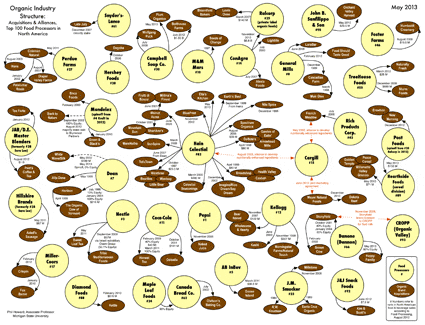
Who owns "Organic"?
Organic Industry Structure, Acquisitions & Alliances,
Top 100 Food Processors in North America
Full size version of chart
All of these boring stats quoted above should convince you that "organic" is the best thing since sliced bread for producing higher profits for Big Food.

The chart at the right shows the scramble of Big Food to buy up everything that gives them an entry into the organic market.  Big Food has invaded and captured the organic market.

Organic eggs has grown from $15.8 Million sales in 2008 to $21.6 Million in 2012 for an average growth rate of 6.83%/yr.

Of the 3,000 organic products sold in Canada, 43% of those products originate from within Canada, 30% come from USA, and 19% come from parts unknown.

For all these organic products, are they really organic, or do they just say that, and hope you won't really notice the difference, or care to check.

In the US, the package has to say "Organic USDA" or it is a fake.  Many products have added "Natural" to their label, which means nothing whatsoever; just marketing hype.  Unfortunately, most consumers mistakenly assume that "natural" is the same as "organic"; but that couldn't be further from the truth.

Even those packages that say they are 100% organic may not be truly organic.  For example, hexane is usually used to extract the oil out of soybeans to create soybean meal, one of the main constituents of animal feeds.

I used to work in a petrochemical factory that used hexane as a solvent in huge reactors to make polyethylene plastics.  Hexane is one of the major ingredients in gasoline.  Our chemical plant workers had to be careful with getting too much hexane on themselves, especially their hands, as it would cause permanent nerve damage.  I'm sure when they do the soybean extraction they try to get most of the hexane out before they package it as human or animal feed.  Don't you think?  We'll never know for sure until it's too late.

In the video above, you can see some of the tricks that Big Food and the Egg Mafia use to try and skirt around the organic certification regulations.  Is it any different in Canada?  I don't know, but I'm sure some of you out there do, so the comments section below this posting are open, by name or anonymous, as you prefer.

If someone cheats, it hurts the brand "organic", and financially weakens those who truly follow the organic certification rules.  You get what you pay for.  Buyer beware.

Know where your food comes from, organic or not.

Thursday, October 24, 2013

Throwing Eggs + Pointing Fingers

The media campaigns and Spin Doctors are busy, trying to make the #EggMafia 's chicken abuse issue go away.

I have collected together a few links on the evolving saga of chicken abuse at two #EggMafia farms in Alberta Canada on which I previously Blogged.

Since  the video was first released, almost everyone is running away and distancing itself from this disaster, with the exception of the media, and a few brave (or dumb) individuals.  To save themselves, Burnbrae Farms, the buyer/contractor for the two accused #EggMafia farms, has thrown them under the bus, and stopped buying eggs from them.  McDonald's Restaurants, who has Burnbrae as their sole egg supplier, claims no connection with the accused farms.  Egg Farmers of Alberta went into high alert, sending an emergency email/fax to all its #EggMafia members alerting them to refuse all farm visitors, and not to answer any inquiries from anybody, then refused to acknowledge or discuss the video themselves.

Since then, the #EggMafia have retained the services of 1 or more media gurus and Spin Doctors to try and put out the flames they ignited on themselves.  Ontario Farmer Magazine calls it #EggMafia "damage control".

Better Farming has added that the Egg Farmers of Canada, the Canada-wide Don of the #EggMafia, have hired the USA-based Center for Food Integrity to analyze the video showing the alleged abuse of chickens to get an opinion from them as to whether abuse occurred or not.

I'm not sure why the #EggMafia needed to distance itself from deciding whether the shocking video depicts standard farm practices, or abuse of chickens.  To me, the video clearly depicted abuse and unacceptable practices.  I guess it's easier and less messy when you use a hired gun, rather than do the dirty work yourself.    The only questions were whether the video was staged, and when/where the actions depicted occurred.  That required expertise in forensic science and video taping, not egg farming expertise.

MikeTheChickenVet couldn't resist, and had many interesting points.  MikeTheChickenVet tries to dismiss the video by suggesting what would a video of any of us look like if somebody snooped on us with secret surveillance for 5 weeks, then created a "5 Minutes of Horrors" from those 5 weeks of video.  As a practicing vet in Ontario who earns his living working for the #EggMafia, his point of view is quite understandable.  After I found his viewpoint, I sent him a link to my Blog posting and asked for his comments.  All of a sudden, he doesn't have much to say about the 9 questions I posed for the #EggMafia, to answer except:
chickenvet
Glen, I have no answer to any of your questions. I’m not directly involved with the farm, and you seem to have your mind made up already, in any case.

I find it ironic how every one of the websites for the #EggMafia focus primarily on rainbows, unicorns, and sunshine, and how their eggs are produced by their family of families, so that consumer's families can have eggs.  Trust us, they whisper, again and again.

I'm not buying it.

There has been a serious breach of trust.  The #EggMafia needs to make significant, across the board change.  Neither media spin, nor unicorns and rainbows, will cover it up and make it all go away.

I hope all Small Flockers can, and do learn, some significant lessons from the crumbling empire of the #EggMafia.

Friday, October 4, 2013

Small Flockers are Exempt ? ! ?

On behalf of farm gate egg sellers all across Canada, I questioned and complained to Health Canada about their upcoming Guidelines which are poised to strike Canadians in Dec. 2013. See our prior Blog posting:   Help, we're under attack!

Health Canada quickly responded.  I was shocked by HC's response.  Their initial response is that small flockers and farm gate egg sales are exempt from the new Guideline.

What ??

Yes, that's what Health Canada said.  Small flockers are exempt.  Small flockers can continue selling their eggs at the farm gate.

You may not be, but I'm totally confused.  Here is what Health Canada said on this alleged exemption:

"Section 2.11 of the guidance document defines table eggs as follows:

    A shell egg offered for sale to consumers (including retail environments, restaurants, bakeries, and other foodservice and institutional settings) for the purposes of consumption.

Eggs that are offered for sale at farm gates are excluded from the scope of the document. Please be advised that the guidance document does not recommend a ban on farm gate egg sales.  Therefore, the issues that you raised related to farm gate sales of eggs are not expected to occur."
Later on in their email, HC also states:

"The guidance document [focusses sic.] the recommendations on table eggs originating from regulated flocks, since these eggs represent the majority of eggs offered for sale on the table market." 
That makes sense to me, because this table egg source is more than 90% of the total eggs consumed.  Since I doubt there is a 100 fold higher probability of contaminated eggs with small flocker farm gateeggs, HC seems to be focusing their action on the overall risk to consumers.

Health Canada continues in the same paragraph:

However, there are numerous practices in place in the regulated sector that reduce the risk of S. Enteritidis in grade A table eggs, which do not necessarily extend to eggs originating from sources outside of the regulated sector. For this reason, sources of table eggs outside of the regulated sector may represent an increased risk to consumers.
Note that HC says "may represent an increased risk".  Is there proof, or is it enough to convict small flockers with just mere suspicions?

HC continues:

After the consultation, Health Canada sought additional evidence to support the increased risk of S. Enteritidis associated with eggs originating from sources other than the regulated flocks and has presented this information in section 8.3 of the revised guidance document. Two SE outbreak investigations in Canada, in 2010 and 2012, provide evidence supporting the hypothesis that table eggs originating from sources outside the regulated sector may represent an increased public health risk. The weight of scientific evidence supports that any laying flock, regardless of size, may put consumers at risk by supplying eggs for the table market from a flock infected with S. Enteritidis, and that eggs that are not stored or handled in a way that minimizes the S. Enteritidis hazard, may put consumers at risk.
The consultation referenced above seems to be the one held from Nov. 9 through Dec. 21, 2011.  This was before SFPFC (Small Flock Poultry Farmers of Canada) existed, so it seems somebody else was helping defend our interests back then.  Whomever it was, thank-you for caring and taking the effort.

CFIA now has evidence that the regulated egg producers are confirmed at having up to 11% defects (ie. dirty, cracked, expired, under sized, etc.) in their egg cartons delivered to retail stores.  The defects were alleged by other egg producers to have been purposefully done so as to punish competitive egg producers, or to obtain extra profits.  I wonder if HC included this risk in their calculations?  Can they still say that small flockers are more risky?

Even then, I'm not sure HC is talking about small flockers in the above paragraph.  Who else could they be speaking about, these "sources outside the regulated sector".  If that isn't small flockers that HC is speaking about, then exactly who do they refer to indirectly?

In Section 8.3 HC's draft Guideline refers to the use of ungraded eggs in food service establishments in British Columbia that may have caused illnesses in 2007 - 2010.  They also refer to an non-regulated egg producer who sold dirty eggs to a food service establishment.  That food service establishment had poor food handling techniques, and didn't refrigerate the dirty eggs between when they were delivered, and when they were prepared and served; resulting in 91 illnesses.

It would seem that both regulated and non-regulated egg producers could supply Salmonella contaminated eggs.  This risk can be compounded by dirty, cracked, and unrefrigerated eggs.  Either way, it puts consumers at risk. Then why does HC say small flockers and farm gate eggs are exempt from the new Guidelines? I believe it is a matter of degree of risk from these two different egg sources.  I also believe there are different expectations by consumers for these two different sources. 
 
My email response to Health Canada's current position on the alleged small flock table egg exemption was as follows:

"Thanks for the detailed response.

 I understand that HC excludes the sale and consumption of ungraded farm gate egg sales from your "table egg" definition.  That is hard to understand, as I see no justification for that, neither in the definition nor the report.  Please explain this exemption in the greatest detail possible.

For example, how does HC compare and contrast the sale of ungraded eggs at the farm gate to consumers ( eg. non-resident family members, neighbours, community members, etc.), or sale at Farmers Markets, or the sale to local convenience store who sells them to the public, or a roadside stand on the highway near but not on the farmer's farm?

Am I and other small flockers able to sufficiently rely upon the statements you make on behalf of HC, sufficient to avoid subsequent regulatory action for following your advice and statements?  In other words, what is your authority and expertise on these issues?

The other issues and comments may be moot based on the final definitive answer to the above statement."
I wouldn't rush out to make a major investment in small flock egg sales at the farm gate based on this preliminary and non-verified response.  Perhaps it was a typo by HC.  Perhaps it's a cruel joke to jerk our chain.

Hopefully Health Canada will soon clarify and justify this secret or mysterious position of exempting small flock egg sales at the farm gate.