Google+
Showing posts with label organic. Show all posts

Monday, April 27, 2015

Scams on Free Range & Organic Chicken

The Chicken Mafia are co-opting the terms "free range" and "organic" as a method of cheating and mis-leading the public, and gouging higher profits for themselves.

An anonymous poster on Better Farming was questioning the use of the term "free range", and how it is misused by some.

Free Range Chicken

My definition of free range is that the poultry has free and direct access to the great out of doors; can see the sun; can decompress and get away from their sisters; can walk through the pasture or woods at their leisure; can flap their wings & feel the wind on their feathers; eat any grub, grass, seed, or insect they happen to find; and do dust baths in the dirt of the forest floor to their heart's content. The 18" x 18" door on my coop is opened in the morning, and closed after everybody is back in the coop by dusk.

On my Small Flock poultry farm, we have LGD's (Livestock Guardian Dogs) who protect our birds, and keep them isolated.  If a crow, hawk, fox, coyote, or other wild animal is thinking about coming in to fraternize with our poultry, or steal an egg or chicken, the wildlife quickly reconsiders their plan due to our LGDs.

There are other Small Flockers who do pastured poultry on grass pastures using electric poultry netting, possibly supplemented by LGDs.

Pastured Poultry

On my Small Flocker farm, we are gearing up to do pastured broiler poultry this Spring.  Inside each 10 ft x 12 ft open air cage on a grassy pasture are 75 broiler chickens.  Each cage is moved forward every day to fresh grass for the birds to eat and scratch.  The birds receive a fresh patch of pasture during each day for their entire grow cycle.  Each patch of pasture is only re-used again after 6 weeks of rest and recovery.  Any bugs that enter through the chicken wire, seeds found, grubs in the dirt, or grass under the bottomless cage is welcome food for the birds, who then eat 40% less of the commercially manufactured feed which supplements the pasture.

Is "Organic Chicken" Better. or a Scam?

Beside free range, "Organic Chicken" is another weird definition that is used to confuse and mislead consumers.  The greedy SM cheats salivate over the 30% or higher premium prices available for "organic chicken".  The CFIA organic regulation says,

" 6.8.1 The operator of an organic livestock operation shall establish and maintain animal living-conditions that accommodate the health and natural behaviour of all animals, including:   a) access to the outdoors, shade, shelter, rotational pasture, exercise areas, fresh air and natural daylight suitable to the species, its stage of production, the climate and the environment;"

Unfortunately, the CAFO's (Concentrated Animal Feeding Operations) and "Big Food" have lobbied, done regulatory capture, redefined, twisted, and misinterpreted the organic standard to suit their profit seeking goals.

If the CAFO cheaters open a 8" x 8" door at one obscure corner of a chicken factory barn holding 200,000 birds, and that door leads to a tiny screened-in porch, then the unholy alliance of CAFO cheats and Big Food often label their chicken "free range", and qualify for "organically raised" under the regulations.

Of course, the porch will hold only a tiny fraction (maybe a hundred birds or so) of the 200,000 birds, and even fewer birds ever discover the well hidden door.  Chickens are forced to live in the cesspool of CAFO chicken factories, the method used by most or all of Canada's Supply Management chicken growers.  CAFO birds are crammed in, cheek to jowl, as many as 196,000 birds on one farm.  The birds are forced to live in their own manure for their entire life, forced to breath the toxic dust cloud that never goes away.  They are force fed antibiotics, other drugs, and weird chemical brews so as to keep them alive in spite of the poor living conditions. 

Hopefully it will become clear to all consumers that CAFO chicken factories have found a convenient loophole in the regulations to subvert and mislead consumers, as usual.

Sooner or later, consumers will realize the fraud.  Eventually, the mounting breach of trust by SM's foul chicken factories will be exposed on these issues.  One day soon, all of those lies or half truths will totally rupture the trust between CAFO cheats and society, and the public will totally abandon this terribly flawed system.

Small Flocker Chicken Alternative


As an alternative to all of the crap, cheating, and misleading described above, small flock poultry farmers have an alternative we'd like to offer to Ontario and its citizens.

There are more than 15,000 Small Flock chicken farmers in Ontario.  If the government regulations were made more favorable to small flockers (as opposed to the monopoly of cheating and misleading Chicken Mafia henchmen), then some or most of Small Flockers would be ready, willing, and capable of growing safe, affordable, nutritious, locally grown chicken for their family, friends, and local communities.

The choice is clear.  We just need help getting the word out.  Once the public has all the necessary facts, then the public can make an informed decision.  Choice and freedom.  That's what a democracy is supposed to be all about.

That's exactly what the Chicken Mafia are fearful of, and are desperately fighting against.

Soon, you will need to stand up and make a choice as to which side you are on.

Monday, June 2, 2014

Biohazardous Ground Zero: Factory Chicken Farms

Scientists have discovered that crops of spinach growing in fields within 10 miles of a factory chicken growing operation are 172 times more likely to be contaminated with deadly E. coli bacteria.  This contamination likely comes from the chicken factory exhaust air that is spewed into the atmosphere on a near-constant basis.

The study was done by Texas A&M University, published in July 2013 in the peer-reviewed journal Applied and Environmental Microbiology., and was summarized in Science Daily in June 2013.

As we should know, correlation doesn't prove causation.  There is a slim chance that this 720 times higher risk is a spurious correlation that means nothing.  However, that is highly unlikely, especially with such a huge risk ratio of 720 times.

As an example, the odds ratio for cigarette smoking and lung cancer vary between 7 (1 cigarette per day) to as high as 16.3 (25+ cigarettes per day).  See the 1947 epidemiological study of Doll, and 1951 study by Hill and here.

Compare the odds ratio of 720 for E.coli/chicken factory to 16.3 for cigarette-lung cancer. If you believe cigarette smoking increases the risk of lung cancer, should you believe that mega chicken factories cause or contribute to significantly higher risk of E.coli induced food contamination leading to food poisoning?
Wrinkles and crevices in baby spinach
hold tight any any contamination, defying
most attempts to remove

In 2006, baby spinach grown by Natural Selection Foods LLC in Salinas Valley, California USA was contaminated with E. coli, killing 1 person and making over 193 other people in 21 States seriously ill.  They packaged the same spinach under 34 different brand names, then distributed it to every major city and 74 percent of America's supermarkets in the US.

In Sept. 2013, four brands of contaminated spinach packaged and distributed by a Burlington ON company were suspected of having Salmonella.  It is unknown

Spinach is especially dangerous, as the wrinkly leaves defy the effective removal of the contamination through any feasible methods of washing, whether at the farm, packaging, or the home.  If the baby spinach is used raw in a salad, likely somebody will get sick or die from eating contaminated spinach.

Will mega chicken factories, whether in US or Canada, share this news with their neighbouring farmers, warning them about the airborne contamination spewed into the atmosphere by their bad acting chicken farm neighbours?

In Ontario, the Occupational Health and Safety Act, 1980, is supposed to control worker exposure to biological and chemical agents. At the present time, the OHSA does not apply to farming operations (per OMAF website). Consequently, farming operations are exempted from the general industrial establishment standards which cover ventilation requirements, and the regulations regarding air contaminants and dust.

OMAF also says,
 "In animal housing, 70 to 90% of the dust is organic. This means that it is biologically active and will react with the defense system of the respiratory system. Included in the organic barn dust are feed components, dried faecal material, hair and skin cells, feather particles, pollen, insect parts, molds, fungi, viruses and bacteria. Endotoxins are produced by bacteria. These endotoxins are generally strong allergens causing immediate or delayed reactions in the respiratory system."
and
"The main health problems with poultry workers occurred while moving or handling older birds; these symptoms could be attributed to exposure to the combined effects of dust, ammonia and endotoxins."
Since it is standard practice to put antibiotics in chicken feed so as to maximize the mega chicken factory's profits, those antibiotics also enter the air as dust, Carol Morison was allergic to the dust and many antibiotics used for humans from her occupational exposure (see our 2013-10-27 Blog posting:  Chicken Factory ).  Shortly after appearing in the documentary Food Inc., she quit as a chicken farmer, and is pleased to report a significant improvement in her personal health.
After years working in a mega chicken factory, Carol Morison's
health is severely compromised.

In a 2004 scientific report on poultry factory air quality (made available in 2011 by a leading supplier of products and services to the poultry industry), they reviewed all the available scientific literature, and concluded":
"The data that does exist is quite clear and unequivocal. Air quality within poultry housing is poorer than in confinement facilities for any other species. Subsequently, poultry workers suffer from more respiratory damage than any other workers in animal agriculture. Because much of the damage is insidious in nature and/or delayed in onset, its connection to occupational exposure is often overlooked."
There is no legal protection for the workers inside the chicken factories, even less protection for all those unsuspecting victims down wind from a mega chicken factory, yet this air pollution is clearly causing or contributing to the death and/or disease (both acute and chronic) of hundreds or thousands of people.

The proper thing to do is:
  1. Define "Acceptable Farm Practices" to include adequate indoor air quality for both animals and workers; and
  2. Install filters and scrubbers on any mega chicken factory that exceeds emissions of X kg/yr of organic dust, or Y mg/litre organic dust concentration levels.
     
  3. Determine the acceptable level of bio-security risk for mega chicken factories.  For example, even if the exhaust scrubbers are 99.999% efficient, with the trillions of bacteria that are potentially released each year from mega chicken factories, the risk will likely be significantly greater than zero.  How bad is "good enough"?
  4. Ensure zoning separation between mega chicken factories and all  homes, public buildings (eg. schools, hospitals, arenas, etc.), agriculture lands that grow food crops (animal or human), and other land users.
  5. While a 10 mile radius is clearly a problem, just how big is No Man's Land around mega chicken factories?  We need scientific research to determine the No-Go Zone around the mega chicken factory Ground Zero sites.
  6. With all of the growing lists of risks and unintended consequences with the mega chicken factory model (eg. biosecurity, occupational health, tainted raw chicken, poor nutritional profile for rapid-raised chicken, unaffordable food prices, etc.) is this a flawed model for food production that must be phased out or abandoned?
As soon as I finish this posting, I will send a link to it for Chicken Farmers of Canada ("CFC"), Chicken Farmers of Ontario ("CFO"), Health Canada ("HC"), Ontario's Ministry of Environment ("MOE"), Ontario's Ministry of Health & Long Term Care ("MOHLTC"), and Ontario's Ministry of Agriculture and Food ("OMAF").

Who wants to bet that they are all silent, or say its not them who is responsible to protect the public?

The obvious solution is treat mega factory chicken farming as being similar to nuclear fuel processing, lead smelting, PCB's, dioxin, or other similar noxious and dangerous environment.  The offending source of air pollution must be filtered and scrubbed before it is exhausted into the air to everyone downwind.

Just how strong is the Chicken Mafia lobbying effort?  Will it be able to deflect and avoid this issue as well?

We will have to wait and see.

Sunday, November 3, 2013

Organic Eggs, or Not!


Organic Egg Scorecard Criteria

There is a huge fight going on in organics.

As of 2012, Organic Trade Association reports that Canada's organic products market is worth $3.7 Billion, of which $2.98 Billion is for organic food and beverage (excluding alcoholic beverages).

Like a ripe cow pattie attracting flies, $3.7 Billion attracts a multitude of flies too.  For example, in the USA over 80% of "organic" eggs are sold by Big Food and the #EggMafia.

In 2012, organic food had only 1.7% market share, but it's growing each year (20%/yr growth on average for the last 6 years, for a total of 300% increase since 2006).  Canadians buy 45% of these organics from mainstream retail stores (eg. grocery stores, malls, big box, etc.).  For all Canadians, 58% of these families buy organic products every week.  In some segments, it's as high as 67% non-Caucasians, 66% BC residents, 63% of residents in major cities, and 62% of families with children under 2 yrs. old, 62% of 35-44 yrs olds, and 61% of university graduates.

For the average Canadian organic shopper, they spend 39% of their weekly grocery shopping budget ($51.75/wk.) on organics, which ended up costing them an extra $17.50 per week vs. those who don't buy organics.  At 35 Million Canadians, an average family size of 3, that organic market is worth $10.6 Billion sales premium for Big Food.

Anybody who stand in Big Food's way at getting this extra $10.6 Billion will be run over with vengeance by the Big Food steamroller.

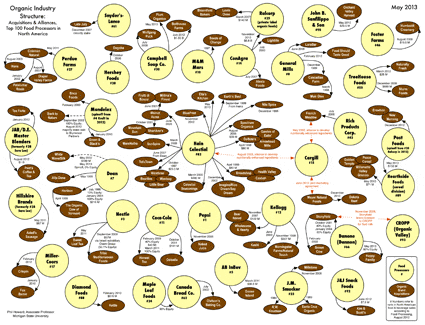
Who owns "Organic"?
Organic Industry Structure, Acquisitions & Alliances,
Top 100 Food Processors in North America
Full size version of chart
All of these boring stats quoted above should convince you that "organic" is the best thing since sliced bread for producing higher profits for Big Food.

The chart at the right shows the scramble of Big Food to buy up everything that gives them an entry into the organic market.  Big Food has invaded and captured the organic market.

Organic eggs has grown from $15.8 Million sales in 2008 to $21.6 Million in 2012 for an average growth rate of 6.83%/yr.

Of the 3,000 organic products sold in Canada, 43% of those products originate from within Canada, 30% come from USA, and 19% come from parts unknown.

For all these organic products, are they really organic, or do they just say that, and hope you won't really notice the difference, or care to check.

In the US, the package has to say "Organic USDA" or it is a fake.  Many products have added "Natural" to their label, which means nothing whatsoever; just marketing hype.  Unfortunately, most consumers mistakenly assume that "natural" is the same as "organic"; but that couldn't be further from the truth.

Even those packages that say they are 100% organic may not be truly organic.  For example, hexane is usually used to extract the oil out of soybeans to create soybean meal, one of the main constituents of animal feeds.

I used to work in a petrochemical factory that used hexane as a solvent in huge reactors to make polyethylene plastics.  Hexane is one of the major ingredients in gasoline.  Our chemical plant workers had to be careful with getting too much hexane on themselves, especially their hands, as it would cause permanent nerve damage.  I'm sure when they do the soybean extraction they try to get most of the hexane out before they package it as human or animal feed.  Don't you think?  We'll never know for sure until it's too late.

In the video above, you can see some of the tricks that Big Food and the Egg Mafia use to try and skirt around the organic certification regulations.  Is it any different in Canada?  I don't know, but I'm sure some of you out there do, so the comments section below this posting are open, by name or anonymous, as you prefer.

If someone cheats, it hurts the brand "organic", and financially weakens those who truly follow the organic certification rules.  You get what you pay for.  Buyer beware.

Know where your food comes from, organic or not.

Tuesday, October 29, 2013

Root Cause of Factory Food

Source:  Surrey BC Backyard Chickens & CLUCK Surrey
This image speaks for itself.

EatLocalGrown, the original source of the image, was started shortly after Rick D. read the book The Omnivore's Dilemma.  You can read Rick D's story here.

The problem today is that the legal definition of "organic" has been highjacked and watered down by Big Food.

In Canada, we have a second problem.  CFIA changed the definition of "Local Food" so that it means it was grown somewhere in your Province, plus the first 50 km. of all other Provinces around you.  Canadian Provinces are BIG places, bigger than some countries.  Food grown in Windsor ON isn't too local to somebody living on the James Bay coast of Far Northern Ontario.  Not too local, if you ask me.

EatLocalGrown is out of Boston MA.  Here is a map of everybody they have signed up to be a local food producer (green square with the white carrot).  Impressive.  Bostonians might not starve after all.

EatLocalGrown and their Local Food suppliers near Boston MA, USA


Now the Ontario Government is passing the Local Food Act to enshrine that definition.  That will enable, and the #ChickenMafia and #EggMafia are already lined up and promoting themselves, the entire Supply Management System to be defined as "Local Food Producers".

So you see, that eliminates the distinction between your friendly neighbourhood Small Flocker, vs. the mega food factory over 1,000 km away.  No difference, says the government.

Again, I'm not sure what a chicken or an egg raised in Southern Ontario, then shipped over 1,000 km to my local store has anything to do with "Local Food"

But alas, it's not me who gets to make those decisions.  I submitted Small Flockers' comments to Ontario's Government, the NDP Opposition, and our local MPP back on April 14, 2013.  The Act is 6 pages long, and we had multiple comments on every page (the comments are in the little yellow splotches on the Adobe Acrobat page, click on them and you can read the comment in the context of the Act).

We asked to come to testify at the Legislature's Sub-Committee who was holding about 6 hours of hearings on the Local Food Act, but we were denied the privilege. We did however, re-submit our comments to the Sub-Committee.

It seems all of it was sucked into a Black Hole, never to be seen or heard from again.

Perhaps you need to read the book, or watch the documentary Food Inc.  (see yesterday's Blog Posting ), or like John D. says, get really pissed off.