Germany has consistently refused to allow the importation of contaminated chicken that has been washed with chlorine water solutions so as to remove some of the deadly contamination. Canada accepts this contaminated chicken. I wonder why.
Angela Merkel said, "There will be no import of chlorine-washed chicken from the United
States. I have prevented it for years and will continue to do so. There
is no question about that,"
In the 12 to 24 hours before shipping to slaughter, the chickens are allowed water, but are not allowed to eat any food. This saves the chicken factory producer on feed used, and minimizes the undigested food in the bird's digestive tract, minimizing the material present during the slaughter process. Because the chickens had food removed from them for many hours before shipping, the manure during shipping is liquid diarrhea, full of bacteria.
The chickens becomes contaminated by being placed in crates
stacked one on top of the other while on the shipping truck going from chicken factory to the slaughter plant. The bottom
row of chickens receive a rain of manure coming from all the chickens
above them. Their feathers become coated in the potent chicken manure. During the slaughter process, that external contamination gets sprayed everywhere during the high speed mechanized slaughter process. The internal contents of the bird's digestive tract released during the slaughter process adds to the mess.
With fecal matter flying everywhere, the eviscerated chicken meat become highly contaminated, inside and out, with fecal matter. To minimize the impact of this contamination, high pressure spray nozzles are used with acid, caustic, chlorine, or other chemicals to wash some of the contamination away. Of course, the bacteria can't all be washed away, in spite of their best efforts.
The chickens smell of chlorine, taste of chlorine, and still have significant risk of food poisoning is the consumer makes even a small mistake.
With Germany and the rest of the EU refusing to receive contaminated chicken rinsed in chlorine solutions, that means there will be no shortage of this "wonderful" product so as to ensure and enhance Supply Management's ongoing abuse of the Canadian consumer. By the way, Canadian slaughter plants used by the chicken factory producers use similar technology and chemicals, so the Canadian chicken isn't any better than what is imported from the US or elsewhere.
Alternatively, a farmer with a sharp knife can cleanly dispatch a chicken one at a time with 96.3% less contamination (ie. 133 CFU during on-farm slaughter vs. 3,600 CFU with the government approved high speed machine slaughter system. See Joel Salatin and our Blog posting Hope for the Mega Meat Manufacturers?)
Germany has made their decision. What will Canadians choose for themselves?

A blog to communicate, discuss, and advocate for the civil rights and important role Small Flock Poultry Farmers can play (and should play) in Canadian Society. Small Flockers are on the side of justice & truth, and against privilege & power. Unfortunately, the more we compromise with privilege and power, the more we reduce the capacity for truth and justice.
Showing posts with label contaminated chicken. Show all posts
Showing posts with label contaminated chicken. Show all posts
Wednesday, June 11, 2014


Saturday, December 21, 2013
Oops! They did it Again
Consumer Reports has again found that almost all raw US chicken is contaminated with 1 or more deadly bacteria (ie. enterococcus, E. coli, campylobacter, klebsiella pneumonia, salmonella, and staphylococcus aureus). These 316 samples of chicken breasts were taken from retail stores all across USA in July 2013.
Consumer Reports tested for enterococcus (79.8 % of samples were contaminated), E. coli (65.2% contaminated), campylobacter (43% contaminated), klebsiella pneumonia (13.6% contaminated), salmonella (10.8% contaminated) and staphylococcus aureus (9.2% contaminated).
They have also found that 49.7% of samples had bacteria that were resistant to 3 or more antibiotics; in other words, the chicken was contaminated with superbugs. If you accidentally contaminated yourself or a member of your family with the superbugs on the chicken, the medical system would have great difficulty curing you of the infection, as most available antibiotcs would be helpless against the superbugs.
Please note that Agriculture & Agri-Foods Canada reports that for 2012, 88.6% of the chicken meat imports into Canada, and 99.79% of the mature chicken (spent fowl) imports into Canada, came from USA. CFC's Chicken Data Booklet 2013 shows that those USA chicken imports (ie. a total of 218,677,453 kg., or 0.22 Million metric tonnes of chicken), represent 21.43% by weight of the chicken consumed in Canada.
No matter how much the #ChickenMafia puff themselves up, or hold their noses high in the air, don't think that Canadian chicken is pure and safe. CFIA, University of Guelph, and OMAF have consistently found that 30% to 80% of Canadian chicken is contaminated with lethal bacteria, including superbugs ( for example, see Blog Posting Contaminated Chicken and here.
The FDA has posted draft regulations to force their chicken industry to slowly taper off on the antibiotics being fed chicken, supposedly to get rid of the superbugs. In vitro mouse tests showed that salmonella had a doubling time that ranged from 20 minutes to more than 1 hour, depending on the mouse's immune system (presence or absence of macrophages). The geometric median between 20 min and 1 hr is 34.64 minutes. A three year tapering period proposed by the FDA is 1.5768 million minutes, or 45,519 doublings. Assuming we started with just 1 superbug, in that 3 year period with 45,519 doublings, we would produce a number far bigger than what any spreadsheet or calculator can compute. This number is bigger than all the nucleons in the entire visible universe (estimated to be 1080 nucleons, see Harrison, Edward Robert, Cosmology: The Science of the Universe Cambridge University Press, 2000, pp. 481, 482).
Note that an E.coli bacteria weighs approximately 10-15 kg., while Earth weighs 5.9763 x 1024 kg., so I calculate it to take 132.13 doublings of 20 minutes each for one E.coli bacteria to grow into an Earth-sized super-colony, which is 1.83 days; slightly different from Crichton's calculation.
So how do you feel about the FDA letting this issue go on for another 3 years?
Of course, Health Canada has no plans whatsoever as of now. Why panic?
So what do the experts suggest to protect yourself from biohazardous chicken? Use a cutting board that is only used for poultry, prepare the chicken without washing the chicken (ie. washing spreads the contamination all over the kitchen), and as soon as you're done, put the cutting board into the dishwasher.
I go into a hospital to visit, or for emergency medical care about 1 or 2 times per year. Every week, my wife or I enter a grocery store where bio-hazardous chicken is handled, stored, and sold. Both the grocery store and the hospital are known reservoirs for superbugs. Which represents the greatest superbug infection potential for my family, the grocery store, or the hospital?
Obviously, the grocery store is a far greater risk, both in probability and lack of detectability (ie. the grocery store risk is poo-poohed, covered up, and hushed up by everybody, including the government).
Today, the Supreme Court of Canada ruled that Canada's prostitution laws are non-constitutional because they put sex trade workers at significant risk. The #ChickenMafia puts most Canadians at significant risk too from their biohazardous chicken. Why is biohazardous chicken permitted and enforced by government regulations?
Why isn't biohazardous chicken from the #ChickenMafia also declared non-constitutional?
Consumer Reports tested for enterococcus (79.8 % of samples were contaminated), E. coli (65.2% contaminated), campylobacter (43% contaminated), klebsiella pneumonia (13.6% contaminated), salmonella (10.8% contaminated) and staphylococcus aureus (9.2% contaminated).
They have also found that 49.7% of samples had bacteria that were resistant to 3 or more antibiotics; in other words, the chicken was contaminated with superbugs. If you accidentally contaminated yourself or a member of your family with the superbugs on the chicken, the medical system would have great difficulty curing you of the infection, as most available antibiotcs would be helpless against the superbugs.
Please note that Agriculture & Agri-Foods Canada reports that for 2012, 88.6% of the chicken meat imports into Canada, and 99.79% of the mature chicken (spent fowl) imports into Canada, came from USA. CFC's Chicken Data Booklet 2013 shows that those USA chicken imports (ie. a total of 218,677,453 kg., or 0.22 Million metric tonnes of chicken), represent 21.43% by weight of the chicken consumed in Canada.
No matter how much the #ChickenMafia puff themselves up, or hold their noses high in the air, don't think that Canadian chicken is pure and safe. CFIA, University of Guelph, and OMAF have consistently found that 30% to 80% of Canadian chicken is contaminated with lethal bacteria, including superbugs ( for example, see Blog Posting Contaminated Chicken and here.
The FDA has posted draft regulations to force their chicken industry to slowly taper off on the antibiotics being fed chicken, supposedly to get rid of the superbugs. In vitro mouse tests showed that salmonella had a doubling time that ranged from 20 minutes to more than 1 hour, depending on the mouse's immune system (presence or absence of macrophages). The geometric median between 20 min and 1 hr is 34.64 minutes. A three year tapering period proposed by the FDA is 1.5768 million minutes, or 45,519 doublings. Assuming we started with just 1 superbug, in that 3 year period with 45,519 doublings, we would produce a number far bigger than what any spreadsheet or calculator can compute. This number is bigger than all the nucleons in the entire visible universe (estimated to be 1080 nucleons, see Harrison, Edward Robert, Cosmology: The Science of the Universe Cambridge University Press, 2000, pp. 481, 482).
"The mathematics of uncontrolled growth are frightening. A single cell of the bacterium E. coli would, under ideal circumstances, divide every twenty minutes. That is not particularly disturbing until you think about it, but the fact is that bacteria multiply geometrically: one becomes two, two become four, four become eight, and so on. In this way it can be shown that in a single day, one cell of E. coli could produce a super-colony equal in size and weight to the entire planet Earth."
Michael Crichton (1969) The Andromeda Strain, Dell, N.Y. p247
Note that an E.coli bacteria weighs approximately 10-15 kg., while Earth weighs 5.9763 x 1024 kg., so I calculate it to take 132.13 doublings of 20 minutes each for one E.coli bacteria to grow into an Earth-sized super-colony, which is 1.83 days; slightly different from Crichton's calculation.
So how do you feel about the FDA letting this issue go on for another 3 years?
Of course, Health Canada has no plans whatsoever as of now. Why panic?
So what do the experts suggest to protect yourself from biohazardous chicken? Use a cutting board that is only used for poultry, prepare the chicken without washing the chicken (ie. washing spreads the contamination all over the kitchen), and as soon as you're done, put the cutting board into the dishwasher.
I go into a hospital to visit, or for emergency medical care about 1 or 2 times per year. Every week, my wife or I enter a grocery store where bio-hazardous chicken is handled, stored, and sold. Both the grocery store and the hospital are known reservoirs for superbugs. Which represents the greatest superbug infection potential for my family, the grocery store, or the hospital?
Obviously, the grocery store is a far greater risk, both in probability and lack of detectability (ie. the grocery store risk is poo-poohed, covered up, and hushed up by everybody, including the government).
Today, the Supreme Court of Canada ruled that Canada's prostitution laws are non-constitutional because they put sex trade workers at significant risk. The #ChickenMafia puts most Canadians at significant risk too from their biohazardous chicken. Why is biohazardous chicken permitted and enforced by government regulations?
Why isn't biohazardous chicken from the #ChickenMafia also declared non-constitutional?
Wednesday, September 4, 2013
Contaminated Chicken
We're surrounded by contaminated chicken, and may need to surrender.
Nobody thinks they will fall victim to food poisoning, until it's too late.
Studies have shown that 30% to 80% of the chicken sold at retail are significantly contaminated by E. Coli, Salmonella, Campylobacter, Listeria, and/or other human pathogen.
How could this be allowed to happen? Why have we allowed it to continue, so that contaminated chicken has now become the new "standard of quality" ?
If
you use permanent grocery bags when you go shopping, get one that is a
totally different colour (or mark a bag so it is obvious), and use it to
carry for all radioactive and/or contaminated foods that you buy (eg. raw
chicken). That way, you minimize cross-contamination potential between chicken and raw vegetables, or between this
shopping trip and the next one.
When you get home and want to refrigerate your prized chicken, keep the chicken double wrapped, yet assume it will leak, so watch out below because the fresh veggies are usually at the bottom of the fridge in harm's way (who designed fridges with fresh veggies in a crisper at the bottom of the fridge ???). Placing the chicken in a bowl may be a better idea. Check the grocery bag for leaks, and if found, launder or throw it out.
Remember, DO NOT WASH your raw chicken carcass after you take it out of its plastic bag. Studies have found that the micro-drops splashed from the chicken can have sufficient contamination to make someone sick, and the splashing can travel up to 5 ft. radius from the sink; contaminating counter tops, cutting boards, and any foodstuffs sitting there. If you can't bear the idea of cooking your bird complete with all the ooze you paid for at the store, go ahead and rinse the chicken, but be sure to do a major decontamination of your kitchen. See HAZMAT suit below.
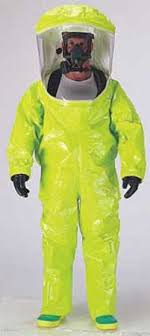 Use soap and water to wash and rinse your hands and arms (most contamination potential), then all the counters and surfaces near where you were working. You may want to use a disinfectant as well. Check the fridge for drips, and wash the shelf when the chicken sat. Rinse the bowl carefully. Most household hot water systems operate at 60°C or cooler, so it won't kill Salmonella or other pathogens at that temperature, so you may want to use the electric heat cycle on a dishwasher to be sure.
Nobody thinks they will fall victim to food poisoning, until it's too late.
Studies have shown that 30% to 80% of the chicken sold at retail are significantly contaminated by E. Coli, Salmonella, Campylobacter, Listeria, and/or other human pathogen.
How could this be allowed to happen? Why have we allowed it to continue, so that contaminated chicken has now become the new "standard of quality" ?
Canada's Food and Drugs Act,
Article 4 states:
I also understand from http://www.hc-sc.gc.ca/fn-an/legislation/acts-lois/act-loi_reg-eng.php that:
I therefore have some burning questions for government authorities about the risky and ridiculous situation they have allowed Canadians to be preyed upon by the Chicken Mafia.
No person shall sell an article of food that
(a) has in or on it any poisonous or harmful substance;
(b) is unfit for human consumption;
(c) consists in whole or in part any filthy, putrid, disgusting rotten, decomposed or diseased animal or vegetable substance;
(d) is adulterated; or
(e) was manufactured, prepared, preserved, packaged or stored under unsanitary conditions.
I also understand from http://www.hc-sc.gc.ca/fn-an/legislation/acts-lois/act-loi_reg-eng.php that:
"All health and safety standards under the Food and Drug Regulations are enforced by the Canadian Food Inspection Agency. The Agency is also responsible for the administration of non-health and safety regulations concerning food packaging, labelling and advertising."
I therefore have some burning questions for government authorities about the risky and ridiculous situation they have allowed Canadians to be preyed upon by the Chicken Mafia.
They condemn and prohibit small flock farmers from processing their fowl at their farm gate, yet allow the current system to run amock.
If that isn't bad enough, CFIA has plans for allowing unlimited chicken slaughter plant line speeds. Some of these chicken abattoirs now run at over 200 birds per minute. That gives the CFIA Inspector just 0.3 seconds per bird to inspect (ie. 3 birds per second whizzing by the CFIA Inspector), haplessly and hopelessly trying to ensure the birds are healthy and not contaminated.
I have worked as a Quality Assurance Manager and a consultant in high volume automotive parts manufacturing plants and electronic circuit board manufacturing plants that used similar line speeds. I tested our quality inspectors to see what they could consistently achieve at those speeds. Generally, the inspector was mentally fatigued and no longer effective after 10 minutes to 2 hours on-the-job; depending on the individual inspector, lighting, number of possible defects, defect rates, and ambient conditions. To ensure consistent quality, we had to build it in at source (ie. prevent the defect from occurring, so it doesn't need to be inspected for later), and relieve (or rotate) the inspectors faster than their capabilities deteriorated.
Has CFIA done similar, statistically valid tests for all of their Inspectors and determined their proven capabilities? If not, why not?
Hint to CFIA: Conduct an R&R (Repeatability & Reproducibility) Study, long method (3 Inspectors, 3 trials, 10 samples= 90 measurements), or some other statistically valid AOQL (Average Outgoing Quality Level) inspection plan. Prove to Canadians that CFIA can consistently achieve less than 10% R&R error at the line speeds and environmental conditions each CFIA Inspector is forced to work under. If you are unwilling or unable to do so, feel free to submit your resignation so as to make room for somebody who can and will.
Hint to CFIA: Conduct an R&R (Repeatability & Reproducibility) Study, long method (3 Inspectors, 3 trials, 10 samples= 90 measurements), or some other statistically valid AOQL (Average Outgoing Quality Level) inspection plan. Prove to Canadians that CFIA can consistently achieve less than 10% R&R error at the line speeds and environmental conditions each CFIA Inspector is forced to work under. If you are unwilling or unable to do so, feel free to submit your resignation so as to make room for somebody who can and will.
How many people have to be killed or made seriously ill (perhaps with effects lasting decades, if not forever) by contaminated chicken before Health Canada, CFIA, and provincial governments will rein in the Chicken Mafia?
To get answers, I have sent an email to the CFIA and a few MP's and MPP's. We will have to wait until they respond to get the important answers Canadians need and deserve.
Raw Chicken Buying & Handling Instructions
Until we get answers and solutions, you will need to keep yourself and your family safe. Here are a few tips.
Studies have shown that the outer surface of raw chicken wrapper film is likely to be contaminated too. Therefore, at the grocery store meat
counter, get a new plastic bag from the store's meat counter (or fresh
vegetables Dept.), open it up, put it over your hand as a glove, then grab hold of the
packaged chicken with your bagged hand. Carefully turn the bag
inside-out over the chicken, tie the bag, and place it in your grocery
cart at the opposite end of the cart, well away from ready-to-eat foods
and those eaten raw.
| Download and print it off, then glue copies to all sides of the shopping bag you use to transport raw chicken. |
Remember, DO NOT WASH your raw chicken carcass after you take it out of its plastic bag. Studies have found that the micro-drops splashed from the chicken can have sufficient contamination to make someone sick, and the splashing can travel up to 5 ft. radius from the sink; contaminating counter tops, cutting boards, and any foodstuffs sitting there. If you can't bear the idea of cooking your bird complete with all the ooze you paid for at the store, go ahead and rinse the chicken, but be sure to do a major decontamination of your kitchen. See HAZMAT suit below.
When you want to cook the chicken, find a counter that you can readily disinfect after you are done. Carefully grab the chicken out of the refrigerated bowl by the outer bag and hold it over the roasting pan. Undo the outer bag, and use scissors to cut open the inner bag, then place the used scissors into the chicken bowl. Slowly and carefully, allow the chicken to slide out of the bag into the roasting pan. Place the bags into the chicken bowl for drip-free transport to the garbage. Throw out all plastic bags so they cannot be re-used nor touched by some
unsuspecting person who could be subsequently contaminated (even somebody pushing down on the garbage to create more room, or placing something else into the garbage).
Season and cook fully, using a meat thermometer set for 82.5 °C (temperature at which most pathogens are killed or denatured)
For those who are somewhat accident prone or afraid, you may want to invest in a HAZMAT suit to protect you from your raw chicken.
Once the chicken thermometer reads 71°C, you can get out of your HAZMAT suit and get ready to eat some delicious Canadian chicken, courtesy of the Chicken Mafia.
If you can consistently do all the above, then congratulations. You are now fully qualified to handle contaminated Canadian chicken, and/or handle spent nuclear fuel rods at your friendly neighbourhood nuclear power plant.
Be sure to put that on your resume.
Subscribe to:
Posts (Atom)