Google+
Showing posts with label import. Show all posts

Monday, December 15, 2014

Import Chicken: Help the Poor in both Canada & the World?

Some experts think the best way to help the poor, both in Canada and around the world, is to allow free trade in agricultural products to occur.  Supply Management is the worst offender to this goal, and is therefore a prime target for change.

In a recent Blog posting SM is Dead: Mulroney's Trial Balloon, or Loose Cannon?, I raised the question about Mulroney's meaning and purpose on his suggestion to end Supply Management in Canada.  In the news media reporting on Mulroney's speech, it also said,

"...those in favour of reaching a deal [ie. reducing agricultural subsidies and import barriers through free trade treaties] say it would be worth many times as much as all of the foreign aid to the world’s developing nations."

Not being an expert in international trade (who is?), I didn't understand what this meant.  Today, after re-reading the mainstream media reporting on Mulroney's speech, I noticed all of them included this cryptic comment, but nobody explained what it meant.  As I dug deeper and deeper, I finally developed a child-like understanding of this issue.  Perhaps I need to research this much more, but I will share what I have discovered so far.  If I am all wet, perhaps those in the know will see my obvious error, take pity, and guide me in the right direction.

It appears that this statement refers to a study done and book published in 2004 by William R. Cline (a US economist and a Senior Fellow at the Peterson Institute for International Economics) who wrote Trade Policy and Global Poverty

Mr. Cline seems to propose that the fastest and easiest way to reduce poverty on a world-wide basis is to allow free trade for agricultural products.  Of course, agriculture is the global-wide bastion of the most pernicious protectionism.

In support of Mr. Cline's theory, he presents the following evidence:

  1. World-wide poverty (ie. the "Poor") is generally defined as someone earning less that US$ 2.00 per day ($730/yr).

  2. There are 3 billion Poor in the world.  75% of these Poor live in a rural setting. [I assume that means people living in a rural setting of a developing nation have the means to grow food, and might be able to sell some of that food as an exportable product.]
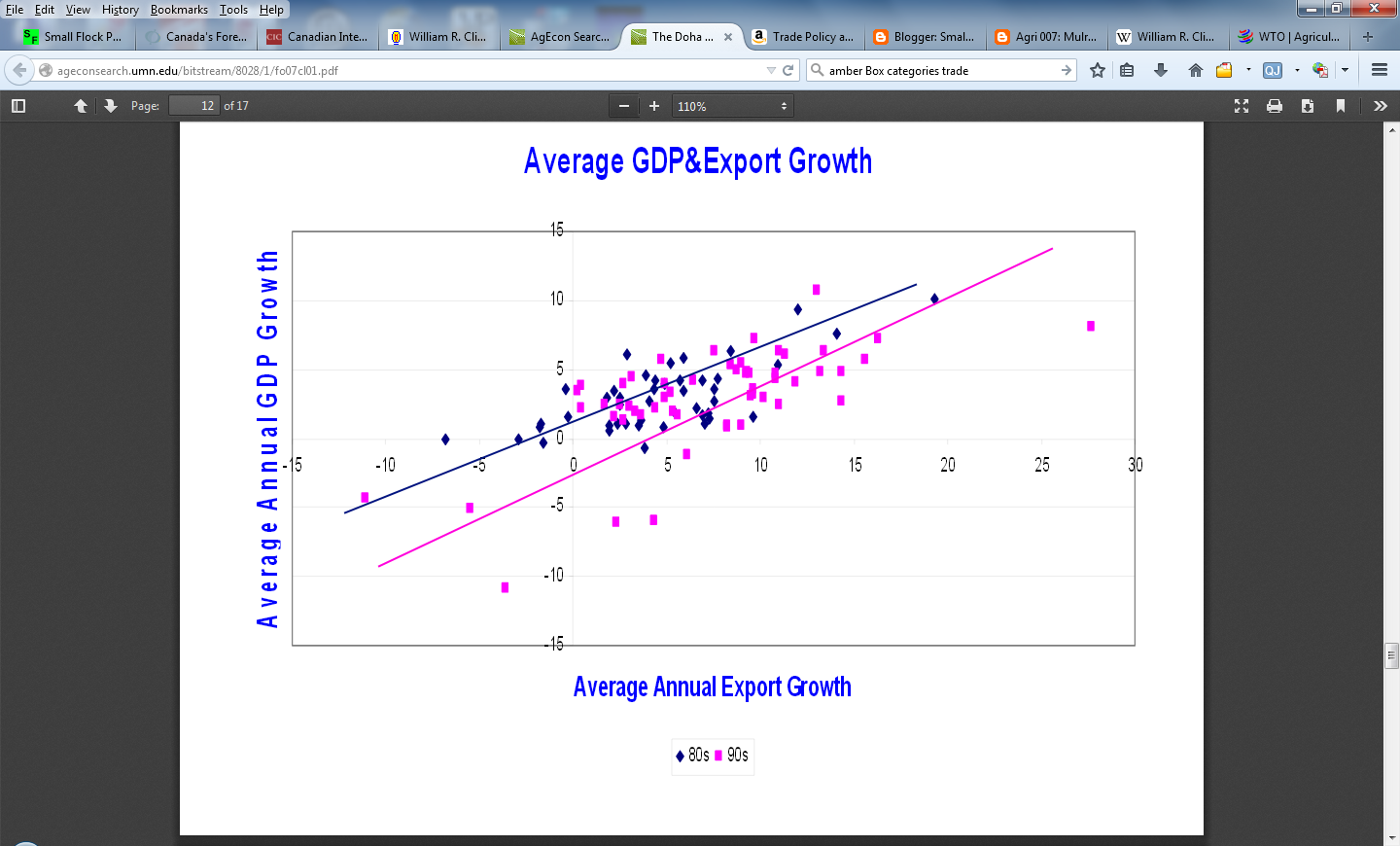
  3. Figure 1:  Mr. Cline's datapoints showing the correlation
    between a developing country's GDP vs. the growth in
    their exports.  The lines were added by me.

  4. In developing countries, data from the 1980's and 1990's suggest that as their exports grow, local GDP grows also.  See Figure 1.

  5. That boost to the economies of developing nations via free trade could be as much as $200 Billion per year.  Half of that boost would be from free trade for agricultural commodities.  The other major sectors for boosting their economies would be from exporting textiles and apparel.

  6. Global free trade would raise the GDP by 1.5% to 2% directly.  The dynamic (ie. spin-off) effects would more than double the direct effect, so the total effect (ie. both direct and indirect) would be more than 4%.

  7. While the average effect on people would be 4%, the poorest of the poor are estimated to receive the biggest impact of free trade, estimated by Mr. Cline to be double of the average effect (ie. 8% for the Poor vs. 4% on average for all citizens in a developing country).

  8. In Mr. Cline's 2007 paper to a USDA conference, he states:   "...the broad empirical relationship between poverty and income shows that the “poverty elasticity” – the percent by which the number of poor declines for a 1 percent rise in their income– is about 2. So multiply once again by 2 and you get a total of 16 percent reduction in the number of poor. Apply that to 300 million [sic, appear he meant 3 Billion] in poverty and you get about 500 million reduction in global poverty."  Therefore, Mr. Cline concludes that free trade would raise the income of Poor people sufficiently to remove 500 million people from the poorest category (ie. earn $2.00/day or less).

  9. Free trade for agriculture is essential to achieving these positive effects for the world's poor.  See Figure 2.  WTO defines ag. subsidies as colour-coded boxes, similar to traffic light colours (red= prohibited, amber= caution or subsidies that are to be reduced, green= OK in unlimited quantities, plus blue=amber with conditions that limit the quantities that farmers can produce.  The protectionism of Japan's farmers is legendary, estimated to be equivalent to an 82.1% import tariff when you count true tariffs (76.4%) and domestic subsidies (3.2%).  Canada is the 2nd worst villain in ag. tariffs and subsidies at 52.3%.  The EU is 46.4%, and the US is just 19.9%.  The weighted average for all industrialized nations is 36%.  No wonder Canada is in such huge trouble in trade talks with the US, EU, TPP, and WTO; we're 45% higher in ag. trade barriers than the world average for industrialized nations.

  10. Figure 2:   Mr. Cline's estimates of barriers to free
    trade in agricultural.  Japan is seen as the worst, with a
    total of 82.1% tariff-equivalent import barrier, with Canada
    in 2nd place of this Rogue's Gallery at 52.3% tariff-
    equivalent barrier to ag. imports from developing nations.
So that is Mr. Cline's theory in a nutshell.  I assume that is what was being referred to in the story about Mr. Mulroney's call for the end of SM when it said removing ag. subsidies and protectionism would have a greater effect than foreign aid.

In 2012, Canada spent $5.67 Billion on foreign aid according to CIDA's data, which is stingy when compared to our relative wealth and the aid by other OECD nations.  About 69% of Canada’s aid in 2012 was channeled through the Canadian International Development Agency (CIDA), 9% through Finance Canada, and 8.2% through the Department of Foreign Affairs and International Trade, while the International Development Research Center (IDRC) accounts for 3.5%.  About 33.4% of that aid went to Least Developed (or poorest) Countries, another 2.5% went to other Low Income Countries, and 16.8% went to Lower Middle Income countries (41% is not coded by income group). Africa received the highest share at almost 42%, followed by Asia (22%), and the Americas (17%).  Following nearly a decade of sustained increases, Canada's aid spending has stalled and is set to decline in the coming years.
About 69% of Canada’s aid in 2012 was channeled through the Canadian International Development Agency (CIDA), about 9% through Finance Canada and 8.2% through the Department of Foreign Affairs and International Trade, while the International Development Research Center (IDRC) accounts for 3.5%. - See more at: http://cidpnsi.ca/blog/portfolio/canadas-foreign-aid/#sthash.5R7LsQkW.dpuf

As a Small Flocker in Canada, there are a few issues of which I am concerned.

First, I have seen the jars of pickles on my local grocery store shelves that have been imported from India.  I have eaten some of those pickles, as they are significantly cheaper than N. American pickles and seem to have reasonable quality.  I also fret about "what is this world coming to" when Canadian pickle producers have permanently shut their doors, and we are now forced to import from elsewhere.  I assume I would feel equally conflicted about SM products of dairy, chicken, and eggs being imported into Canada at the expense of domestic production.

Secondly, the quality of N. American chicken is a disaster, with bacterial contamination (including superbugs), bad Omega-3 to Omega-6 fatty acid ratios, bad bird welfare habitats, etc.  I assume that 2nd and 3rd world imports might be significantly worse; witness the recent news reports of falsified species in fish imported from South-East Asia, melamine tainted milk in China, and many similar events. As an example of a disaster going someplace to happen, live US chicken was proposed to be exported to China, slaughtered in China, processed and further processed in China to create boxed chicken, then import those packaged chicken products back into the US with no review whatsoever of that entire international supply chain by USDA inspectors (see Blog posting COOL Blowback ).  Canadians need higher quality products, not lower.  Can we be assured of this quality if we are importing SM replacement products from the developing world?

Thirdly, I am cautious of Free Traders and others who pretend to be helping the poor, when in reality they are propaganda shills for Big Ag., the PTB ("Powers That Be"), the NWO ("New World Order"), and the 0.01%'ers.  Exactly who is this Mr. Cline?  CIC (Canadian International Council) seems to support Mr. Cline's research.  Is Mr. Cline a master manipulator, or a straight arrow?  For me, it's too soon to tell, but I am wary about trusting too quickly.

Fourthly, if SM will not yield any ground to domestic Small Flockers, I assume that international small flockers don't have a chance.  I would assume that the poorest of the poor would be small flockers in chicken, and small market gardeners in fruits and vegetables.

Fifthly, if WTO, TPP, and EU trade talks achieve agricultural free trade by some miracle, how long before Big Ag. moves in to their third world countries where they create a monopoly for themselves via unfair or predatory trade practices so as to steal the free trade opportunities away from those who need them most.

By slowly and carefully reducing Canada's import tariffs and subsidies to Canada's #ChickenMafia, I believe that would be beneficial to Canada's consumers and small flockers alike, and would eventually force Canada's #ChickenMafia to dramatically improve, or die.  However, is there a tariff level below which no Canadian chicken farmer can compete, and dropping import tariffs below this threshold will surely kill all the #ChickenMafia, and possibly even Canada's small flockers?  If yes, what is that critical tariff level?

A lot of questions, conflicts, and inconsistencies currently exist inside of me on these SM trade issues.  I assume each of you has a similar list.  These are complex issues, and we need to get them right the first time.  That is exactly why those acting against the best interests of the majority purposefully cloud the issues so as to protect their special interests.

Hopefully with additional study by myself and other, the mud will settle and we can see clearly on the best path to take.


Saturday, November 22, 2014

COOL Blowback

COOL (Country Of Origination Labeling) has been a hot issue for Canadian pork being exported to the US.  What about chicken?

Consumers, both in US and Canada (and I assume the rest of the world), would like to know where their food comes from.  With the 100 mile diet, eat local, buy local, and xenophobia, there is considerable pressure to buy from local producers.  That is why Canadian pork producers object to having "Raised in Canada" being put on Canadian pork that is sold in US grocery stores.  Everybody realizes that would be the kiss of death for sales.  The meat will rot on grocery store shelves, rejected by US consumers.  Alternatively, US grocery stores would have to sell Canadian pork at deep discount pricing, so low it would drive Canadian pork exporters into bankruptcy.

Is this issue isolated to just Canadian pork?

No.  It also applies to both Canadian and US chicken.

China has been frozen out of many industries, but they want greater access to US markets for all of their products, including food.

US Food and Drug Administration ("FDA") has their hands full with lousy chicken quality produced by US growers, US abattoirs, and US processors.  They don't need the added risk and headaches from sketchy Chinese poultry producers.  If Chinese dairy producers were willing to adulterate milk and baby formula with toxic melamine, or thousands of dead pigs purposefully dumped into Chinese rivers, what would you expect to occur if they could export Chinese chicken to the US?

But the Chinese kept pushing their agenda.

Finally a compromise was reached. IN Sept. 2013, Economy In Crisis Blog reported with outrage that Chinese abattoirs would be allowed to buy US grown chickens, eviscerate them, cook the meat, package it, and export it back to the US for sale in US grocery stores.  The package would say "Made In USA", likely due to COOL regulations.  That would allow retailers to hock this US chicken processed in China as 100% bona fide Star Spangled Banner home grown chicken to an unsuspecting public.

US farmers were likely in favor as it gave them additional production, and the Chinese buyers would likely pay a premium to get the necessary chicken supply.

As an interesting sidebar, FDA only has sufficient resources to inspect 2% of the imported chicken.  In the US, 60% of imported food comes from developing nations.  It isn't just snooty and fancy mustards from France that are being imported into the US.  Just like in Canada, when half century old canning factories in Canada are shut down so that we can buy pickles imported from India.

USDA inspectors regularly come to Canada to make sure Canadian foot exporters and CFIA are both doing their job of ensuring safe food is being exported to the US.

However, there are no plans for USDA inspectors to ensure the quality or safety of this chicken processed in China.

Should Canadians jump on this opportunity, saying "Americans are spooked by Chinese chicken.  We believe American would be much more comfortable with US chickens processed in Canada then re-exported back to the US.  Canadians will build the extra slaughter capacity that's necessary to meet this marketing and exporting opportunity.

Would Canadians be ready to unknowingly accept Canadian chicken that was processed in China, but the retail meat counter label on the packages hides that fact?

For all we know, CFIA may have already cut that deal with China and its exporting allies.

Where does this place Small Flockers within this boiling kettle of politics and chicken broth?

How is it cheaper and better to ship chicken all the way around the globe before humans eat it?

Obviously this well traveled chicken will only occur if someone is making more money doing things the crazy way.

Can we not find a solution that will allow the underutilized Small Flockers to spread their wings and fly?


Wednesday, December 4, 2013

The Chef Knows

I saw the floppy Chef's hat and couldn't resist.  Sure enough, he was the Chef for a major downtown hotel.

"What do you think about the situation of Canadian poultry?", I asked.

He smiled, cautious not to offend a hotel guest.  As the Concierge listened in, he said, "In what way do you mean?"

I shared with him a few of the facts I had slowly learned over the last 2 years about the inner workings of poultry in Canada. For most citizens, their eyebrows start to raise after a few seconds, then they go bug-eyed, then their jaws start to drop as I tell my tale of woe.  Occasionally, I get a silent mouthed "Oh my God!" or "That's crazy!", or "You're kidding !?!".

Not today.  Chef stayed calm.  He listened politely, like a kind Grade 3 teacher while his favorite student carefully read his latest composition out loud to the class.  Smiling, nodding encouragement, no shock could be discerned on his face.

I missed the shocked part.  I stopped talking.

"Yes", he said.  "That certainly is a problem.  Those are some of the reasons I don't buy any Canadian poultry.  I can buy whatever I need for the hotel, but I have a budget.  I can't afford Canadian poultry.  We order our poultry from our suppliers.  I can't tell you who they are, but it all comes in from either the US or Chile.  Chile has some excellent poultry, and seafood as well."

"Yes, I said.  "I noticed that in Statistics Canada's most recent import data, Chilean poultry imports exceeded even the US imports.  I was kind of surprised to see that."

"It's good stuff", he repeated.

I thanked him, smiled at the Concierge, and went down the hallway towards my hotel room.

He knew.  Unlike the typical consumer, he knew.  Nothing I had said surprised him.  I wondered if most or all of the other Chefs in Canada also know?  Had all of them long ago given up on Canadian poultry?  They buy enough, they can order whatever they want from around the world.

Most Canadians are chained to their neighbourhood grocery store.  Only the wrinkly, over 70 generation go all over the city picking up a few specials at this store, and a few different items at the other store across town.  They think it makes a difference.  They blow any savings on tuna fish by the added cost of gas and wear on their vehicle.  However, they'd rather operate at a net loss on tuna, so as to gain the opportunity to teach and re-teach the grocers that people will go out of their way for a bargain.  They think it keeps the grocers on their toes. However, even the wrinklies don't do it as much as they used to.

The food monopolies have us right where they want us.

Trapped, with no real alternative.

That's where Small Flockers, as Canadian's friendly neighbourhood source of fresh meats, comes in.

The market is primed for an alternative.

The Chefs already know it.


Monday, October 14, 2013

Chicken Mafia causes another disaster

There is a full-blown crisis in the Canadian chicken industry.  Sound the alarms.  This crisis threatens the loss of 56,000 Canadian jobs, and $6.5 Billion GDP.

Spent fowl imports to Canada are probably being used to defraud Canadians, and destroy the Canadian chicken industry.

Spent fowl are female chickens that have spent an entire year laying eggs, are getting worn out, egg production is dropping, and are then only commercially suitable for making chicken soup, pet food, compost fertilizer, or similar fates such as defrauding Canadian consumers.

Fraudulent spent fowl imports are being used to escape paying the 285% import tariffs for broiler chicken at the Canadian border.

Source: http://chickenfarmers.ca/upload/Documents/Spent_Fowl_Imports_webBooklet.pdf

If the current trend of fraudulent spent fowl imports continues, these imports are forecast to double again from the current 16.9% of the domestic broiler production, to 33.76% in just 5.3 years from now, and will reach 50% of Canada's domestic broiler production in just 7 years from now, and 100% of domestic chicken production on or before June 18, 2023 (9.68 years from today).

The data shows a double exponential rate of increase (ie. an exponential of an exponential rate of growth), with a correlation coefficient of 90.48% (ie. the double exponential equation explains 90.48% of the year-to-year variation in the data, with just 9.52% random error).

That means that Canada's entire domestic chicken industry will be wiped out as of 2023, as all the needed chicken will be fraudulently imported into Canada, right under the noses of Chicken Farmers of Canada ("CFC"), the organization who is supposed to be in charge of chicken for all of Canada .

Of course, the Canadian industry for growing and processing chicken, and the growing of grains and making chicken feed for those domestic chickens will likely collapse long before those doomsday dates are reached, due to massive loss of both market share and cash flow.

Note that this dangerous trend is likely created by cannibalism from within the Chicken Mafia (ie. all those who support, use, and benefit from the monopolistic chicken supply management system).  Pure greed likely means that some members of the Chicken Mafia aren't satisfied with a mere 300% markup on chicken in Canada that consumers are forced to pay.  The Chicken Mafia wants more and more profits.  It is likely more than one Chicken Mafia members who are eating Canada's chicken supply management system alive from the inside out, just like in the movie Alien.

Alien monster emerging from inside Astronaut Kane (played by John Hurt) in the 1979 move "Alien"


If something isn't done soon, Canada's entire value-added chicken industry will suffer a similar fate to that of Astronaut Kane, as shown in the above video clip; a sudden, scary, violent, painful, and gruesome death.

Will CFC attack its own members of the Chicken Mafia, so as to save the overall system?  So far, CFC has allowed it to continue.

While Small Flockers don't like the tyranny and oppression of the current chicken supply management system, and we call for dramatic changes, this current crisis isn't our doing, is not what we had in mind, and we do not support letting the current crisis trend to continue.

Somebody needs to do something, and quick.  Perhaps the decades of oppression by the Chicken Mafia has found an outlet, and it is already too late to make amends.

Unfortunately, CFC now wrings their hands in worry and makes pretty brochures about the crisis they created by delay and indifference.

The above graph is taken from a CFC brochure they published as of Sept. 16, 2013.  In a previous Blog posting, I showed how this emerging crisis was detectable back in 2003, but CFC was asleep at the switch, and only realized the trend existed in 2010; which is 7 years behind the times.

Google Internet Search terms for Canada (see graph above) show no interest whatsoever in this topic between 2004 and today.  Shocking and sad!

So that's it? For ten years the problem is allowed to fester, and all CFC can do is produce a 6 page pamphlet on this crisis; a crisis that can and will destroy the entire Canadian chicken industry?

Rip Van Winkle wasn't asleep that long.  Incompetence and negligence by CFC needs to be investigated on this issue.

Perhaps CFC should be taking specific action.  If they don't know what to do, perhaps they should ask somebody who does know.  It appears that all they have done is complain to Minister Ritz, then sit back and wait for a solution from the government.

I find CFC's inaction or glacial pace to be hard to understand.  Talk about fiddling while Rome burns!

You should also be aware of the increasing danger in the Canadian system for supply management of chicken from other sources.  It appears to be approaching the breaking point in multiple area, from stressor originating from multiple sources (see http://canadiansmallflockers.blogspot.com/2013/10/quota-based-chicken-farmer-speaks-out.html )

Today, when a truck of chicken arrives at the US-Canada border, Canadian Border Services Agency ("CBSA") cannot take action on a truck that contains 51% spent chicken that is mixed in with 49% broilers unless they have a scientifically sound, objective method for determining what is a spent fowl and what is a plump young broiler.  I suggest the following 5 step action plan can be in place within 6 months or less if we get somebody competent on the job (ie. not Chicken Farmers of Canada):
  1. Secretly purchase a truckload of 100% verified and certified USA spent chicken , and a truckload of verified and certified USA broilers ( in parts, whole fresh, and frozen).  Statistical analysis of the meat is done to characterize it, and identify the factor(s) that provide the maximum confidence interval for differentiating between spent fowl and plump broilers (eg. weight, density, conductivity, skin/meat durometer, pH, water activity, etc.).  I guess that the weight differential should be adequate, but the other data can act as an insurance policy.
  2. Repeat the purchase and testing from different suppliers and different processing plants so as to build a sufficient database.
  3. The database and testing method is verified for repeatability, reproducibility, precision, accuracy, and predictability through a double blind test of the draft method, data is statistically analyzed for prediction efficiency.
  4. CBSA personnel are trained on the certified testing method.  Method is implemented at all borders.
  5. Random samples are taken by CBSA for all trucks of alleged spent chicken imports into Canada.  Based on these samples, the % spent chicken in the shipment is estimated, and CBSA applies the TRQ or other tariff to the balance of the shipment.  If the importer is able to present sufficient objective evidence to prove a different % spent is in the shipment, then this other data will be considered by CBSA prior to assessing the duty owed.

Monday, March 18, 2013

Magical Trucks of Chicken

Since starting this Blog 18 days ago, I've been receiving a number of interesting phone calls and emails.  Most of the people who called wanted to remain anonymous, and once they explained the purpose of contacting me, I understood the reason for the secrecy.

They were intrigued with all that I wrote so far on the Blog, but wondered when I was going to get down to the real juicy stuff.

"What might that be", I asked.

"The magical chicken trucks", they said.

I was confused, so I asked them to explain.

They said that they used to work in one of the slaughter plants.  Every once and a while, they would load a truck with eviscerated chickens that was supposed to be exported from Canada, but it never crossed the US-Canadian border.  It went somewhere else.  Nobody on the plant floor knew where it went, except that it didn't go export like it was supposed to.

"It was a magical chicken truck", they repeated.

After asking some more questions, my light bulb finally went on.  You see, eviscerated chicken all looks the same, it's not traceable except by the paper that accompanies the chicken.  One truckload of chicken looks the same as the next; they're indistinguishable.

It appears that live chicken had been imported from the US for Canadian processing, and they were supposed to be re-exported as eviscerated chicken meat to some foreign country.  However, those chickens never left Canada.  By claiming to import for subsequent re-exporting, the processor escapes paying the 300% import tariff.  When the magical chicken truck is used, the chicken appears to leave Canada (but don't), and then the processor was free to sell the resulting meat in Canada at 3 times the selling price available in export markets.  Not a bad profit margin, if you can get away with it.

After all, it's easy for a magician to make a magical chicken truck disappear here and re-appear over there.   

Another person contacted me to say that they drove long haul reefer truck, often for chicken slaughter plants exporting to the States.  Sometimes they would have a load that they took to the States that would have some paper problems.  It appears that 2 or more slaughter plants were claiming the same truck as their own shipment, so that it would go towards their export quota license.

You get awarded quota for export, then claim that you exported as you were supposed to do (but never really export those chickens).  You then have an extra truckload of chicken in Canada that you can sell in the high priced Canadian chicken market.  That sounds like a nice way to make some quick cash, provided you can get away with it.

I understand that both Chicken Farmers of Ontario (CFO) and Chicken Farmers of Canada (CFC) are supposed to be monitoring the chicken supply management system, and ensuring that the rules are followed by everybody.

Whatever you do, make sure you don't wake up CFO or CFC to tell them about the magical chicken trucks.  They're trying to sleep.

Thursday, February 28, 2013

Chicken Price Parity: Will it Ever Come?

Canadians needs to be patient. Our chicken prices will be on par with US retail prices in just 22.7 more years.  Here is the price trend for Canadian chicken at Canadian retail stores.

You might wonder how I figured we only have to wait for one more generation before we have affordable chicken in Canada.

Here's the chicken pricing for good 'ol USA.

 Data Source: http://www.ers.usda.gov/data-products/meat-price-spreads.aspx

For more than 22 years, the US broiler chicken composite markup between wholesale and retail prices (ie. the green line in the above graph) has run at a steady 40.2% (ie. WholesalePrice/RetailPrice= 0.402). This 40.2% is the profit & expenses of wholesale distributors. Composite price is a weighted price based on relative fraction of weight sold for the various cuts or whole chicken.

Chicken prices in USA for both retail (red line) and wholesale (blue line) have been trending up at the same average inflation rate of 5.4% per year from 1990 to 2012.

On the Canadian side of the border, we get something totally different. Today, our Canadian average wholesale chicken prices in Canada are approximately twice the US wholesale price, and climbing.

Ouch!


 Source: http://www.cfo.on.ca/_pdfs/CFO-SM-Brochure-03.pdf

2014/10/06:   The above link was found broken.  CFO removed the incriminating evidence from their website.  Fortunately, I saved a copy which is still available here

The rate of wholesale price increase in Canada is approximately 2.6% per year vs. the 5.4% in the US. Canada.  With a higher chicken starting price but a lower chicken inflation rate in Canada,  this means the US prices will eventually match Canadian prices.

 If my math is correct, the US-Canada price gap will close around Feb. 8, 2035 (ie. 22.7 years from now).

Hold on, Canada, chicken price relief is coming. The day of chicken price parity with the USA will soon be here (in another 22.7 years).

The retail price increases for chicken seem out of control.  Below is the CFO's Chicken Consumer Price Index, showing rapid inflation of chicken at the retail grocery store (Ref: CFO-SM-Brochure-03.pdf, pg. 4)


Fortunately, Canadians are a very patient people. In the mean time (ie. the rest of my natural life), Canadians will have to do cross-border shopping if they want a good deal on chicken. Hopefully, the Canadian poor will be able to hitchhike to the US grocery stores and return with their affordable chicken.

Sooner or later, Canadians will have had their fill with price gouging on chicken.

 Source: http://www.georgemorris.org/uploads/userfiles/files/ccmr-july-2012.pdf

George Morris' data for May 2010 - May 2012 shows a steep collapse of chicken sales from Sept. 2011 to Mar. 2012, interpreted to mean that Canadian consumers were disgusted with excessive chicken prices, and closed their wallets. The sudden leap in sales for April 2012 was US chicken wings imported by retailers at excellent prices, so as to better serve Canadians.

This demonstrate that Canadians don't hold a grudge, as they are willing to quickly respond to reasonably priced chicken.