Google+
Showing posts with label retail. Show all posts

Tuesday, December 30, 2014

Big Ag rides the Monopolistic Coattails of SM

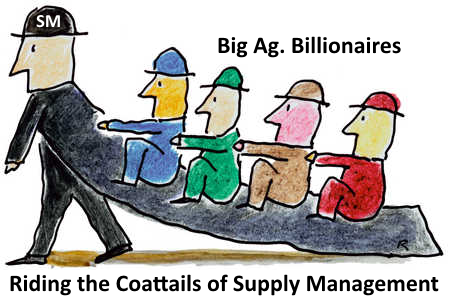
Big Ag. billionaires ride the monopolistic coattails of Supply Management ("SM").

The Big Ag. Billionaires love riding the coattails of Supply Management. Like most
"Deals with the Devil", both parties benefit from the relationship in the short term.
Long term, losing your freedom and your soul has significant consequences.

The Big Ag. Billionaires love riding the coattails of Supply Management. Like most
"Deals with the Devil", both parties benefit from the relationship in the short term.
Long term, losing your freedom and your soul has significant consequences.

Anonymous comments posted on Better Farming recently postulated that retailers enjoy, benefit, and welcome the price stability of SM commodities (dairy, chicken, eggs, & turkey), as it enables steady profits while minimizing consumer anger at high food prices.  Do big grocery chains ride SM's coattails too?

Big retail grocery chains tend to use 4 basic commodities (bread, milk, eggs, chicken) as "loss leaders" in their advertising and advertising flyers, where they focus their price competition efforts.  This theory assumes that if a grocer has excellent prices on these 4 basic foods, customers flock to your grocery store, then you can charge prices as you please on all the other items on your shelves.

That may be somewhat true, but there are limits to the retail price gouging that can occur under this method.

Groceries have always been a high volume, low margin business, and highly competitive.  More recently, grocers complain that it has become even more cut throat and competitive.  Walmart selling food in Canada has been a major disruptive force in the marketplace.  Some experts feel that Walmart will terminate its grocery sales experiment within the next five years.     

A Feb. 2014 Financial Post article said,
"Quarterly earnings margins before interest, taxes, depreciation, amortization and rent costs at Loblaw, Sobeys and Metro [the three largest grocery chains] have ranged from 6.5% to as high as 9% over the past two years."
I read with interest the recent article on Sobeys in Canadian Grocer.  Mr. Marc Poulin said healthier food products introduced into Sobeys over the past year are part of the reason for the recent profit jump at the stores.  I also note that the same article shared that "Analysts have said Sobeys faces fierce price competition in the grocery business."

On Empire Company Ltd.'s website (Empire is the parent company of Sobeys), it states, "Empire is committed to maximizing sustainable long-term shareholder value by supporting Sobeys’ purpose to help Canadians Eat Better, Feel Better and Do Better while also strengthening our related real estate investments."

Sobeys commitment sounds pretty good to me.  I hope that Sobeys follows through with their commitment.  I asked Empire's Board about that commitment on 2014/09/20 (ie. 100 days ago), and have not yet received a response from them.  They must still be thinking about it.

In 1996, researchers published their price modeling for the relationship  between farm and retail prices for 9 Canadian food staples. 
They found that
  • In 1986, Canada had 101 chicken processing plants.  The four largest processing firms, some of which operate multiple plants, account for at least fifty percent of total Canadian sales for meat (ie. low competition).  For chicken, the Canadian concentration ratio in 1982 was more than twice that in USA.
     
  • SM products sold at retail in Canada completely passed on all of the farm gate price increases to consumers (ie. a 1% increase in SM farm gate price increased retail store prices by 1%),
  • Non-SM foods usually passed on less than half of the farm gate price increase.
While Canada's chicken processor concentration in 1982 was double the US concentration, it has become even more concentrated by plant closures, mergers, and acquisitions.

That research confirms that it isn't just SM farmers who are solely responsible for the unfair gouging of consumers for SM commodities.  Those Big Ag. "friends" of SM who ride on the monopolistic coat tails of SM farmers also play a role in unfairly boosting prices of SM foods at retail stores.

It was reported to me earlier this year by the Meat Department Manager at a local grocery store that he was selling chicken at a price below their cost ($1.88 per lb., or $4.14/kg), which is roughly the same as US retail pricing.  I believe what he told me was true.  While it may not happen every day, it appears to happen at least sometimes that some food items are sold at retail prices that are at or below the retail store's cost.

Chicken Farmers of Ontario ("CFO") seems to have learned the "boiling frog" method of slow steady price inflation of 3.57%/yr as an insidious attack on consumers so as to maximize the profits of their multi-millionaire CFO members and their Big Ag friends. See Chicken Price Parity:  Will It Ever Come?

That "boiling frog" steady rate of price inflation for chicken may help retailers as well, just as the BF poster suggested.

Thursday, November 13, 2014

Meat Price Mania

The Canadian retail prices for meat have entered a mania phase.  How will Canadians react when more and more of us are forced to become vegetarians by unaffordable meat prices?

Figure 1:  Canadian Retail Prices of Meat, Sept. 2014.  Prime Rib roast of beef
is 277% higher than chicken.  How do they justify these pricing
differential?
Figure 1 shows data from Statistics Canada on the retail price of meat in Sept. 2014.  Click on the graph for a bigger version.  As expected, prime rib of beef is the most expensive.  I am pleased to see chicken is still the cheapest on a $/kg basis.

Note that prime rib is 277% more expensive than chicken.

CAFO (Concentrated Animal Feed Operation) has the biggest market share for beef, is usually the cheapest method of producing beef, and has an FCR (Feed Conversion Ratio) of around 5, while Ontario chicken has an FCR of around 1.72.  If all other factors are similar, the cost of feed is the biggest factor in determining the price of meat.  Therefore beef should  be 290% higher priced than chicken, but is actually just 277% higher.  Does this mean that beef is 4.7% too expensive, or chicken is 4.7% cheaper than it should be, or a combination of the two?

I think it's safe to assume that the prices are reasonably close to the correct ratio; but both beef and chicken need to be deflating in price, not inflating.

Figure 2:  Trends in Canadian meat prices for 2010 to 2014.  Stewing beef wins the race towards
unaffordability with a 9.9%/yr increase, doubling and re-doubling every 7 years, with a total increase of 52.3%
in price from 2010 to 2014.  Chicken is up 3.79% per year, doubling every 18 years, with a total increase of
16.1% from 2010 to 2014.
Figure 2 above shows the trends in Canadian meat prices for 2010 to 2014.  Stewing beef wins the race towards unaffordability with a 9.9%/yr increase, doubling and re-doubling every 7 years, with a total increase of 52.3% in price from 2010 to 2014.  Chicken prices are up 3.79% per year, doubling every 18 years, with a total increase of 16.1% from 2010 to 2014.

I wish to congratulate the Canadian chicken industry for resisting the natural urge to jack up prices like the other meat industries did in 2013-2014.

See, I can offer the #ChickenMafia a heart-felt complement when they deserve it.

It is interesting that, except for chicken, the cheapest meat cuts have the highest rate of price inflation.  As meat prices go up, more and more people will naturally gravitate towards the cheaper cuts of meat.  As stewing beef flies off the store shelves, the available supply of stewing beef  drops.  Stewing beef is usually the trims cut off the higher priced cuts of beef during the butchering process.  When that is all gone, butchers can start cutting up prime cuts of meat to make stewing beef (highly unlikely), or sell out and have a bare meat counter with no stewing beef for sale, or they can raise the price of stewing beef to balance supply & demand. 

Beef and pork were both suffering severe struggles on the farm in 2013-2014 due to the PED virus for pork, and the severe US drought in Texas and California.  Are these being used as excuses (or are just and reasonable reasons) for these extreme price increases?  Even weiners, mostly made from pork and chicken, jumped on the price inflation bandwagon in 2014.

However, chicken resisted the price inflation trend set by everybody else.

Did this Blog and its whiny voice have any influence in the #ChickenMafia's decision?  I doubt that.

It appears that the #ChickenMafia has determined that flying below the radar is in their long term best interest.  Large price swings tend to incur the attention and anger of the public, and that is when Supply Management might add the straw that breaks the back of SM's camel.

Instead, #ChickenMafia continues their policy of a "steady as she goes" inflation of 3.79% year over year, like clockwork.  Let the sleeping public stay asleep.  It appears the #ChickenMafia's strategy is working pretty well for them.

Hopefully, Supply Management can be changed so that the #ChickenMafia have a "steady as she goes" price reduction each and every year, requiring them to work very hard each year to find more and more methods to improve their efficiency and productivity, thereby lowering prices like clockwork.

In that way, the #ChickenMafia become excellent stewards for the public, using their government created monopoly to serve both stakeholders (ie. themselves, as well as the greater good of the public).

Tuesday, November 5, 2013

Celebrations: ! or ?

Retail chicken prices should soon see a "huge" price drop of $1.06 per kg (ie. an 18.365% price drop).  CFO's quota period A-120 (Oct. 6 2013 to Nov. 30 2013) is when cheaper chicken will leave farm gates throughout Ontario, and start to work its way towards the grocery store meat counters. 

Thank-you to all who helped make this price decrease happen for the Canadian people.  I say Canada for a good reason, even though it is only Ontario that this drop has been ordered by Ontario Farm Products Marketing Commission ("OFPMC").

The reason I say "Canada" is that Ontario is about 1/3 of the total chicken market in Canada, and almost all the other provinces have traditionally taken their farm gate live chicken pricing lead from Ontario.

Perhaps I need to explain further.  Bogus farm gate live chicken prices charged by Chicken Farmers of Ontario ("CFO") were ordered reduced by OFPMC by 6.9 cents per kg. in Ontario.  That is what the main stream media and CFO's press releases focus on, but that is just the beginning of the story.
 
With a 16.3% drop in the FCR (Feed Conversion Ratio) as ordered by OFPMC, and feed is about 60% of the total variable cost of live chicken production, that is a 9.7% drop in live chicken prices.  With 73.72% weight for eviscerated chicken meat from live birds, that live bird price decrease should be equivalent to a 7.21% drop in eviscerated meat cost.  In a previous Blog posting, I showed that the average retail price for chicken was $5.75/kg for Dec. 16, 2012 to Jul. 27, 2013.  According to CFO, the average live price for birds weighting 0.9 to 1.1 kg (ideal weight) during that same time period (Quota periods A-114 to A-118) was $1.8778/kg.  We therefore calculate an overall markup of 254.72% during the marking up of the slaughter, wholesale, and retail steps in the #ChickenMafia 's supply chain.

Just for interest sake, if we assume all 3 steps gets an equal percentage markup (NB: we don't know this), then each of those processing steps gets an average markup of 31.18% (ie. 1.3118*1.3118*1.3118= 2.5472).

If price increases get marked up as they travel from farm to retail meat counter, so should price decreases (I know, it's true heresy in the #ChickenMafia, a price decrease!).  Therefore as the equivalent eviscerated meat price drops 7.21% at the farm gate due to OFPMC's order to CFO, the retail meat counter price, using the same 254.72% markup rate, should cause the retail meat price to drop by 18.365%. For an average retail price of chicken at $5.75/kg. before the price decrease, that comes out to be a $1.06/kg price drop.

At least those 254.72% price markups were in place when the price of chicken was going up.  We will soon learn if the #ChickenMafia is as quick to follow the Ontario prices down, as they were in following Ontario price increases.

It is interesting that other agriculture media report (see "Chicken prices cut begins today" posted on Ontario Farmer with a byline date of Nov. 1, 2013) an Ontario chicken price drop of just 6.9 cents per kg.  They specify neither what this prices refers to (live or eviscerated), nor where it is located at (ie. farm, slaughter, wholesale, or retail), thereby not clarifying fully.

Note that I say this is what should happen.  However, I fear reality will be more cruel than this.  Most likely, there will be asynchronous price changes (ie. a hysteresis):
  • Fast (and highly probable) price increases
     
  • Slow (and highly improbable) price decreases.
We obviously need the media to celebrate this victory for Canadian consumers, alerting consumers as to what could become true.

Without the expectation and anticipation of a retail price drop for chicken, it will never happen, as somebody else along the #ChickenMafia supply chain between the farm gate and the grocery store meat counter will grab that price reduction as extra profit for themselves.

How do we ensure that Canadians get the savings they deserve?  If the CFO is now forced to stop raping consumers, is it OK for somebody else in the #ChickenMafia to start raping consumers?

Let's get your ideas in the comment section below:

  • What will you personally do to get your fair share of this chicken price reduction ?

     
  • What should other people or groups be doing to help ensure all Canadians benefit from this price reduction so retail chicken prices drop?

Wednesday, September 11, 2013

Gouger and Gougee

CFC's data on Wholesale & Retail Prices in Canada
for chicken, 2010 - 2013

Who is the gouger, and who is the gougee for Canadian chicken?

Chicken Farmers of Canada supplies market data in their monthly Chicken Fax issued Sept. 6, 2013 that may help answer this question.  The two graphs on the right were extracted from there.

The top graph shows remarkable stability in wholesale prices for chicken during a 4 year period (2010 to 2013).  Wholesale prices occur between the slaughter plants and the grocery stores.

The bottom graph shows the Consumer Price Index for chicken, beef, and pork from Jan. 2008 to August 2013.  Here we see an almost constant upward trend in chicken prices.

Statistics Canada Table 326-0020 shows that the fresh or frozen whole chicken retail prices between Jan. 2010 and July 2013 went from a CPI of 133.7 to 147.0

Live chicken pricing at farm gate, 2010 - 2013
Over this 43 month period, retail chicken prices went up at an average inflation rate of 2.68% per year.  Meanwhile, wholesale prices are virtually flat, constant, always the same, more or less.

Note that it isn't just chicken, for beef and pork are up to the same tricks.  I'm not sure who is leading the dance, but they're all jiving to the same tune.

This graph shows the life chicken price paid at the farm gate.  There have been steady price increases, plus seasonal variations.  Most of the price increases were related to the increasing chicken feed prices that the Chicken Mafia fraudulently inflated even more so they could get additional unjust profits.  See Blog posting here where Ontario's government forced the Ontario wing of the Chicken Mafia to roll back the bogus FCR charges they had been making for the last 10 years; a cool $136.59 million per year previously being stolen by the Ontario branch of the Chicken Mafia.

There has been a knock down, drag out fight between chicken farmers and chicken processors over the quantity and price of chicken for a very long time.  The processors have complained the chicken farmers are protected by a guaranteed price minimum, while the producer takes all the risk on getting a price that is profitable and selling all the chicken before it goes rotten.

On this battle between chicken producers and processors, I have received a CD full of documents from the Federal Farm Products Council based on a Access to Information Act request.  More on these juicy disclosures as soon as I finish reading all 692 pages.

As bad as the farmers have been, the tail-end of the Chicken Mafia  (ie. the retail vendors & grocery stores) aren't much better.

I therefore conclude that the chicken farmers have been gouging the public for at least 10 years.  The retail grocery stores are now taking their turn at gouging the public between 2010 to 2013.

It warms my heart when everybody plays together nicely and take turns.

It's good that both gougers share and take turns screwing the public.


Monday, September 9, 2013

Time for an Apology

The nerve of CFC (Chicken Farmers of Canada)!

CFC suggests that "it's just pennies" from the consumer's wallet that they have been over-charged for chicken, so it doesn't matter.  Forgetaboutit

Barrie McKenna at the Globe & Mail saw my Blog and did an article on it in their national paper.  Barrie contacted both Chicken Farmers of Ontario ("CFO") and CFC to get their comments.

CFO refused to discuss the $10 Billion stolen from Canadians by the Chicken Mafia.  Is that their arrogance showing?

CFC's Executive Director Mike Dungate disputed my $10 Billion figure, and rejected my claim that the Chicken Mafia have been grossly overcharging for a decade.

OK, so if CFC disagrees with my calculations and assumptions, then where are their calculations and a list of their assumptions?  To dismiss & reject our estimate without providing an alternative is pure, 100% arrogance by Mr. Dungate, and CFC (the Canada-wide Don of the Chicken Mafia).

To add insult to injury, Mr. Dungate told the Globe & Mail that:

"The net impact ... would be “cents” per kilogram at the grocery store."

Where do these guys get off?

In a previous Blog post,  I showed how the Chicken Mafia stole $10 Billion from the Canadian consumers with illegal and immoral chicken prices obtained by cheating on the FCR (Feed Conversion Ratio) that producers get reimbursed for.

And you thought the phony expense claims by Senators was insulting to Canadians.  Compared to the Chicken Mafia, the Canadian Senators are Jr. Kindergarten pupils in wet, stinky diapers.

I concluded that when the Ontario Government ordered the Chicken Mafia Don (ie. CFO) to drop their FCR by 16.3%, this should translate into a 7.21% drop in retail price of chicken at your friendly grocery store.  That assumes that everybody else in the chicken supply chain can resist grabbing the savings for themselves as added profit, before it can get to the consumers.  Fat chance on that!

So is CFC's Mike Dungate right?  Will it be just "cents", and not worth worrying about?

Let's see.

Statistics Canada reports via Agriculture & Agri-Foods Canada in Table 031N that Ontario's retail price for fresh whole chicken from Dec. 16/2012 to July 27.2013 was $5.75/kg.  With a 7.21% drop at retail, that would save consumers $0.4145/kg.  So Mr. Dungate is correct, it is "just cents".  What Mr. Dungate has done is mis-lead and dismiss, a common ploy by the Chicken Mafia.

In CFO's 2012 annual report they say that 195 million chickens were raised in Ontario by the Chicken Mafia in 2012, and that was a total of 447 million kg. of live chicken, for an average bird weight of 2.292 kg.  Since the eviscerated weight is 73.72% of the live weight, those CFO numbers equate to 329.53 million kg of eviscerated chicken at the grocery store meat counter.

When you take $0.4145/kg price reduction times the 329.53 million kg of eviscerated meat produced, that is an aggregate total of $136.59 million per year previously stolen by the Ontario branch of the Chicken Mafia.

$136.59 Million per year, proceeds of crime for the Ontario Chicken Mafia.

That ain't chicken feed!  [Ed. Note: Well in this case, it was for chicken feed, a bogus FCR to be exact]

I think Mr. Dungate owes an apology to the Ontario people.  If you agree, tell him so yourself.  Here is his email address:   mdungate@chicken.ca


Monday, September 2, 2013

When do we get Cheaper Chicken?

Ontario residents want to know exactly when we get cheaper chicken.

On July 11, 2013, Ontario's Farm Products Marketing Commission ("FPMC") ordered Chicken Farmers of Ontario ("CFO") to drop the feed conversion ratio ("FCR") price adjustment factor by 16.3%.  CFO has been using this bogus FCR to screw the Ontario consumer for the better part of 10 years.

I've been getting phone calls, email, and conversations in person. Even the Globe & Mail has expressed an interest.

My best estimate is:   Never!

Think about crude oil and fuel (gasoline, diesel, home heating oil, etc.).  When there is a spike in crude oil prices, ever liter of fuel almost instantly gets upwardly re-priced at the new crude price plus the cost to change it from crude to gasoline or diesel.

If there is a sudden drop in crude oil prices, it takes forever (or at least 3 to 6 months) for the first penny to slowly work its way towards the consumer.  The consumer has to fight and competitively shop for each and every penny drop in retail prices.

Should we expect anything different here?

When CFO vacates 16.3% on the FCR, that should create a  9.78% drop in the minimum price of chicken.  Realize that is the minimum legal price.  Chicken producers could always charge more, and perhaps that is just what they will do, all 1,114 of them in Ontario.  In that case, there is nothing to hope for.

However, members of Ontario Independent Poultry Processors Association ("OIPPA") and Association of Ontario Chicken Processors ("AOCP") may have some bargaining power with the factory chicken producers.  They may be able to use this and some hard bargaining to get a lower price of chicken.

If they do this, there may be hope.

However, there are further processors for chicken that process it after the slaughter plant.  That could be breaded chicken fingers, TV dinners, ground chicken, and many other variations.  Ontario Independent Poultry Processors Association ("OIPPA") has some of these further processors as members.  Ontario has about 65 per cent of Canada’s further processors.

In addition, there are brokers, distributors, and wholesalers; all of whom would like to become (or stay) millionaires.  That means they will try to grab some or all of the vacuum created by CFO's correction in their bogus FCR pricing.

Finally, some retail stores have been using "cheap" chicken as a loss leader to attract customers.  These large grocery chains may use this lower cost chicken to raise their profits, changing chicken from a loss leader to a profit centre.

If all of these steps in the chicken chain from chicken factory to retail meat counter get a pang of conscience, or are asleep at the switch, there is hope that the consumer will see a price reduction.

The new pricing starts in Chicken Quota Period A-120 (Oct. 6 to Nov. 30).

At current consumption rates, there is usually 1 to 3 months supply of fresh and/or frozen birds in the system (depending on cut, grade, geography, and supply chain).  Since the Chicken Mafia want to delay the introduction of cheaper chicken as long as possible, we will assume a FIFO (First In, First Out) inventory system so that profits and product freshness are both maximized.

We can therefore hope for reduced chicken prices starting as early as the slim chance of Dec. 1, 2013 to the possibility of Feb. 1, 2014, or most likely never.

However, there is hope.  Consumer expectation is everything.  If EVERYBODY knows and expects a reasonable and timely drop in chicken prices, that expectation could carry the day.

If everybody tells there butcher, meat counter re-stocking student worker, or grocery store managers about this bogus FCR, the 16.3% reduction, and their expectation to see it as a retail price reduction of 7.21% at the retail meat counter.

If we all start our lower chicken price expectation marketing today, we just might get an early Christmas present at the meat counter.

Thursday, February 28, 2013

Chicken Price Parity: Will it Ever Come?

Canadians needs to be patient. Our chicken prices will be on par with US retail prices in just 22.7 more years.  Here is the price trend for Canadian chicken at Canadian retail stores.

You might wonder how I figured we only have to wait for one more generation before we have affordable chicken in Canada.

Here's the chicken pricing for good 'ol USA.

 Data Source: http://www.ers.usda.gov/data-products/meat-price-spreads.aspx

For more than 22 years, the US broiler chicken composite markup between wholesale and retail prices (ie. the green line in the above graph) has run at a steady 40.2% (ie. WholesalePrice/RetailPrice= 0.402). This 40.2% is the profit & expenses of wholesale distributors. Composite price is a weighted price based on relative fraction of weight sold for the various cuts or whole chicken.

Chicken prices in USA for both retail (red line) and wholesale (blue line) have been trending up at the same average inflation rate of 5.4% per year from 1990 to 2012.

On the Canadian side of the border, we get something totally different. Today, our Canadian average wholesale chicken prices in Canada are approximately twice the US wholesale price, and climbing.

Ouch!


 Source: http://www.cfo.on.ca/_pdfs/CFO-SM-Brochure-03.pdf

2014/10/06:   The above link was found broken.  CFO removed the incriminating evidence from their website.  Fortunately, I saved a copy which is still available here

The rate of wholesale price increase in Canada is approximately 2.6% per year vs. the 5.4% in the US. Canada.  With a higher chicken starting price but a lower chicken inflation rate in Canada,  this means the US prices will eventually match Canadian prices.

 If my math is correct, the US-Canada price gap will close around Feb. 8, 2035 (ie. 22.7 years from now).

Hold on, Canada, chicken price relief is coming. The day of chicken price parity with the USA will soon be here (in another 22.7 years).

The retail price increases for chicken seem out of control.  Below is the CFO's Chicken Consumer Price Index, showing rapid inflation of chicken at the retail grocery store (Ref: CFO-SM-Brochure-03.pdf, pg. 4)


Fortunately, Canadians are a very patient people. In the mean time (ie. the rest of my natural life), Canadians will have to do cross-border shopping if they want a good deal on chicken. Hopefully, the Canadian poor will be able to hitchhike to the US grocery stores and return with their affordable chicken.

Sooner or later, Canadians will have had their fill with price gouging on chicken.

 Source: http://www.georgemorris.org/uploads/userfiles/files/ccmr-july-2012.pdf

George Morris' data for May 2010 - May 2012 shows a steep collapse of chicken sales from Sept. 2011 to Mar. 2012, interpreted to mean that Canadian consumers were disgusted with excessive chicken prices, and closed their wallets. The sudden leap in sales for April 2012 was US chicken wings imported by retailers at excellent prices, so as to better serve Canadians.

This demonstrate that Canadians don't hold a grudge, as they are willing to quickly respond to reasonably priced chicken.