Google+
Showing posts with label export. Show all posts

Wednesday, April 15, 2015

Chicken Exporters for the World

Who exports chicken so as to help feed the world?  How does Canada compare?  Since we lost most of our manufacturing jobs and GDP to China et al., agriculture production is the biggest boost for Canadian GDP.  That means jobs.  Canadians need jobs.  Agricultural jobs could be a help to improving prosperity for Canadians.  Unfortunately, we have Supply Management which kills all that potential.

Broiler Chicken Production

US Dept. of Agriculture ("USDA") keeps track of the world's food production.  Index Mundi reports those data as shown below in Figure 1.


We can see that the USA is the world's biggest producer of broiler chicken meat, 17.752 Million metric tonnes per year.  The US is followed by Brazil, Chine, EU-27, India, Russia, and so on, and eventually you find Canada in 16th place.

The US population is 318.9 Million, so that broiler production is 55,666 MT per million population.

Jaguafrangos chicken process plant in Londrina,
Parana, southern Brazil.
Photo: AFP PHOTO/GILBERTO
ABELHA/GAZETA DO POVO/AE
Brazil, the world's #2 chicken grower, has a population of 202.034 Million.  With 13,115,000 MT of broiler chicken grown, that a per capita production of 64,914.8 MT/million population, which is 16.61% higher that the US per capita production.  Brazil is a chicken powerhouse!

Economic challenges are affecting Brazil and its chicken industry.  The Brazilian currency (viz. the Brazilian Real, BRL) has been devalued by 28% since Aug. 2014 which helps Brazilian exports, including chicken.

Canada, with 35.345 Million citizens and just 1,100,000 MT of broiler production, has a ratio of 31,121.80 MT per million population; which is just 55.9% of what the USA produces.  Do you think Canada only produces 55.9% of the US per capita broiler production because of our backward Supply Management system?

What is wrong with Canada and our chicken exports?  I previously discussed Canada's chicken exports, as compared to the other OECD nations, and we suck on that basis too (see Blog post "Why not Export Canadian Chicken?" ).

I suggest that exporting is hard work, and takes decades to establish.  Canada's Chicken Supply Management Millionaires would rather sit back, take it easy, and pick off helpless Canadian consumers with the Chicken Mafia's poor quality chicken and price gouging.  This easier work is made foolproof when you have paid lobbyists and friends in high places.

Growth in Canadian Chicken Exports

Figure 2:  Growth Rate in Broiler Chicken Exports, by Country.
Canada had a 2.04% annual growth, putting us in 28th place.
Canada barely beat Guatemala.
Maybe what Canada lacks in volume, we make up for in rate of growth.  Here is the world data from Index Mundi:

Nope, sorry.  Canada  is in 28th place.  No gold, no silver, no bronze medals for us.

However, we did beat small, yet tropical Guatemala, for what its worth.

Chicken Exports

Chicken exports by Canada puts us in 9th place amongst the 28 countries that export chicken into the world, exporting just 155,000 Metric Tonnes per year.  I guess that is better than being dead last amongst the OECD Nations for chicken exports.


Can We Learn From Brazil?

If Brazil can do it, why not Canada?

Brazil started exporting chicken in 1975.  Brazil increased their exports by an average of 12.81%/yr, doubling and re-doubling every 5.5 years.

If Brazil can, why not Canada? All we have to do is get rid of Supply Management.

Figure 4:   Brazil's chicken exports, starting from zero in 1975, has become the largest
chicken exporter in the world.  If Brazil can, why not Canada?

Monday, December 15, 2014

Import Chicken: Help the Poor in both Canada & the World?

Some experts think the best way to help the poor, both in Canada and around the world, is to allow free trade in agricultural products to occur.  Supply Management is the worst offender to this goal, and is therefore a prime target for change.

In a recent Blog posting SM is Dead: Mulroney's Trial Balloon, or Loose Cannon?, I raised the question about Mulroney's meaning and purpose on his suggestion to end Supply Management in Canada.  In the news media reporting on Mulroney's speech, it also said,

"...those in favour of reaching a deal [ie. reducing agricultural subsidies and import barriers through free trade treaties] say it would be worth many times as much as all of the foreign aid to the world’s developing nations."

Not being an expert in international trade (who is?), I didn't understand what this meant.  Today, after re-reading the mainstream media reporting on Mulroney's speech, I noticed all of them included this cryptic comment, but nobody explained what it meant.  As I dug deeper and deeper, I finally developed a child-like understanding of this issue.  Perhaps I need to research this much more, but I will share what I have discovered so far.  If I am all wet, perhaps those in the know will see my obvious error, take pity, and guide me in the right direction.

It appears that this statement refers to a study done and book published in 2004 by William R. Cline (a US economist and a Senior Fellow at the Peterson Institute for International Economics) who wrote Trade Policy and Global Poverty

Mr. Cline seems to propose that the fastest and easiest way to reduce poverty on a world-wide basis is to allow free trade for agricultural products.  Of course, agriculture is the global-wide bastion of the most pernicious protectionism.

In support of Mr. Cline's theory, he presents the following evidence:

  1. World-wide poverty (ie. the "Poor") is generally defined as someone earning less that US$ 2.00 per day ($730/yr).

  2. There are 3 billion Poor in the world.  75% of these Poor live in a rural setting. [I assume that means people living in a rural setting of a developing nation have the means to grow food, and might be able to sell some of that food as an exportable product.]
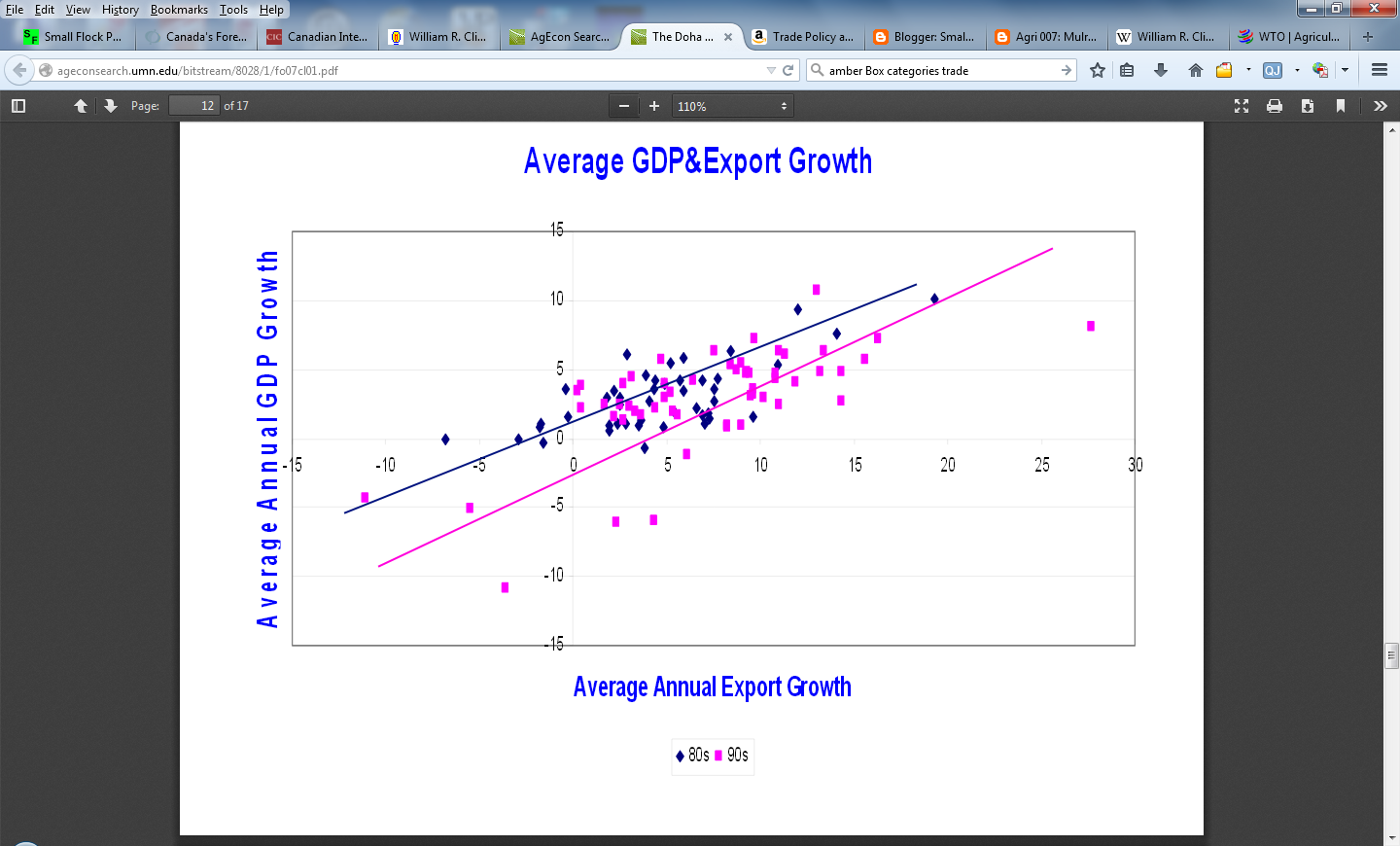
  3. Figure 1:  Mr. Cline's datapoints showing the correlation
    between a developing country's GDP vs. the growth in
    their exports.  The lines were added by me.

  4. In developing countries, data from the 1980's and 1990's suggest that as their exports grow, local GDP grows also.  See Figure 1.

  5. That boost to the economies of developing nations via free trade could be as much as $200 Billion per year.  Half of that boost would be from free trade for agricultural commodities.  The other major sectors for boosting their economies would be from exporting textiles and apparel.

  6. Global free trade would raise the GDP by 1.5% to 2% directly.  The dynamic (ie. spin-off) effects would more than double the direct effect, so the total effect (ie. both direct and indirect) would be more than 4%.

  7. While the average effect on people would be 4%, the poorest of the poor are estimated to receive the biggest impact of free trade, estimated by Mr. Cline to be double of the average effect (ie. 8% for the Poor vs. 4% on average for all citizens in a developing country).

  8. In Mr. Cline's 2007 paper to a USDA conference, he states:   "...the broad empirical relationship between poverty and income shows that the “poverty elasticity” – the percent by which the number of poor declines for a 1 percent rise in their income– is about 2. So multiply once again by 2 and you get a total of 16 percent reduction in the number of poor. Apply that to 300 million [sic, appear he meant 3 Billion] in poverty and you get about 500 million reduction in global poverty."  Therefore, Mr. Cline concludes that free trade would raise the income of Poor people sufficiently to remove 500 million people from the poorest category (ie. earn $2.00/day or less).

  9. Free trade for agriculture is essential to achieving these positive effects for the world's poor.  See Figure 2.  WTO defines ag. subsidies as colour-coded boxes, similar to traffic light colours (red= prohibited, amber= caution or subsidies that are to be reduced, green= OK in unlimited quantities, plus blue=amber with conditions that limit the quantities that farmers can produce.  The protectionism of Japan's farmers is legendary, estimated to be equivalent to an 82.1% import tariff when you count true tariffs (76.4%) and domestic subsidies (3.2%).  Canada is the 2nd worst villain in ag. tariffs and subsidies at 52.3%.  The EU is 46.4%, and the US is just 19.9%.  The weighted average for all industrialized nations is 36%.  No wonder Canada is in such huge trouble in trade talks with the US, EU, TPP, and WTO; we're 45% higher in ag. trade barriers than the world average for industrialized nations.

  10. Figure 2:   Mr. Cline's estimates of barriers to free
    trade in agricultural.  Japan is seen as the worst, with a
    total of 82.1% tariff-equivalent import barrier, with Canada
    in 2nd place of this Rogue's Gallery at 52.3% tariff-
    equivalent barrier to ag. imports from developing nations.
So that is Mr. Cline's theory in a nutshell.  I assume that is what was being referred to in the story about Mr. Mulroney's call for the end of SM when it said removing ag. subsidies and protectionism would have a greater effect than foreign aid.

In 2012, Canada spent $5.67 Billion on foreign aid according to CIDA's data, which is stingy when compared to our relative wealth and the aid by other OECD nations.  About 69% of Canada’s aid in 2012 was channeled through the Canadian International Development Agency (CIDA), 9% through Finance Canada, and 8.2% through the Department of Foreign Affairs and International Trade, while the International Development Research Center (IDRC) accounts for 3.5%.  About 33.4% of that aid went to Least Developed (or poorest) Countries, another 2.5% went to other Low Income Countries, and 16.8% went to Lower Middle Income countries (41% is not coded by income group). Africa received the highest share at almost 42%, followed by Asia (22%), and the Americas (17%).  Following nearly a decade of sustained increases, Canada's aid spending has stalled and is set to decline in the coming years.
About 69% of Canada’s aid in 2012 was channeled through the Canadian International Development Agency (CIDA), about 9% through Finance Canada and 8.2% through the Department of Foreign Affairs and International Trade, while the International Development Research Center (IDRC) accounts for 3.5%. - See more at: http://cidpnsi.ca/blog/portfolio/canadas-foreign-aid/#sthash.5R7LsQkW.dpuf

As a Small Flocker in Canada, there are a few issues of which I am concerned.

First, I have seen the jars of pickles on my local grocery store shelves that have been imported from India.  I have eaten some of those pickles, as they are significantly cheaper than N. American pickles and seem to have reasonable quality.  I also fret about "what is this world coming to" when Canadian pickle producers have permanently shut their doors, and we are now forced to import from elsewhere.  I assume I would feel equally conflicted about SM products of dairy, chicken, and eggs being imported into Canada at the expense of domestic production.

Secondly, the quality of N. American chicken is a disaster, with bacterial contamination (including superbugs), bad Omega-3 to Omega-6 fatty acid ratios, bad bird welfare habitats, etc.  I assume that 2nd and 3rd world imports might be significantly worse; witness the recent news reports of falsified species in fish imported from South-East Asia, melamine tainted milk in China, and many similar events. As an example of a disaster going someplace to happen, live US chicken was proposed to be exported to China, slaughtered in China, processed and further processed in China to create boxed chicken, then import those packaged chicken products back into the US with no review whatsoever of that entire international supply chain by USDA inspectors (see Blog posting COOL Blowback ).  Canadians need higher quality products, not lower.  Can we be assured of this quality if we are importing SM replacement products from the developing world?

Thirdly, I am cautious of Free Traders and others who pretend to be helping the poor, when in reality they are propaganda shills for Big Ag., the PTB ("Powers That Be"), the NWO ("New World Order"), and the 0.01%'ers.  Exactly who is this Mr. Cline?  CIC (Canadian International Council) seems to support Mr. Cline's research.  Is Mr. Cline a master manipulator, or a straight arrow?  For me, it's too soon to tell, but I am wary about trusting too quickly.

Fourthly, if SM will not yield any ground to domestic Small Flockers, I assume that international small flockers don't have a chance.  I would assume that the poorest of the poor would be small flockers in chicken, and small market gardeners in fruits and vegetables.

Fifthly, if WTO, TPP, and EU trade talks achieve agricultural free trade by some miracle, how long before Big Ag. moves in to their third world countries where they create a monopoly for themselves via unfair or predatory trade practices so as to steal the free trade opportunities away from those who need them most.

By slowly and carefully reducing Canada's import tariffs and subsidies to Canada's #ChickenMafia, I believe that would be beneficial to Canada's consumers and small flockers alike, and would eventually force Canada's #ChickenMafia to dramatically improve, or die.  However, is there a tariff level below which no Canadian chicken farmer can compete, and dropping import tariffs below this threshold will surely kill all the #ChickenMafia, and possibly even Canada's small flockers?  If yes, what is that critical tariff level?

A lot of questions, conflicts, and inconsistencies currently exist inside of me on these SM trade issues.  I assume each of you has a similar list.  These are complex issues, and we need to get them right the first time.  That is exactly why those acting against the best interests of the majority purposefully cloud the issues so as to protect their special interests.

Hopefully with additional study by myself and other, the mud will settle and we can see clearly on the best path to take.


Saturday, November 22, 2014

COOL Blowback

COOL (Country Of Origination Labeling) has been a hot issue for Canadian pork being exported to the US.  What about chicken?

Consumers, both in US and Canada (and I assume the rest of the world), would like to know where their food comes from.  With the 100 mile diet, eat local, buy local, and xenophobia, there is considerable pressure to buy from local producers.  That is why Canadian pork producers object to having "Raised in Canada" being put on Canadian pork that is sold in US grocery stores.  Everybody realizes that would be the kiss of death for sales.  The meat will rot on grocery store shelves, rejected by US consumers.  Alternatively, US grocery stores would have to sell Canadian pork at deep discount pricing, so low it would drive Canadian pork exporters into bankruptcy.

Is this issue isolated to just Canadian pork?

No.  It also applies to both Canadian and US chicken.

China has been frozen out of many industries, but they want greater access to US markets for all of their products, including food.

US Food and Drug Administration ("FDA") has their hands full with lousy chicken quality produced by US growers, US abattoirs, and US processors.  They don't need the added risk and headaches from sketchy Chinese poultry producers.  If Chinese dairy producers were willing to adulterate milk and baby formula with toxic melamine, or thousands of dead pigs purposefully dumped into Chinese rivers, what would you expect to occur if they could export Chinese chicken to the US?

But the Chinese kept pushing their agenda.

Finally a compromise was reached. IN Sept. 2013, Economy In Crisis Blog reported with outrage that Chinese abattoirs would be allowed to buy US grown chickens, eviscerate them, cook the meat, package it, and export it back to the US for sale in US grocery stores.  The package would say "Made In USA", likely due to COOL regulations.  That would allow retailers to hock this US chicken processed in China as 100% bona fide Star Spangled Banner home grown chicken to an unsuspecting public.

US farmers were likely in favor as it gave them additional production, and the Chinese buyers would likely pay a premium to get the necessary chicken supply.

As an interesting sidebar, FDA only has sufficient resources to inspect 2% of the imported chicken.  In the US, 60% of imported food comes from developing nations.  It isn't just snooty and fancy mustards from France that are being imported into the US.  Just like in Canada, when half century old canning factories in Canada are shut down so that we can buy pickles imported from India.

USDA inspectors regularly come to Canada to make sure Canadian foot exporters and CFIA are both doing their job of ensuring safe food is being exported to the US.

However, there are no plans for USDA inspectors to ensure the quality or safety of this chicken processed in China.

Should Canadians jump on this opportunity, saying "Americans are spooked by Chinese chicken.  We believe American would be much more comfortable with US chickens processed in Canada then re-exported back to the US.  Canadians will build the extra slaughter capacity that's necessary to meet this marketing and exporting opportunity.

Would Canadians be ready to unknowingly accept Canadian chicken that was processed in China, but the retail meat counter label on the packages hides that fact?

For all we know, CFIA may have already cut that deal with China and its exporting allies.

Where does this place Small Flockers within this boiling kettle of politics and chicken broth?

How is it cheaper and better to ship chicken all the way around the globe before humans eat it?

Obviously this well traveled chicken will only occur if someone is making more money doing things the crazy way.

Can we not find a solution that will allow the underutilized Small Flockers to spread their wings and fly?


Wednesday, February 5, 2014

Canadian Feed Mills

There was an interesting post on Better Farming's website yesterday:

Thank SM for the feed mills we have!

Lets face it, without Supply Management there wouldn't be near the number of feed mills we have.
They cater to the people that pay their bills, its that simple!

Sorry, but I couldn't let that stand without a response.  Here is my response:

If I understand your comments, you seem to feel there would be fewer feed mills if we didn't have SM (Supply Management). Please explain your logic in the greatest of details.
Based on research that I have done (most on chickens, some on eggs, a tiny bit on other SM commodities), which is fully described on SFPFC's Blog, Canada has only 1.4% of the international chicken market for OECD nations. The US exports about 18% of its chicken, but SM holds us back from exporting much of anything.
Our Canadian domestic prices for chicken are 2 to 3 times higher than prices in the international market. Virtually nobody would buy our Canadian chicken exports at the price that Canadians are forced to buy them at.
If Canadian SM producers were to drop their prices to match the prices of our international competitors, we could gain significant market share on the international markets. However selling internationally at prices that are half to one third of domestic prices is the definition of "dumping" which is illegal under NAFTA and WTO and GATT and other trade agreements.
If SM didn't exist, Canadians would likely pay a lot less for their SM products, as I doubt the rest of the world would suddenly start charging 3 times more so as to match crazy Canadian prices.
If we worked hard, we would eventually regain our competitiveness in SM products (ie. in the next 20 years, for we are close to invalids in SM products today, compared to the rest of the world).
Once we regained our competitiveness, continued hard work could eventually earn us up to 50% market share for SM products in OECD international markets.
With 50% OECD international market share, we would have to raise 5 times more chicken than what we currently raise in Canada today.
If we raised 5 times more chicken in Canada, I would assume there would be logic in having that huge extra demand for chicken feed produced in Canada, close to the source of the input crops, or close to the end user of the feed produced. That would mean a significant increase in operating capacity of current feed mills in Canada, or the building of many new feed mills, perhaps up to 5 times more than what exist today.
Therefore it would seem that SM has killed off up to 80% of the feed mills that would have been built (or continued to exist) than under a non-SM system.
Oilseed and grain farming is the largest farming income producer in Canada, about 32% of the total farming income for Canada. That's big GDP for Canada. I think these grain+oilseed farmers would welcome the opportunity to grow and sell 5 times more grain, if they could. Unfortunately, SM will never allow that opportunity to be realized. SM farmers have a death grip on the throats of most other farmers.
If you (or others) have other facts and logic to support your prior statement, please share it with all of us so we can learn and better understand.
If you don't supply your logic, I believe it is fair to assume that you accept the above data and logic, and have retracted your prior statement.
Glenn Black
Small Flock Poultry Farmers of Canada

We'll have to wait and see if we get any response, or additional facts that support alternative viewpoints.

Thursday, December 19, 2013

Question for Ontario Premier & Agriculture Minister Kathleen Wynne


I understand that Ontario's Premier Wynne will be doing a call-in Q&A session on CBC Radio – Sudbury on Thursday Dec. 19th, 2013.  I respectfully request consideration of the following question to be put to Premier Wynne at that time.

If this question doesn't make it to air on CBC Radio, perhaps Premier Wynne would like to send an answer to Small Flockers on her own initiative.  Alternatively, some aware and inquisitive MPP might stand at Queens Park and ask the government this question.

Question
             As Agriculture Minister, on Oct. 7th you called for the doubling of agri-food exports from Ontario, thereby creating 120,000 new jobs before 2020.  Do you expect Ontario’s Supply Management chicken sector to support and participate in achieving that goal?


Follow-up Question

Domestic chicken prices are more than twice the price of chicken on the international export markets.  If Canada was to export significant quantities of chicken, we’d find no buyers at our sky-high domestic prices, or we would soon be slapped with WTO trade complaints for dumping chicken on the international market that was priced significantly lower than our domestic prices.  This would seem to explain why Canada only has 1.4% market share for OECD chicken exports.  If Canada was to gain just 50% OECD market share, Canada would have to produce 5 times more chicken than what we do today.  It is estimated that Ontario’s share of that would be $10.8 Billion per year of additional economic activity.

Premier, would you support the lowering of the price charged to Canadians for chicken, thereby helping Canadians with more affordable food, while simultaneously enabling up to $10.8 Billion per year of additional economic activity and many new jobs for Ontario?


Background Facts
  1. Health Canada reports that 7.6% of Canadians cannot afford the food they need to feed their families.  Ontario is 8.2%, which is 11% worse than the Canadian average.  The local foodbank near my home reports, like many other foodbanks in Ontario, that usage of their services is climbing at over 20% per year for the last 3 years.  I conclude there is a greater & greater need for affordable food in Ontario.
  2. Remote and rural communities in the North, and many others need the affordable food and local jobs produced by locally grown chicken.  Unfortunately, there are just 1,114 Supply Management chicken producers, all in Southern Ontario.  There are about 13,500 small flock chicken farmers throughout Ontario, but they are prevented or severely restricted in supplying affordable chicken for their local communities.
  3. Canadians in general, including us in Ontario, currently pay between 200% to 300% more for chicken, as compared to US prices (depending on the cut & the store & time of year).  The Chicken Farmers of Ontario have continuously raised the price of chicken by 3.54% per year for more than 17 years.  Historically, chicken was the "Meat for the Masses" (ie. the cheapest meat available on a $/kg basis), but is now double the price of turkey.    These price increases have been a severe burden on Ontario citizens.
  4. The Chicken Farmers of Ontario ("CFO") used trickery and lack of regulatory oversight to over-charge Ontario citizens with a bogus FCR (Feed Conversion Ratio), which inflated their alleged costs to raise chickens, thereby gaining more than their "reasonable costs".  This resulted in excess charges to Canadians of about $1 Billion per year for more than 10 years, for a total of more than $10 Billion that was unjustly charged to Canadians.  After years of complaints by numerous victims, the Ontario government finally ordered CFO to reduce their bogus FCR by 16.3% as of August 2013.  Do the Supply Management chicken farmers get to keep their ill gotten gains of $10 Billion they took from Canadians?
  5. As food becomes less and less affordable, people compensate by buying cheaper, less nutritious foods; usually higher in carbohydrates.  Poor nutrition causes or contributes to many of the health epidemics that we have today, such as obesity, diabetes, rheumatoid arthritis, cardiovascular disease, liver dysfunction, Alzheimer's, Metabolic Syndrome, stroke, cancer, etc.
  6. The Supply Management system condones & supports the regular feeding of antibiotics and other drugs to chickens as growth promoters, not because the chickens are sick, nor to keep them healthy, but so they can earn extra profits.  These drugs & chemicals significantly alter the birds health, metabolism, and the resulting nutritional profile of the resulting meat.
  7. The current Supply Management system produces chicken such that 30% to 80% of the raw chicken being sold at grocery store meat counters is contaminated with deadly pathogens (eg. E.Coli, campylobacter, listeria, salmonella, etc.) , some of which are superbugs with antibiotic resistance due to the Supply Management's bad habit of regularly feeding chickens antibiotics, contrary to Health Canada recommendations.
  8. The insiders of the Supply Management system have had ongoing arguments amongst themselves (ie. province to province, producer to processor, processor to processor, etc.), and even the insiders say the system is significantly flawed and dysfunctional.  Ontario has been repeatedly denied the right to produce adequate amounts of chicken to feed our Ontario citizens and Ontario chicken processing businesses.  Alberta has given up and is abandoning the chicken Supply Management system as of Dec. 31, 2013 unless a "Hail Mary" rescue can be achieved in the next few weeks.
  9. Today, there is little to no Canadian chicken exported; neither from Ontario nor the rest of Canada.  Canada has only 1.4% market share of OECD chicken exports.  The reason is that the high domestic prices make it uneconomical for other countries to purchase the chicken at Canadian domestic prices, and to lower the price for Canadian export chicken invites other countries to lodge WTO complaints against Canada dumping chicken on international markets (ie. export pricing lower than domestic pricing is defined as "dumping" under WTO rules).  Alternatively, if we lowered Canadian chicken prices, we could export, and in exporting we could go from 1.4% market share to maybe as much as 50% OECD market share.  At 50% market share, that means Canada could then grow 5 times more chicken than what we do today.  Since Ontario has about 1/3 of the Canadian production, this would mean an additional $10.5 Billion of GDP for Ontario, and thousands of additional, permanent, good paying jobs.
  10. The Chicken Supply Management system isn't interested in exporting because that's too much like work.  They're happy with their 99.97% domestic market share at 200% to 300% gouging pricing that most people in Ontario are forced to pay, or go without chicken (ie. Hobson's Choice   http://en.wikipedia.org/wiki/Hobson%27s_choice ).

All of the above is based upon, and supported by the objective evidence presented on our Blog http://canadiansmallflockers.blogspot.ca

Glenn Black
President
Small Flock Poultry Farmers of Canada
(705)-377-4039
cdn.small.flockers@gmail.com

Friday, October 11, 2013

Pharaoh Kathleen Wynne: Let my people go!

Vision and Dreams: "I dream of a better tomorrow, where chickens can cross roads, and not have their motives questioned.
Ontario's Premier and Agriculture Minister Kathleen Wynne has challenged Ontario's agriculture, food, and beverage sector to double its agri-foods exports by 2020.

Her government's press release notes that the agri-food sector has grown by a little more than 10% since 2002.  In 11 years, that's an average annual growth rate of 0.87% per year.

That's pretty weak performance, I'd say.  However, we have to admit that 6 of those years were through one of the biggest economic shocks since the Great Depression in the 1930's.

If we are going to double again between now and 2020, just 7 years from now, that would be an average growth rate of 10.41% per year.

Interesting!

China, the world's greatest exporter, and their historic
GDP quarterly growth, 2007 - 2013
The graph at the right from Trading Economics shows what China achieved in their GDP annualized quarterly growth rate.  As most people know, China has been one of the world's most powerful exporters in the last decade.

China's arithmetical average GDP growth over this period was 9.08%/yr, and the geometric average (probably a more useful statistic than the simple arithmetical average) was 8.96%/yr.

After recovering from the world-wide Great Recession in 2007, China had its very best GDP growth of 11.9% during Q2 of 2010.

Realize also that these results were produced only because China's government was laser beam focused on manufacturing and exporting, regardless of the environmental, health, safety, or social risks that this focus may have caused.

So our Premier wants us  to achieve growth in exports equal or better than the world records set by China when the world economy was booming.  Very interesting!

Growth is always a risky period for a business, as you have significantly higher costs for months or years, and you have to hope and pray that that huge investment in money and people can be recouped before something changes.

What happens if an ag-food business decides to take on this challenge for the good of Ontario, and the government changes its mind half way towards the goal, or a new government is elected and the policy changes?  You would be left high and dry, and nobody would come to rescue you.

Under the Green Energy Act, people got a guaranteed, no cut contract for 20 years, and about a 12% return on their investment.  What is the ag-food sector being offered?

Ontario's Premier has proposed this challenge to the ag-food industry, but it seems she neither offered nor provided any resources or plan with which to accomplish this challenging goal.

Just how dumb does she think farmers are?

However, for the sake of politeness, we will set aside for the moment any concerns about the advisability of this goal, or the potential of creating a severe overbuild of ag-food capacity (just like the Ontario government created in their electrical energy production system via the rapid priority shift via the Green Energy Act), or the social costs, or the inefficiencies created by last minute 90 degree turns in government policy.

In the interest of helping and supporting the Premier's goal, Small Flockers would like to offer a suggestion to the Premier of Ontario:
Pharaoh Kathleen Wynne,
Premier for the Province of Ontario, Canada

Pharaoh Wynne:   Let my people go!


I don't want the job of Moses leading his people out of Egypt from the oppression of the cruel Pharaoh, but neither did Moses when God called him to the task. Unlike Moses, I didn't even get the call.

However in Jan. 2012, I became concerned about some of the government policies and actions affecting small flock farmers, so I spoke up and asked for changes. Since then, I've learned that it's far worse than the relatively small issues that got me started on this quest. Now, as I learn more and more, I'm becoming more and more pissed off at all the craziness that has been going on for decades.

In a previous Blog posting, I suggested that the current Supply Management system be re-directed to focus on exports, and small flockers need to be freed up to supply the local domestic market in Ontario.

Today, Ontario has a debt of $252 Billion.  We pay $10.6 Billion per year in interest on that debt, rising at 5.5% per year.  Debt interest is now the 3rd. largest item on the provincial budget.

Enabling Ontario's small flockers can provide a significant part of the necessary hope and plan for getting Ontario the extra jobs it needs, the economic stability to get the huge provincial debt paid down, and eliminate Ontario's $9.2 Billion/yr deficit.

Small flockers have been badly wounded by severe wing clipping done to us by the Government and the Chicken Mafia over the past 3 decades. I believe there is still a spark within Ontario's small flockers that can be fanned and nurtured back into a vibrant roaring fire to warm Ontario's economy.

Let my people go, Pharaoh Wynne! Let us help you to help all of Ontario. Let small flockers supply safe, nutritious, affordable, locally grown poultry meats and eggs for our family, friends, and neighbours.

Small Flockers have suffered decades
of abuse at the hands of these two
co-conspirators
As an example, let's look at what Ontario has already done to create province-wide freedom.  In April 2008, Ontario used the Green Energy Act to pass Regulation 97/08 which now prohibits the banning of clotheslines for the drying of laundry by most building owners, condominiums, subdivision land covenants, or municipal bylaw. That broke 50 years of wrong-headed precedence to look "pretty" in spite of the cost and rights violations that had slowly creped into our society.

Ontario should now do a similar regulatory rationalization and standardization across Ontario for backyard poultry, in both municipal and rural areas.

Small Flockers suggest that if  municipalities insist on continuing restrictions for backyard poultry, then the municipality must show cause for any restrictions it imposes (ie. the burden of proof that the restrictions are necessary rests on the municipality), and those restrictions would have to be renewed every 5 years or they would automatically terminate.

For farmers, the Chicken Mafia and the Government need to release their death grip on the throats of small flock poultry farmers.

Small Flockers are currently prohibited from raising more than 300 birds per year.  That limit needs to be immediately raised to 2,000 chickens per year without quota.

The government must also relax the Meat Regulations so that on-farm poultry processing can occur in a safe manner; especially in remote and under serviced areas where there is no local government-approved abattoir that does custom processing.

Premier, let my people go, and you might be surprised at how close you come to your ag. doubling goal by 2020.
Paul Robeson (1898 - 1976), African-American
  Lawyer, Actor, All-American
Football Player,Social Activist, and Singer.

Oh! Let My People Go

The Lord, by Moses, to Pharaoh said:
Oh! let my people go.

If not, I'll smite your first-born dead—
Oh! let my people go.

Oh! go down, Moses,
Away down to Egypt's land,
And tell King Pharaoh
To let my people go.


Monday, June 3, 2013

Meat Regs: More at stake than meat

Ontario Ministry of Agriculture and Food ("OMAF") is reviewing their Meat Regulations.  When they held public information meetings on their proposed changes, I attended the Sudbury meeting.  See my previous report after their public information meeting.

I finally finished it and filed Small Flocker's recommendations and comments with OMAF. Small Flocker's comments and recommended improvements on Ontario's current Meat Regulations are available here

Some of the issues I raised are as follows:

Food Borne Illness Outbreaks
Food borne illness in the US is estimated at $77.7 Billion per year.  We might therefore estimate Canada's impact at $7.77 Billion per year, 10% of US total.  Similarly based on US results from CDC, Canadian food borne illness outbreaks (ie. many individuals over a large area affected) from meats and poultry (ie. excludes fish & seafood) probably account for 22% (n=210,000) of the outbreaks, 22% (n= 572) of the resulting hospitalizations, and 29% (n=18) of the deaths.

Sporadic Food Poisoning
Add to the outbreaks described above are the sporadic food borne illnesses (1 or a few people, closely contained). More than 9 million persons each year in the USA have a food borne illness caused by a major pathogen, so Canada probably has 900,000 sporadic illnesses per year.

Poor Diet due to high cost of Meat
There is growing understanding by food nutrition experts  that excess dietary carbohydrates are causing or contributing to significant incidence and prevalence of multiple diseases such as obesity, diabetes, Alzheimer’s, arthritis, metabolic syndrome, cardiovascular disease, high blood pressure, cancer, etc.  See Dr. Lustig here and here, Gary Taubes here, and Dr. Jay Wortman here and CBC Television Documentary here

Health care is more than 40% of Ontario’s Provincial budget, and these dietary influenced diseases are directly and indirectly related to most of these health care costs, possibly up to 70% of these direct and indirect health care costs (ie. 70% of 40%, or a grand total of 28% of Ontario’s budget caused by poor diet).  Ontario’s 2013-2014 budget for healthcare is $48.9 Billion per year.  This total diet-related tax burden is suggested as 70% of this total annual budget, representing $34.23 Billion per year, a significant cost to Ontario.  The cost of food borne illness can be added as well, further raising the stakes.

I suggest that this $34.23+ Billion health care cost trumps the total value-added GDP of $8 Billion per year that is created by Ontario’s meat industry.

If meat protein and the accompanying animal fat is more affordable and available, this can help reduce these food-induced risks and disease burden for Ontario.

When considering the Meat Regulation amendments and these specific recommendation, it is suggested that this indirect cost to Ontario of $34.23 Billion per year be kept in mind.

Meat Export Opportunities
I previously posted about the appalling, weak-kneed meat export business Canada has for chicken.  In 2012, CFC reported that Canada produced 1.0247 Billion kg of chicken, at a price of $1.80/kg or higher.  We calculate a total value of $1.844 Billion.  If OECD exports can allow us to increase our production 5 times 2012 levels, that's an additional $7.378 Billion in GDP for Canada.  Ontario's share would be about 1/3 of this, or $2.46 Billion.  Assuming a 3:1 spin-off effect, that is a total of $7.378 Billion of additional business for Ontario.

Grand Total

When we add up all the above, we get a grand total in excess of $41.61 Billion per year that is directly affected by this Meat Regulation revision process.  I hope OMAF gives it the attention it deserves.

There is more at stake than just meat.

Monday, March 18, 2013

Magical Trucks of Chicken

Since starting this Blog 18 days ago, I've been receiving a number of interesting phone calls and emails.  Most of the people who called wanted to remain anonymous, and once they explained the purpose of contacting me, I understood the reason for the secrecy.

They were intrigued with all that I wrote so far on the Blog, but wondered when I was going to get down to the real juicy stuff.

"What might that be", I asked.

"The magical chicken trucks", they said.

I was confused, so I asked them to explain.

They said that they used to work in one of the slaughter plants.  Every once and a while, they would load a truck with eviscerated chickens that was supposed to be exported from Canada, but it never crossed the US-Canadian border.  It went somewhere else.  Nobody on the plant floor knew where it went, except that it didn't go export like it was supposed to.

"It was a magical chicken truck", they repeated.

After asking some more questions, my light bulb finally went on.  You see, eviscerated chicken all looks the same, it's not traceable except by the paper that accompanies the chicken.  One truckload of chicken looks the same as the next; they're indistinguishable.

It appears that live chicken had been imported from the US for Canadian processing, and they were supposed to be re-exported as eviscerated chicken meat to some foreign country.  However, those chickens never left Canada.  By claiming to import for subsequent re-exporting, the processor escapes paying the 300% import tariff.  When the magical chicken truck is used, the chicken appears to leave Canada (but don't), and then the processor was free to sell the resulting meat in Canada at 3 times the selling price available in export markets.  Not a bad profit margin, if you can get away with it.

After all, it's easy for a magician to make a magical chicken truck disappear here and re-appear over there.   

Another person contacted me to say that they drove long haul reefer truck, often for chicken slaughter plants exporting to the States.  Sometimes they would have a load that they took to the States that would have some paper problems.  It appears that 2 or more slaughter plants were claiming the same truck as their own shipment, so that it would go towards their export quota license.

You get awarded quota for export, then claim that you exported as you were supposed to do (but never really export those chickens).  You then have an extra truckload of chicken in Canada that you can sell in the high priced Canadian chicken market.  That sounds like a nice way to make some quick cash, provided you can get away with it.

I understand that both Chicken Farmers of Ontario (CFO) and Chicken Farmers of Canada (CFC) are supposed to be monitoring the chicken supply management system, and ensuring that the rules are followed by everybody.

Whatever you do, make sure you don't wake up CFO or CFC to tell them about the magical chicken trucks.  They're trying to sleep.

Wednesday, March 13, 2013

Why Not Export Canadian Chicken?

Note:   This posting is expanded from the response I gave for a comment posted in "Bogus FCR takes $945 Million per year from Canadians".

There are many Canadians who believe that US chicken is terrible, as compared to Canadian chicken. I'm not so sure.

In 2011, Canada imported 159 million kg of chicken, most of it from good 'ol USA (74%), followed by Brazil, Thailand, Chili, and Israel.  If the difference between US and Canadian chicken was so great, people would pick the better ones, and leave the rest to rot on the meat counter.

For example, back in the 1970's Sony Trinitron colour TV's were manufactured in both Japan and California, both to the exact same specifications.  While the technical specs were the same, the California TV's had a varying level of quality, while those made in Japan were virtually identical to each other.  The retail stores in N. America tried to sell TV's from both California and Japan, side by side on the showroom floor.  The customers could distinguish the difference, and would only buy the Japanese version. As long as one TV from Japan was available for comparison, no California TV's got sold.

Small Flock Poultry Farmers believe that Canada should be self-sufficient in supplying chicken for ourselves. We also believe that we should be exporting our Canadian chicken everywhere in the world.

Unfortunately, Canada is a very poor chicken exporter. Of the 7 top OECD chicken exporters in the world, Canada exports just 1.42% of the total exports for these 7 countries, putting us in last place for these 7 countries.

What's stopping Canada from being #1? To me, it seems the the chicken processors are quite happy raping the Canadian public, and are so comfortable in the fat profits derived from this, they have no hunger or interest to look farther afield.

This world-market stuff scares a lot of people.  Once you grow the birds, they have to go to slaughter, or you get stuck with having to continue feeding them.  If you slaughter them after losing your customer, the fresh meat has a limited storage life. If you freeze your surplus product, you have to pay on-going storage costs, and it still has a shelf life limit.  If you don't find a replacement customer with 1 to 3 months, CFC (Chicken Farmers of Canada) will fine you for failing to export per your export license.   Since prospective buyers know all this, and can use it to their advantage, this enables them to back the farmer and/or processor into a corner, refusing to buy unless they drop their price.

This is the same as in the auto industry when we compare GM to Toyota.  GM is notorious for "channel stuffing".  GM has no confirmed sales, but they make the cars anyway, then twist the arms of their dealers to buy the cars, pay interest on the money they borrow to buy the cars, so that the unwanted cars sit on the dealers' lots while they slowly rust.  At the end of the year, it's a fire sale to get rid of the cars.

Alternatively, Toyota only makes a car when a dealership has ordered that car, usually for a specific customer, and then makes the car exactly as the customer has ordered.  No arm twisting required.  No channel stuffing.

For chicken, we can learn from Toyota.  Chicks are ordered only when a confirmed export order for a specific customer has been received, and that customer has provided an irrevocable letter of credit from your friendly neighbourhood bankster.  In this way, when the birds are ready 8 weeks later, whether the customer takes them or not, payment to the farmer is guaranteed by the bank.  That way, the exporter is always protected.  If there are no export orders, then you don't order chicks, or you do some domestic production.

WTO (World Trade Organization) rules forbid a country to do predatory dumping of any product in a foreign market.  That is usually defined as selling the product for a lower price than what is charged domestically.  Since Canada has the world's highest domestic prices for chicken, there isn't one country in the world that Canada can ship to without being subject to a charge of predatory dumping of chicken, illegal under WTO rules.  If Canadians were allowed to purchase chicken at the world price (about half of today's prices in Canada), we could ship to every country in the world without a worry of be accused of dumping.

For another example, look at Canadian wines.  With few exceptions, Canada historically produced only garbage wines (ie. Baby Duck).  However, Canada quickly went from one of the worst to one of the best for our Canadian wine industry after we signed the Free Trade deal with the US.  We were forced to, and the wine industry responded. I believe we can do the same for chicken, if given half a chance.

In 2011, Canada exported 123.4 Million kg of chicken, about 12% of the kg of domestic chicken production; in other words, a paltry after thought.  I believe we can do far better than that.  Why can't Canada grab 50% of the world's export markets?  That would be 4.43 Billion kg of eviscerated chicken exported per year, a little more than what Brazil did in 2011.  If Brazil can do it, why not Canada?  If Canadians consumed 1.07 Billion kg., and we exported 4.43 Billion kg, then Canadian farmers would have to produce a total of 5.5 Billion kg., which is 5.4 times more chicken than what Canada currently produces.  Either we get 5,400 more people to become quota-bearing chicken farmers, or all the current farmers are given 5.4 times the quota they currently have, or some combination in between.  What's wrong with that?
 
Transitioning from our current supply management system towards something better will not be easy.  The Canadian Supply Management System has allowed us to be "fat dumb & happy" for a very long time.  Compared to other countries, Canadian farmers and processors have lost our competitive edge long ago.  For example, New Zealand chicken farmers have a FCR (Feed Conversion Ratio) as low as 1.38 while Ontario chicken farmers have an FCR around 1.82 which is 31.9% worse than world-class.  Since feed costs are about 60% of the total live chicken price, the poor Canadian FCR raises our live bird price by 19.14%.  No wonder Canadian prices are so high.

It takes years, if not decades to get an FCR optimized to be the best in the world.  I have reservations about going down this road due to the impact on the bird's health, and the resulting nutrition level of the meat coming from an "optimized" chicken, but that is what has been going on in the rest of the world.

What would happen if we threw in the towel for chicken supply management?  The rest of the world did that decades ago.  Canada is the only country in the world with a supply management system.  Exactly what do we think Canadians know that the rest of the world is clueless about, so as to explain that we are the only ones left with a Supply Management system?

When New Zealand gave up supply management for their dairy business, they were a insignificant speck on the world's dairy scene. It took 6 long years to rebuild their dairy industry.  Curing their "fat dumb happy" slovenly habits wasn't easy.  Decades of neglect came home to roost in a very short transition period of just 6 years.  After that 6 years in purgatory, the New Zealand dairy industry took off, and is now the #1 dairy product exporter in the world. They learned their lessons the hard way.

Of course, New Zealanders now pay world prices for dairy products, rather than the government tax subsidized prices previously enjoyed. Don't be fooled, for what citizens saved in their left-hand pocket, was pick pocketed out of their right-hand pocket, plus a little extra.  I would suggest that every time any government touches something, they add a significant overhead cost. For a government to tax the public, then send some of those tax dollars back to the dairy industry to subsidize the cost of dairy products, this government bureaucracy adds additional costs above what would be the world-priced products.

When governments use general tax revenues to subsidize dairy products, everybody pays, even those who hate dairy, or are allergic to dairy.  How could that be fair?  Isn't "User Pay" better and more fair?  While I don't have the stats to prove it, it is suggested that the subsidized dairy price previously paid by consumers plus the per capita tax burden required to generate the government subsidy would exceed the non-subsidized dairy prices that are paid on the world markets.

Since the end of New Zealand supply management for dairy, there has been significant consolidations of the New Zealand dairy industry. That is usually not good. In a stable competitive market, there are usually only 3 significant competitors. I suggest that governments must prevent excess consolidation (ie. mergers and acquisitions) by anti-monopoly (anti-trust) legislation such as Canada's Competition Act.

Canada first passed their anti-trust legislation in 1889, one year before the US passed the Sherman Act, the US equivalent. See  a summary of Canada's Competition Act for more info.

We initially learned back in the 1600's that monopolies are bad policy, and need to be avoided like the plague. Unfortunately, sometimes we forget this, and have to re-learn our lessons, just like the current Supply Management System issues we face today.

Thursday, February 28, 2013

Chicken Price Parity: Will it Ever Come?

Canadians needs to be patient. Our chicken prices will be on par with US retail prices in just 22.7 more years.  Here is the price trend for Canadian chicken at Canadian retail stores.

You might wonder how I figured we only have to wait for one more generation before we have affordable chicken in Canada.

Here's the chicken pricing for good 'ol USA.

 Data Source: http://www.ers.usda.gov/data-products/meat-price-spreads.aspx

For more than 22 years, the US broiler chicken composite markup between wholesale and retail prices (ie. the green line in the above graph) has run at a steady 40.2% (ie. WholesalePrice/RetailPrice= 0.402). This 40.2% is the profit & expenses of wholesale distributors. Composite price is a weighted price based on relative fraction of weight sold for the various cuts or whole chicken.

Chicken prices in USA for both retail (red line) and wholesale (blue line) have been trending up at the same average inflation rate of 5.4% per year from 1990 to 2012.

On the Canadian side of the border, we get something totally different. Today, our Canadian average wholesale chicken prices in Canada are approximately twice the US wholesale price, and climbing.

Ouch!


 Source: http://www.cfo.on.ca/_pdfs/CFO-SM-Brochure-03.pdf

2014/10/06:   The above link was found broken.  CFO removed the incriminating evidence from their website.  Fortunately, I saved a copy which is still available here

The rate of wholesale price increase in Canada is approximately 2.6% per year vs. the 5.4% in the US. Canada.  With a higher chicken starting price but a lower chicken inflation rate in Canada,  this means the US prices will eventually match Canadian prices.

 If my math is correct, the US-Canada price gap will close around Feb. 8, 2035 (ie. 22.7 years from now).

Hold on, Canada, chicken price relief is coming. The day of chicken price parity with the USA will soon be here (in another 22.7 years).

The retail price increases for chicken seem out of control.  Below is the CFO's Chicken Consumer Price Index, showing rapid inflation of chicken at the retail grocery store (Ref: CFO-SM-Brochure-03.pdf, pg. 4)


Fortunately, Canadians are a very patient people. In the mean time (ie. the rest of my natural life), Canadians will have to do cross-border shopping if they want a good deal on chicken. Hopefully, the Canadian poor will be able to hitchhike to the US grocery stores and return with their affordable chicken.

Sooner or later, Canadians will have had their fill with price gouging on chicken.

 Source: http://www.georgemorris.org/uploads/userfiles/files/ccmr-july-2012.pdf

George Morris' data for May 2010 - May 2012 shows a steep collapse of chicken sales from Sept. 2011 to Mar. 2012, interpreted to mean that Canadian consumers were disgusted with excessive chicken prices, and closed their wallets. The sudden leap in sales for April 2012 was US chicken wings imported by retailers at excellent prices, so as to better serve Canadians.

This demonstrate that Canadians don't hold a grudge, as they are willing to quickly respond to reasonably priced chicken.