Ontario is trying to enhance its agri-food exports to help our limping and damaged economy. Will their plan work?
Better Farming reported that Ontario's Premier Kathleen Wynne has hired an Agri-food Trade Advisor to start June 1, 2015 to enhance agri-food exports from Ontario to China. This is supposed to help Ontario double its agri-food exports by 2020.
That would seem like an ideal reason for Ontario to hire an Agri-Food Trade Advisor in Beijing China.
Beef, other non-Supply Management commodities, Canadian technology and manufacturing seem like natural winners.
But what about Canada's Supply Management commodities of chicken, turkeys, eggs, and dairy?
Oops! Sorry, those are commodities with artificially high prices and whopping import tariffs of around 285% that Canadians are forced to pay. Under World Trade Organization treaties that Canada signed, exporting those Canadian SM commodities would be subject to illegal dumping charges if they are sold in export markets at prices lower than the prices paid by Canadian. That will likely lead to trade sanctions against Canada.
The Chinese aren't so stupid as to pay what Canadians are forced to pay every day; 50% to 300% higher prices for SM goods than what the rest of the world pays.
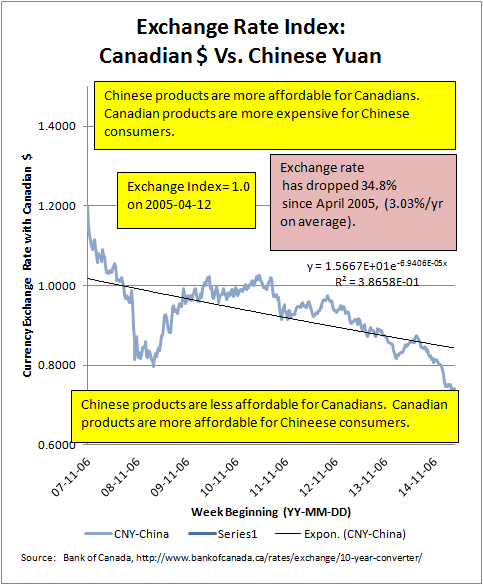
Since the foreign exchange improvements are only 34.8% in 10 years, that is equivalent to a 3.03% per year decrease on average over the last 10 years.
At that rate, it would take another 25.1 years to eliminate Canada's 285% import duty on SM products (ie. 1.0303^(25.1+10)= 2.85).
Perhaps Premier Kathleen Wynne should schedule a ribbon cutting ceremony with her Agri-Food Trade Advisor in Beijing China for a May 2040 launch of Ontario's SM products for China.
It's always good to plan ahead. You know how quickly everybody's schedule fills up.
Until then, too bad for Canada and its dysfunctional Supply Management systems. They hold all of us back from prosperity and Canadian jobs working in the export industry.
A blog to communicate, discuss, and advocate for the civil rights and important role Small Flock Poultry Farmers can play (and should play) in Canadian Society. Small Flockers are on the side of justice & truth, and against privilege & power. Unfortunately, the more we compromise with privilege and power, the more we reduce the capacity for truth and justice.
Showing posts with label WTO. Show all posts
Sunday, April 26, 2015
Wednesday, December 17, 2014
Lies and more Lies. Will SM ever tell the truth?
Dave Janzen, Chairperson of Chicken Farmers of Canada ("CFC"), did an Op-Ed piece in the Ottawa Citizen on July 8, 2014. It appears he was prompted by an opinion piece by Kate Heartfield of the Ottawa Citizen.
I have carefully read Kate's Op-Ed essay. I agree with everything she said.
However, Mr. Janzen's response is: "Don't chicken out on Supply Management". It seems he's afraid that both Kate's Op-Ed and the recent trade talks (TPP, EU, and others) are significant threats to the millionaire chicken farmers of Canada and their cozy feather bed called Supply Management ("SM"). Those threats prompted his Op-Ed response.
Maybe he's right about being under attack on two separate fronts, a dangerous position to be in.
Let's review what he said in defense of SM.
Mr. Janzen said "As a Canadian chicken farmer, I can assure her [Kate Heartfield] that supply management is alive and well and, frankly, should stay that way."
I agree that SM is alive, but is it "well"? I have documented issue after issue of brain dead flatlining by CFC and its provincial counterparts, and the terrible toll inflicted on consumers and Small Flock chicken farmers. It appears obvious that SM isn't well, it's dysfunctional. Yet the millionaire chicken farmers continue to deny, avoid, and resist. So sad.
Mr. Janzen said, "Supply management contributes more than $25 billion to Canada’s GDP every year, directly supporting more than 300,000 jobs, while ensuring robust growth for our fellow farmers in the livestock, oilseed and grain sectors."
I won't argue his statistics, but I do take exception to the invalid assumptions behind those statistics. SM is big, on that we agree. However, SM strangles the chicken industry in Canada by killing off any hope of significant chicken exports. If SM didn't exist tomorrow, the Canadian chicken market would increase significantly. Secondly, if SM didn't exist, or it let the non-SM system some freedom, those jobs and GDP would still continue, as Canadians would still want to buy and eat chicken. So how does Janzen take credit for jobs and GDP that will exist whether or not SM exists? That is a classic fallacious argument.
Janzen said, "For more than 40 years, this system has ensured the success of our country’s dairy and poultry industries by setting optimal production levels and ensuring fair returns for farmers."
It is almost 50 years that Canadian consumers have been chained to the wall in the SM dungeon. When do we get paroled? Murderers have shorter sentences than what we have to suffer. It's been so long, it more than meets the definition of cruel and unusual punishment.
Janzen says they set "optimal production levels". Check on CAMI Poultry in Burlington ON who can't get sufficient supply of chicken to meet the consumer's need for Hong Kong style chicken (see here, here, here, and here). Have you tried buying pastured poultry? Not available, except from a small flock farmer in the most part, but SM severely restrict small flockers from adequately serving this market. SM doesn't want that pastured poultry market, but they won't let anybody else have it either. That's greed and spite, through and through.
Janzen says "fair returns for farmers", but I have shown that his millionaire chicken farmer members got that way by gouging Canadians with bogus FCR charges for 10 years (see here), and premium profits, 21% higher than any other farmers in Canada, whether it's SM or non-SM (see here)
Janzen says Canada's Federal government "fights for market access where Canadian products are in demand, while sustaining excellence at home for products that Canadians depend upon every day — including those provided under supply management."
Yes, it's a fight, because Canada's SM system puts us way out in left field compared to our trading partners. Canada is the 2nd worst (only behind Japan, see here) for agricultural tariff barriers (as high as 285% to import chicken into Canada), and domestic subsidies for the government's friends in SM,. All of our trading partners are very upset with Canada on a chronic basis about Canada's crazy trade policies under SM.
Janzen claims "excellence". Later on in his Op-Ed piece, Janzen states:
"Supply management assures Canadians that they can get a reliable supply of fresh, high-quality food at a reasonable price."
That's a joke! Canadian chicken is mediocre at best, and getting worse all the time. Our Canadian chicken is often contaminated with deadly bacteria and/or Superbugs (see here ). Our Canadian chicken productivity (as measured by FCR Feed Conversion Ratio, the biggest single factor in determining chicken prices) is 25% worse than comparable chicken grown in New Zealand (see here ), and Canadians pay 50% to 300% more for our chicken than most others in the world. Nothing but crappy lies by Janzen to fool the public.
I hereby challenge Janzen to a public debate of his spurious propaganda against the objective facts and true statistics; whenever and wherever. Is there any national media channel willing to cover and air the debate? I doubt he's foolish enough to accept the challenge.
Janzen said, "we are the world’s 15th largest importer of chicken. Indeed, we import more chicken than six of the TPP members — the United States, Peru, New Zealand, Australia, Brunei and Malaysia – combined! Year in and year out we are consistently the second- or third-most important market for US chicken exports."
Canada has the 6th largest economy in the world, but we're the 15th largest in chicken imports. What does that tell you? It's hard to get chicken imported into Canada. Canada imports about 25% of our chicken from other countries, all done so it maximizes profits for the SM chicken farmers and their close friends. Most of the chicken we import comes from USA, Peru, New Zealand, Australia, etc. We import it because those countries don't have a crazy SM system that prevents them from exporting chicken. Canada has a crazy SM system, so we hardly export any chicken to other countries (ie. we're in last place of the OECD nations, with just 1.4% market share for chicken exports, see here). The countries Janzen lists generally don't import chicken because their domestic chicken farmers supply close to 100% of the domestic market, plus produce more chicken for lucrative exports. Again, twisting the facts to make SM look better than it really is. Lipstick on a pig.
Janzen said, "New Zealand is often cited as the poster child for free trade. But it does not allow a single chicken to be imported thanks to strategically designed non-tariff barriers — in this case, excessively restrictive, so-called “sanitary” rules."
Perhaps Canada should learn from New Zealand. Today, more than half of BC is under quarantine from a H5N2 bird flu outbreak that keeps spreading more and more. The Federal government paid hundreds of thousands of dollars to SM chicken farmers so they could develop and implement bio-security systems to prevent these types of issues. CFC blames wild ducks as carriers who infected the BC poultry farms. However, the bio-security rules are supposed to ensure that domestic poultry are separated and protected from contact with wild birds. Annual audits are supposed to be done on every poultry farm to ensure compliance on this issue. How does CFC explain this outbreak of today, especially after it duplicates the last outbreak in BC in 2004, an outbreak of highly pathogenic avian influenza H7N3 that affected about 1.3 million farm poultry birds; an unmitigated disaster. New Zealand has worked hard to have no poultry diseases, unlike Canada. That's typical of SM and Janzen to smear New Zealand's excellence as a negative event.
Janzen said, "Every country does what it can to keep its agriculture sectors viable. In most cases, that support comes in the form of massive government subsidies to farmers. Not so in supply management."
As mentioned previously, Canada is the 2nd worst for agricultural subsidies (Japan is the worst, US has significantly lower subsidies than Canada). CFC and its SM cronies frequently claim they are 100% self-funded and no funding from the government, which he repeats here as well when Janzen said,
"In Canada, farmers under supply management do not get a dime of subsidies.
As mentioned previously, Canada's SM chicken farmers received a government grant to develop and implement their bio-security system, and CFO received a huge grant from taxpayers' pockets so they could buy German software to help run their office ( see here).
So much for Janzen's SM fairy tales. You can believe the truth of Janzen's propaganda, take your pick.
I have carefully read Kate's Op-Ed essay. I agree with everything she said.
However, Mr. Janzen's response is: "Don't chicken out on Supply Management". It seems he's afraid that both Kate's Op-Ed and the recent trade talks (TPP, EU, and others) are significant threats to the millionaire chicken farmers of Canada and their cozy feather bed called Supply Management ("SM"). Those threats prompted his Op-Ed response.
Maybe he's right about being under attack on two separate fronts, a dangerous position to be in.
Let's review what he said in defense of SM.
Mr. Janzen said "As a Canadian chicken farmer, I can assure her [Kate Heartfield] that supply management is alive and well and, frankly, should stay that way."
I agree that SM is alive, but is it "well"? I have documented issue after issue of brain dead flatlining by CFC and its provincial counterparts, and the terrible toll inflicted on consumers and Small Flock chicken farmers. It appears obvious that SM isn't well, it's dysfunctional. Yet the millionaire chicken farmers continue to deny, avoid, and resist. So sad.
Mr. Janzen said, "Supply management contributes more than $25 billion to Canada’s GDP every year, directly supporting more than 300,000 jobs, while ensuring robust growth for our fellow farmers in the livestock, oilseed and grain sectors."
I won't argue his statistics, but I do take exception to the invalid assumptions behind those statistics. SM is big, on that we agree. However, SM strangles the chicken industry in Canada by killing off any hope of significant chicken exports. If SM didn't exist tomorrow, the Canadian chicken market would increase significantly. Secondly, if SM didn't exist, or it let the non-SM system some freedom, those jobs and GDP would still continue, as Canadians would still want to buy and eat chicken. So how does Janzen take credit for jobs and GDP that will exist whether or not SM exists? That is a classic fallacious argument.
Janzen said, "For more than 40 years, this system has ensured the success of our country’s dairy and poultry industries by setting optimal production levels and ensuring fair returns for farmers."
It is almost 50 years that Canadian consumers have been chained to the wall in the SM dungeon. When do we get paroled? Murderers have shorter sentences than what we have to suffer. It's been so long, it more than meets the definition of cruel and unusual punishment.
Janzen says they set "optimal production levels". Check on CAMI Poultry in Burlington ON who can't get sufficient supply of chicken to meet the consumer's need for Hong Kong style chicken (see here, here, here, and here). Have you tried buying pastured poultry? Not available, except from a small flock farmer in the most part, but SM severely restrict small flockers from adequately serving this market. SM doesn't want that pastured poultry market, but they won't let anybody else have it either. That's greed and spite, through and through.
Janzen says "fair returns for farmers", but I have shown that his millionaire chicken farmer members got that way by gouging Canadians with bogus FCR charges for 10 years (see here), and premium profits, 21% higher than any other farmers in Canada, whether it's SM or non-SM (see here)
Janzen says Canada's Federal government "fights for market access where Canadian products are in demand, while sustaining excellence at home for products that Canadians depend upon every day — including those provided under supply management."
Yes, it's a fight, because Canada's SM system puts us way out in left field compared to our trading partners. Canada is the 2nd worst (only behind Japan, see here) for agricultural tariff barriers (as high as 285% to import chicken into Canada), and domestic subsidies for the government's friends in SM,. All of our trading partners are very upset with Canada on a chronic basis about Canada's crazy trade policies under SM.
Janzen claims "excellence". Later on in his Op-Ed piece, Janzen states:
"Supply management assures Canadians that they can get a reliable supply of fresh, high-quality food at a reasonable price."
That's a joke! Canadian chicken is mediocre at best, and getting worse all the time. Our Canadian chicken is often contaminated with deadly bacteria and/or Superbugs (see here ). Our Canadian chicken productivity (as measured by FCR Feed Conversion Ratio, the biggest single factor in determining chicken prices) is 25% worse than comparable chicken grown in New Zealand (see here ), and Canadians pay 50% to 300% more for our chicken than most others in the world. Nothing but crappy lies by Janzen to fool the public.
I hereby challenge Janzen to a public debate of his spurious propaganda against the objective facts and true statistics; whenever and wherever. Is there any national media channel willing to cover and air the debate? I doubt he's foolish enough to accept the challenge.
Janzen said, "we are the world’s 15th largest importer of chicken. Indeed, we import more chicken than six of the TPP members — the United States, Peru, New Zealand, Australia, Brunei and Malaysia – combined! Year in and year out we are consistently the second- or third-most important market for US chicken exports."
Canada has the 6th largest economy in the world, but we're the 15th largest in chicken imports. What does that tell you? It's hard to get chicken imported into Canada. Canada imports about 25% of our chicken from other countries, all done so it maximizes profits for the SM chicken farmers and their close friends. Most of the chicken we import comes from USA, Peru, New Zealand, Australia, etc. We import it because those countries don't have a crazy SM system that prevents them from exporting chicken. Canada has a crazy SM system, so we hardly export any chicken to other countries (ie. we're in last place of the OECD nations, with just 1.4% market share for chicken exports, see here). The countries Janzen lists generally don't import chicken because their domestic chicken farmers supply close to 100% of the domestic market, plus produce more chicken for lucrative exports. Again, twisting the facts to make SM look better than it really is. Lipstick on a pig.
Janzen said, "New Zealand is often cited as the poster child for free trade. But it does not allow a single chicken to be imported thanks to strategically designed non-tariff barriers — in this case, excessively restrictive, so-called “sanitary” rules."
Perhaps Canada should learn from New Zealand. Today, more than half of BC is under quarantine from a H5N2 bird flu outbreak that keeps spreading more and more. The Federal government paid hundreds of thousands of dollars to SM chicken farmers so they could develop and implement bio-security systems to prevent these types of issues. CFC blames wild ducks as carriers who infected the BC poultry farms. However, the bio-security rules are supposed to ensure that domestic poultry are separated and protected from contact with wild birds. Annual audits are supposed to be done on every poultry farm to ensure compliance on this issue. How does CFC explain this outbreak of today, especially after it duplicates the last outbreak in BC in 2004, an outbreak of highly pathogenic avian influenza H7N3 that affected about 1.3 million farm poultry birds; an unmitigated disaster. New Zealand has worked hard to have no poultry diseases, unlike Canada. That's typical of SM and Janzen to smear New Zealand's excellence as a negative event.
Janzen said, "Every country does what it can to keep its agriculture sectors viable. In most cases, that support comes in the form of massive government subsidies to farmers. Not so in supply management."
As mentioned previously, Canada is the 2nd worst for agricultural subsidies (Japan is the worst, US has significantly lower subsidies than Canada). CFC and its SM cronies frequently claim they are 100% self-funded and no funding from the government, which he repeats here as well when Janzen said,
"In Canada, farmers under supply management do not get a dime of subsidies.
As mentioned previously, Canada's SM chicken farmers received a government grant to develop and implement their bio-security system, and CFO received a huge grant from taxpayers' pockets so they could buy German software to help run their office ( see here).
So much for Janzen's SM fairy tales. You can believe the truth of Janzen's propaganda, take your pick.
Monday, December 15, 2014
Import Chicken: Help the Poor in both Canada & the World?
Some experts think the best way to help the poor, both in Canada and around the world, is to allow free trade in agricultural products to occur. Supply Management is the worst offender to this goal, and is therefore a prime target for change.
In a recent Blog posting SM is Dead: Mulroney's Trial Balloon, or Loose Cannon?, I raised the question about Mulroney's meaning and purpose on his suggestion to end Supply Management in Canada. In the news media reporting on Mulroney's speech, it also said,
"...those in favour of reaching a deal [ie. reducing agricultural subsidies and import barriers through free trade treaties] say it would be worth many times as much as all of the foreign aid to the world’s developing nations."
Not being an expert in international trade (who is?), I didn't understand what this meant. Today, after re-reading the mainstream media reporting on Mulroney's speech, I noticed all of them included this cryptic comment, but nobody explained what it meant. As I dug deeper and deeper, I finally developed a child-like understanding of this issue. Perhaps I need to research this much more, but I will share what I have discovered so far. If I am all wet, perhaps those in the know will see my obvious error, take pity, and guide me in the right direction.
It appears that this statement refers to a study done and book published in 2004 by William R. Cline (a US economist and a Senior Fellow at the Peterson Institute for International Economics) who wrote Trade Policy and Global Poverty
Mr. Cline seems to propose that the fastest and easiest way to reduce poverty on a world-wide basis is to allow free trade for agricultural products. Of course, agriculture is the global-wide bastion of the most pernicious protectionism.
In support of Mr. Cline's theory, he presents the following evidence:
In 2012, Canada spent $5.67 Billion on foreign aid according to CIDA's data, which is stingy when compared to our relative wealth and the aid by other OECD nations. About 69% of Canada’s aid in 2012 was channeled through the Canadian International Development Agency (CIDA), 9% through Finance Canada, and 8.2% through the Department of Foreign Affairs and International Trade, while the International Development Research Center (IDRC) accounts for 3.5%. About 33.4% of that aid went to Least Developed (or poorest) Countries, another 2.5% went to other Low Income Countries, and 16.8% went to Lower Middle Income countries (41% is not coded by income group). Africa received the highest share at almost 42%, followed by Asia (22%), and the Americas (17%). Following nearly a decade of sustained increases, Canada's aid spending has stalled and is set to decline in the coming years.
As a Small Flocker in Canada, there are a few issues of which I am concerned.
First, I have seen the jars of pickles on my local grocery store shelves that have been imported from India. I have eaten some of those pickles, as they are significantly cheaper than N. American pickles and seem to have reasonable quality. I also fret about "what is this world coming to" when Canadian pickle producers have permanently shut their doors, and we are now forced to import from elsewhere. I assume I would feel equally conflicted about SM products of dairy, chicken, and eggs being imported into Canada at the expense of domestic production.
Secondly, the quality of N. American chicken is a disaster, with bacterial contamination (including superbugs), bad Omega-3 to Omega-6 fatty acid ratios, bad bird welfare habitats, etc. I assume that 2nd and 3rd world imports might be significantly worse; witness the recent news reports of falsified species in fish imported from South-East Asia, melamine tainted milk in China, and many similar events. As an example of a disaster going someplace to happen, live US chicken was proposed to be exported to China, slaughtered in China, processed and further processed in China to create boxed chicken, then import those packaged chicken products back into the US with no review whatsoever of that entire international supply chain by USDA inspectors (see Blog posting COOL Blowback ). Canadians need higher quality products, not lower. Can we be assured of this quality if we are importing SM replacement products from the developing world?
Thirdly, I am cautious of Free Traders and others who pretend to be helping the poor, when in reality they are propaganda shills for Big Ag., the PTB ("Powers That Be"), the NWO ("New World Order"), and the 0.01%'ers. Exactly who is this Mr. Cline? CIC (Canadian International Council) seems to support Mr. Cline's research. Is Mr. Cline a master manipulator, or a straight arrow? For me, it's too soon to tell, but I am wary about trusting too quickly.
Fourthly, if SM will not yield any ground to domestic Small Flockers, I assume that international small flockers don't have a chance. I would assume that the poorest of the poor would be small flockers in chicken, and small market gardeners in fruits and vegetables.
Fifthly, if WTO, TPP, and EU trade talks achieve agricultural free trade by some miracle, how long before Big Ag. moves in to their third world countries where they create a monopoly for themselves via unfair or predatory trade practices so as to steal the free trade opportunities away from those who need them most.
By slowly and carefully reducing Canada's import tariffs and subsidies to Canada's #ChickenMafia, I believe that would be beneficial to Canada's consumers and small flockers alike, and would eventually force Canada's #ChickenMafia to dramatically improve, or die. However, is there a tariff level below which no Canadian chicken farmer can compete, and dropping import tariffs below this threshold will surely kill all the #ChickenMafia, and possibly even Canada's small flockers? If yes, what is that critical tariff level?
A lot of questions, conflicts, and inconsistencies currently exist inside of me on these SM trade issues. I assume each of you has a similar list. These are complex issues, and we need to get them right the first time. That is exactly why those acting against the best interests of the majority purposefully cloud the issues so as to protect their special interests.
Hopefully with additional study by myself and other, the mud will settle and we can see clearly on the best path to take.
In a recent Blog posting SM is Dead: Mulroney's Trial Balloon, or Loose Cannon?, I raised the question about Mulroney's meaning and purpose on his suggestion to end Supply Management in Canada. In the news media reporting on Mulroney's speech, it also said,
"...those in favour of reaching a deal [ie. reducing agricultural subsidies and import barriers through free trade treaties] say it would be worth many times as much as all of the foreign aid to the world’s developing nations."
Not being an expert in international trade (who is?), I didn't understand what this meant. Today, after re-reading the mainstream media reporting on Mulroney's speech, I noticed all of them included this cryptic comment, but nobody explained what it meant. As I dug deeper and deeper, I finally developed a child-like understanding of this issue. Perhaps I need to research this much more, but I will share what I have discovered so far. If I am all wet, perhaps those in the know will see my obvious error, take pity, and guide me in the right direction.
It appears that this statement refers to a study done and book published in 2004 by William R. Cline (a US economist and a Senior Fellow at the Peterson Institute for International Economics) who wrote Trade Policy and Global Poverty
Mr. Cline seems to propose that the fastest and easiest way to reduce poverty on a world-wide basis is to allow free trade for agricultural products. Of course, agriculture is the global-wide bastion of the most pernicious protectionism.
In support of Mr. Cline's theory, he presents the following evidence:
- World-wide poverty (ie. the "Poor") is generally defined as someone earning less that US$ 2.00 per day ($730/yr).
- There are 3 billion Poor in the world. 75% of these Poor live in a rural setting. [I assume that means people living in a rural setting of a developing nation have the means to grow food, and might be able to sell some of that food as an exportable product.]
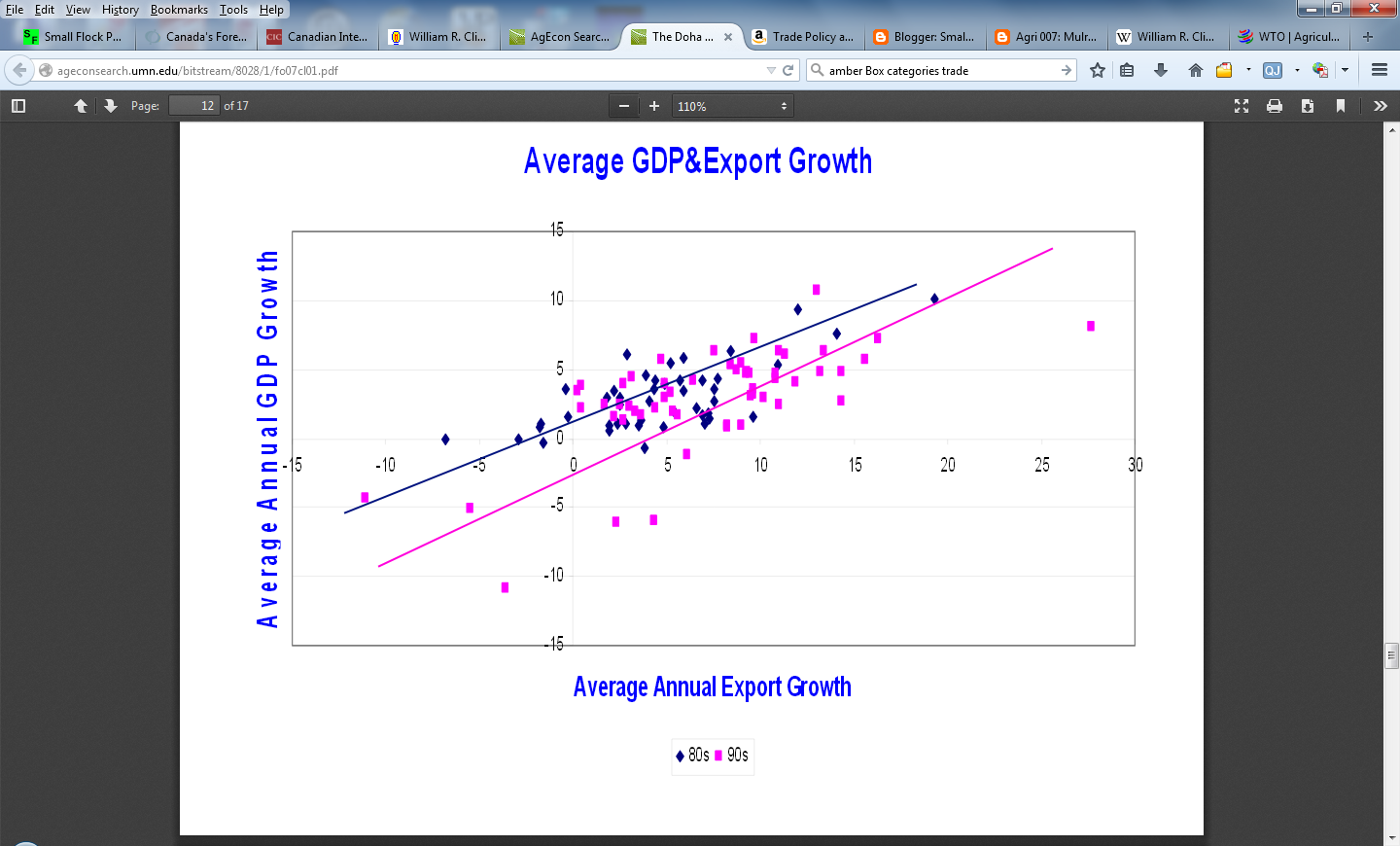
- In developing countries, data from the 1980's and 1990's suggest that as their exports grow, local GDP grows also. See Figure 1.
- That boost to the economies of developing nations via free trade could be as much as $200 Billion per year. Half of that boost would be from free trade for agricultural commodities. The other major sectors for boosting their economies would be from exporting textiles and apparel.
- Global free trade would raise the GDP by 1.5% to 2% directly. The dynamic (ie. spin-off) effects would more than double the direct effect, so the total effect (ie. both direct and indirect) would be more than 4%.
- While the average effect on people would be 4%, the poorest of the poor are estimated to receive the biggest impact of free trade, estimated by Mr. Cline to be double of the average effect (ie. 8% for the Poor vs. 4% on average for all citizens in a developing country).
- In Mr. Cline's 2007 paper to a USDA conference, he states: "...the broad empirical relationship between poverty and income shows that the “poverty elasticity” – the percent by which the number of poor declines for a 1 percent rise in their income– is about 2. So multiply once again by 2 and you get a total of 16 percent reduction in the number of poor. Apply that to 300 million [sic, appear he meant 3 Billion] in poverty and you get about 500 million reduction in global poverty." Therefore, Mr. Cline concludes that free trade would raise the income of Poor people sufficiently to remove 500 million people from the poorest category (ie. earn $2.00/day or less).
- Free trade for agriculture is essential to achieving these positive effects for the world's poor. See Figure 2. WTO defines ag. subsidies as colour-coded boxes, similar to traffic light colours (red= prohibited, amber= caution or subsidies that are to be reduced, green= OK in unlimited quantities, plus blue=amber with conditions that limit the quantities that farmers can produce. The protectionism of Japan's farmers is legendary, estimated to be equivalent to an 82.1% import tariff when you count true tariffs (76.4%) and domestic subsidies (3.2%). Canada is the 2nd worst villain in ag. tariffs and subsidies at 52.3%. The EU is 46.4%, and the US is just 19.9%. The weighted average for all industrialized nations is 36%. No wonder Canada is in such huge trouble in trade talks with the US, EU, TPP, and WTO; we're 45% higher in ag. trade barriers than the world average for industrialized nations.
![]() |
| Figure 1: Mr. Cline's datapoints showing the correlation between a developing country's GDP vs. the growth in their exports. The lines were added by me. |
In 2012, Canada spent $5.67 Billion on foreign aid according to CIDA's data, which is stingy when compared to our relative wealth and the aid by other OECD nations. About 69% of Canada’s aid in 2012 was channeled through the Canadian International Development Agency (CIDA), 9% through Finance Canada, and 8.2% through the Department of Foreign Affairs and International Trade, while the International Development Research Center (IDRC) accounts for 3.5%. About 33.4% of that aid went to Least Developed (or poorest) Countries, another 2.5% went to other Low Income Countries, and 16.8% went to Lower Middle Income countries (41% is not coded by income group). Africa received the highest share at almost 42%, followed by Asia (22%), and the Americas (17%). Following nearly a decade of sustained increases, Canada's aid spending has stalled and is set to decline in the coming years.
About
69% of Canada’s aid in 2012 was channeled through the Canadian
International Development Agency (CIDA), about 9% through Finance Canada
and 8.2% through the Department of Foreign Affairs and International
Trade, while the International Development Research Center (IDRC)
accounts for 3.5%. - See more at:
http://cidpnsi.ca/blog/portfolio/canadas-foreign-aid/#sthash.5R7LsQkW.dpuf
As a Small Flocker in Canada, there are a few issues of which I am concerned.
First, I have seen the jars of pickles on my local grocery store shelves that have been imported from India. I have eaten some of those pickles, as they are significantly cheaper than N. American pickles and seem to have reasonable quality. I also fret about "what is this world coming to" when Canadian pickle producers have permanently shut their doors, and we are now forced to import from elsewhere. I assume I would feel equally conflicted about SM products of dairy, chicken, and eggs being imported into Canada at the expense of domestic production.
Secondly, the quality of N. American chicken is a disaster, with bacterial contamination (including superbugs), bad Omega-3 to Omega-6 fatty acid ratios, bad bird welfare habitats, etc. I assume that 2nd and 3rd world imports might be significantly worse; witness the recent news reports of falsified species in fish imported from South-East Asia, melamine tainted milk in China, and many similar events. As an example of a disaster going someplace to happen, live US chicken was proposed to be exported to China, slaughtered in China, processed and further processed in China to create boxed chicken, then import those packaged chicken products back into the US with no review whatsoever of that entire international supply chain by USDA inspectors (see Blog posting COOL Blowback ). Canadians need higher quality products, not lower. Can we be assured of this quality if we are importing SM replacement products from the developing world?
Thirdly, I am cautious of Free Traders and others who pretend to be helping the poor, when in reality they are propaganda shills for Big Ag., the PTB ("Powers That Be"), the NWO ("New World Order"), and the 0.01%'ers. Exactly who is this Mr. Cline? CIC (Canadian International Council) seems to support Mr. Cline's research. Is Mr. Cline a master manipulator, or a straight arrow? For me, it's too soon to tell, but I am wary about trusting too quickly.
Fourthly, if SM will not yield any ground to domestic Small Flockers, I assume that international small flockers don't have a chance. I would assume that the poorest of the poor would be small flockers in chicken, and small market gardeners in fruits and vegetables.
Fifthly, if WTO, TPP, and EU trade talks achieve agricultural free trade by some miracle, how long before Big Ag. moves in to their third world countries where they create a monopoly for themselves via unfair or predatory trade practices so as to steal the free trade opportunities away from those who need them most.
By slowly and carefully reducing Canada's import tariffs and subsidies to Canada's #ChickenMafia, I believe that would be beneficial to Canada's consumers and small flockers alike, and would eventually force Canada's #ChickenMafia to dramatically improve, or die. However, is there a tariff level below which no Canadian chicken farmer can compete, and dropping import tariffs below this threshold will surely kill all the #ChickenMafia, and possibly even Canada's small flockers? If yes, what is that critical tariff level?
A lot of questions, conflicts, and inconsistencies currently exist inside of me on these SM trade issues. I assume each of you has a similar list. These are complex issues, and we need to get them right the first time. That is exactly why those acting against the best interests of the majority purposefully cloud the issues so as to protect their special interests.
Hopefully with additional study by myself and other, the mud will settle and we can see clearly on the best path to take.
Labels:
EU,
export,
import,
poor,
propaganda,
SM,
Supply Management,
TPP,
trade,
WTO
Friday, June 7, 2013
What changed first, SM or the Tariff?
Last June, Susan Mann of Better Farming wrote about Al Mussell's published report (Sr. Research Associate at George Morris Centre in Guelph ON) suggesting that Supply Management ("SM") didn't need to be scrapped, we just need to allow greater access to the Canadian markets to satisfy our trade partners under WTO (World Trade Organization) and/or TPP (Trans-Pacific Partnership).
The article says that foreign commodity producers want access to Canadian markets, the second largest in the TPP negotiations. I agree. However importers don't have access to all of Canada's market.
For chicken as an example, foreign chicken can enter Canada at an import tariff cost of 0% (NAFTA) or 5% (WTO) under TRQ. TRQ quantities are limited to just 7.5% of the total kg consumed in Canada. After that miniscule market access is exceeded, importer must pay a 285% import tariff cost.
100% of the 2nd largest market is significant, and worth going after under TPP and WTO. 7.5% of the second largest market is more trouble than its worth, for you need bilingual labels, learn all of the intricacies of the Canadian market, form a Canadian supply chain, etc.
All of the above keeps Canadians paying for the most expensive chicken meat prices in the world.
The farmers get some of that gravy as COP (Cost of Production), but the vast majority of those price gouging profits go to others up & down the food chain (ie. chicken feed companies, processors, supplementary processors, distributors, retail, etc.). Gravy train for everybody, except the consumer, who pays for it all.
If the 285% import tariff was reduced, more foreign chicken would soon enter Canada, and everybody would take a hit to their gravy train. Eventually, as everybody in the chicken supply chain got hungrier, retail prices would drop. Anybody working under the arcane rules of SM would be at a considerable disadvantage, and they'd start to drop like flies, or be bought up by foreign suppliers for pennies on the $, because an asset caught in SM's web of fossilized bureaucracy is close to worthless as the import tariffs drop farther & farther.
Dropping import tariffs without first removing SM is a good way to kill the entire domestic chicken production system.
I think we need food security first & foremost, which means we want to ensure we can feed ourselves, even when imported chicken is no longer available.
Same logic applies to all other SM commodities.
That means we must keep the 285% import tariffs on chicken until something else is changed first. I wonder what that something else will be? Do you think it might be SM?
The article says that foreign commodity producers want access to Canadian markets, the second largest in the TPP negotiations. I agree. However importers don't have access to all of Canada's market.
For chicken as an example, foreign chicken can enter Canada at an import tariff cost of 0% (NAFTA) or 5% (WTO) under TRQ. TRQ quantities are limited to just 7.5% of the total kg consumed in Canada. After that miniscule market access is exceeded, importer must pay a 285% import tariff cost.
100% of the 2nd largest market is significant, and worth going after under TPP and WTO. 7.5% of the second largest market is more trouble than its worth, for you need bilingual labels, learn all of the intricacies of the Canadian market, form a Canadian supply chain, etc.
All of the above keeps Canadians paying for the most expensive chicken meat prices in the world.
The farmers get some of that gravy as COP (Cost of Production), but the vast majority of those price gouging profits go to others up & down the food chain (ie. chicken feed companies, processors, supplementary processors, distributors, retail, etc.). Gravy train for everybody, except the consumer, who pays for it all.
If the 285% import tariff was reduced, more foreign chicken would soon enter Canada, and everybody would take a hit to their gravy train. Eventually, as everybody in the chicken supply chain got hungrier, retail prices would drop. Anybody working under the arcane rules of SM would be at a considerable disadvantage, and they'd start to drop like flies, or be bought up by foreign suppliers for pennies on the $, because an asset caught in SM's web of fossilized bureaucracy is close to worthless as the import tariffs drop farther & farther.
Dropping import tariffs without first removing SM is a good way to kill the entire domestic chicken production system.
I think we need food security first & foremost, which means we want to ensure we can feed ourselves, even when imported chicken is no longer available.
Same logic applies to all other SM commodities.
That means we must keep the 285% import tariffs on chicken until something else is changed first. I wonder what that something else will be? Do you think it might be SM?
Wednesday, March 13, 2013
Why Not Export Canadian Chicken?
Note: This posting is expanded from the response I gave for a comment posted in "Bogus FCR takes $945 Million per year from Canadians".
There are many Canadians who believe that US chicken is terrible, as compared to Canadian chicken. I'm not so sure.
In 2011, Canada imported 159 million kg of chicken, most of it from good 'ol USA (74%), followed by Brazil, Thailand, Chili, and Israel. If the difference between US and Canadian chicken was so great, people would pick the better ones, and leave the rest to rot on the meat counter.
For example, back in the 1970's Sony Trinitron colour TV's were manufactured in both Japan and California, both to the exact same specifications. While the technical specs were the same, the California TV's had a varying level of quality, while those made in Japan were virtually identical to each other. The retail stores in N. America tried to sell TV's from both California and Japan, side by side on the showroom floor. The customers could distinguish the difference, and would only buy the Japanese version. As long as one TV from Japan was available for comparison, no California TV's got sold.
Small Flock Poultry Farmers believe that Canada should be self-sufficient in supplying chicken for ourselves. We also believe that we should be exporting our Canadian chicken everywhere in the world.
Unfortunately, Canada is a very poor chicken exporter. Of the 7 top OECD chicken exporters in the world, Canada exports just 1.42% of the total exports for these 7 countries, putting us in last place for these 7 countries.
What's stopping Canada from being #1? To me, it seems the the chicken processors are quite happy raping the Canadian public, and are so comfortable in the fat profits derived from this, they have no hunger or interest to look farther afield.
This world-market stuff scares a lot of people. Once you grow the birds, they have to go to slaughter, or you get stuck with having to continue feeding them. If you slaughter them after losing your customer, the fresh meat has a limited storage life. If you freeze your surplus product, you have to pay on-going storage costs, and it still has a shelf life limit. If you don't find a replacement customer with 1 to 3 months, CFC (Chicken Farmers of Canada) will fine you for failing to export per your export license. Since prospective buyers know all this, and can use it to their advantage, this enables them to back the farmer and/or processor into a corner, refusing to buy unless they drop their price.
This is the same as in the auto industry when we compare GM to Toyota. GM is notorious for "channel stuffing". GM has no confirmed sales, but they make the cars anyway, then twist the arms of their dealers to buy the cars, pay interest on the money they borrow to buy the cars, so that the unwanted cars sit on the dealers' lots while they slowly rust. At the end of the year, it's a fire sale to get rid of the cars.
Alternatively, Toyota only makes a car when a dealership has ordered that car, usually for a specific customer, and then makes the car exactly as the customer has ordered. No arm twisting required. No channel stuffing.
For chicken, we can learn from Toyota. Chicks are ordered only when a confirmed export order for a specific customer has been received, and that customer has provided an irrevocable letter of credit from your friendly neighbourhood bankster. In this way, when the birds are ready 8 weeks later, whether the customer takes them or not, payment to the farmer is guaranteed by the bank. That way, the exporter is always protected. If there are no export orders, then you don't order chicks, or you do some domestic production.
WTO (World Trade Organization) rules forbid a country to do predatory dumping of any product in a foreign market. That is usually defined as selling the product for a lower price than what is charged domestically. Since Canada has the world's highest domestic prices for chicken, there isn't one country in the world that Canada can ship to without being subject to a charge of predatory dumping of chicken, illegal under WTO rules. If Canadians were allowed to purchase chicken at the world price (about half of today's prices in Canada), we could ship to every country in the world without a worry of be accused of dumping.
For another example, look at Canadian wines. With few exceptions, Canada historically produced only garbage wines (ie. Baby Duck). However, Canada quickly went from one of the worst to one of the best for our Canadian wine industry after we signed the Free Trade deal with the US. We were forced to, and the wine industry responded. I believe we can do the same for chicken, if given half a chance.
In 2011, Canada exported 123.4 Million kg of chicken, about 12% of the kg of domestic chicken production; in other words, a paltry after thought. I believe we can do far better than that. Why can't Canada grab 50% of the world's export markets? That would be 4.43 Billion kg of eviscerated chicken exported per year, a little more than what Brazil did in 2011. If Brazil can do it, why not Canada? If Canadians consumed 1.07 Billion kg., and we exported 4.43 Billion kg, then Canadian farmers would have to produce a total of 5.5 Billion kg., which is 5.4 times more chicken than what Canada currently produces. Either we get 5,400 more people to become quota-bearing chicken farmers, or all the current farmers are given 5.4 times the quota they currently have, or some combination in between. What's wrong with that?
Transitioning from our current supply management system towards something better will not be easy. The Canadian Supply Management System has allowed us to be "fat dumb & happy" for a very long time. Compared to other countries, Canadian farmers and processors have lost our competitive edge long ago. For example, New Zealand chicken farmers have a FCR (Feed Conversion Ratio) as low as 1.38 while Ontario chicken farmers have an FCR around 1.82 which is 31.9% worse than world-class. Since feed costs are about 60% of the total live chicken price, the poor Canadian FCR raises our live bird price by 19.14%. No wonder Canadian prices are so high.
It takes years, if not decades to get an FCR optimized to be the best in the world. I have reservations about going down this road due to the impact on the bird's health, and the resulting nutrition level of the meat coming from an "optimized" chicken, but that is what has been going on in the rest of the world.
What would happen if we threw in the towel for chicken supply management? The rest of the world did that decades ago. Canada is the only country in the world with a supply management system. Exactly what do we think Canadians know that the rest of the world is clueless about, so as to explain that we are the only ones left with a Supply Management system?
When New Zealand gave up supply management for their dairy business, they were a insignificant speck on the world's dairy scene. It took 6 long years to rebuild their dairy industry. Curing their "fat dumb happy" slovenly habits wasn't easy. Decades of neglect came home to roost in a very short transition period of just 6 years. After that 6 years in purgatory, the New Zealand dairy industry took off, and is now the #1 dairy product exporter in the world. They learned their lessons the hard way.
Of course, New Zealanders now pay world prices for dairy products, rather than the government tax subsidized prices previously enjoyed. Don't be fooled, for what citizens saved in their left-hand pocket, was pick pocketed out of their right-hand pocket, plus a little extra. I would suggest that every time any government touches something, they add a significant overhead cost. For a government to tax the public, then send some of those tax dollars back to the dairy industry to subsidize the cost of dairy products, this government bureaucracy adds additional costs above what would be the world-priced products.
When governments use general tax revenues to subsidize dairy products, everybody pays, even those who hate dairy, or are allergic to dairy. How could that be fair? Isn't "User Pay" better and more fair? While I don't have the stats to prove it, it is suggested that the subsidized dairy price previously paid by consumers plus the per capita tax burden required to generate the government subsidy would exceed the non-subsidized dairy prices that are paid on the world markets.
Since the end of New Zealand supply management for dairy, there has been significant consolidations of the New Zealand dairy industry. That is usually not good. In a stable competitive market, there are usually only 3 significant competitors. I suggest that governments must prevent excess consolidation (ie. mergers and acquisitions) by anti-monopoly (anti-trust) legislation such as Canada's Competition Act.
Canada first passed their anti-trust legislation in 1889, one year before the US passed the Sherman Act, the US equivalent. See a summary of Canada's Competition Act for more info.
We initially learned back in the 1600's that monopolies are bad policy, and need to be avoided like the plague. Unfortunately, sometimes we forget this, and have to re-learn our lessons, just like the current Supply Management System issues we face today.
There are many Canadians who believe that US chicken is terrible, as compared to Canadian chicken. I'm not so sure.
In 2011, Canada imported 159 million kg of chicken, most of it from good 'ol USA (74%), followed by Brazil, Thailand, Chili, and Israel. If the difference between US and Canadian chicken was so great, people would pick the better ones, and leave the rest to rot on the meat counter.
For example, back in the 1970's Sony Trinitron colour TV's were manufactured in both Japan and California, both to the exact same specifications. While the technical specs were the same, the California TV's had a varying level of quality, while those made in Japan were virtually identical to each other. The retail stores in N. America tried to sell TV's from both California and Japan, side by side on the showroom floor. The customers could distinguish the difference, and would only buy the Japanese version. As long as one TV from Japan was available for comparison, no California TV's got sold.
Small Flock Poultry Farmers believe that Canada should be self-sufficient in supplying chicken for ourselves. We also believe that we should be exporting our Canadian chicken everywhere in the world.
Unfortunately, Canada is a very poor chicken exporter. Of the 7 top OECD chicken exporters in the world, Canada exports just 1.42% of the total exports for these 7 countries, putting us in last place for these 7 countries.
What's stopping Canada from being #1? To me, it seems the the chicken processors are quite happy raping the Canadian public, and are so comfortable in the fat profits derived from this, they have no hunger or interest to look farther afield.
This world-market stuff scares a lot of people. Once you grow the birds, they have to go to slaughter, or you get stuck with having to continue feeding them. If you slaughter them after losing your customer, the fresh meat has a limited storage life. If you freeze your surplus product, you have to pay on-going storage costs, and it still has a shelf life limit. If you don't find a replacement customer with 1 to 3 months, CFC (Chicken Farmers of Canada) will fine you for failing to export per your export license. Since prospective buyers know all this, and can use it to their advantage, this enables them to back the farmer and/or processor into a corner, refusing to buy unless they drop their price.
This is the same as in the auto industry when we compare GM to Toyota. GM is notorious for "channel stuffing". GM has no confirmed sales, but they make the cars anyway, then twist the arms of their dealers to buy the cars, pay interest on the money they borrow to buy the cars, so that the unwanted cars sit on the dealers' lots while they slowly rust. At the end of the year, it's a fire sale to get rid of the cars.
Alternatively, Toyota only makes a car when a dealership has ordered that car, usually for a specific customer, and then makes the car exactly as the customer has ordered. No arm twisting required. No channel stuffing.
For chicken, we can learn from Toyota. Chicks are ordered only when a confirmed export order for a specific customer has been received, and that customer has provided an irrevocable letter of credit from your friendly neighbourhood bankster. In this way, when the birds are ready 8 weeks later, whether the customer takes them or not, payment to the farmer is guaranteed by the bank. That way, the exporter is always protected. If there are no export orders, then you don't order chicks, or you do some domestic production.
WTO (World Trade Organization) rules forbid a country to do predatory dumping of any product in a foreign market. That is usually defined as selling the product for a lower price than what is charged domestically. Since Canada has the world's highest domestic prices for chicken, there isn't one country in the world that Canada can ship to without being subject to a charge of predatory dumping of chicken, illegal under WTO rules. If Canadians were allowed to purchase chicken at the world price (about half of today's prices in Canada), we could ship to every country in the world without a worry of be accused of dumping.
For another example, look at Canadian wines. With few exceptions, Canada historically produced only garbage wines (ie. Baby Duck). However, Canada quickly went from one of the worst to one of the best for our Canadian wine industry after we signed the Free Trade deal with the US. We were forced to, and the wine industry responded. I believe we can do the same for chicken, if given half a chance.
In 2011, Canada exported 123.4 Million kg of chicken, about 12% of the kg of domestic chicken production; in other words, a paltry after thought. I believe we can do far better than that. Why can't Canada grab 50% of the world's export markets? That would be 4.43 Billion kg of eviscerated chicken exported per year, a little more than what Brazil did in 2011. If Brazil can do it, why not Canada? If Canadians consumed 1.07 Billion kg., and we exported 4.43 Billion kg, then Canadian farmers would have to produce a total of 5.5 Billion kg., which is 5.4 times more chicken than what Canada currently produces. Either we get 5,400 more people to become quota-bearing chicken farmers, or all the current farmers are given 5.4 times the quota they currently have, or some combination in between. What's wrong with that?
Transitioning from our current supply management system towards something better will not be easy. The Canadian Supply Management System has allowed us to be "fat dumb & happy" for a very long time. Compared to other countries, Canadian farmers and processors have lost our competitive edge long ago. For example, New Zealand chicken farmers have a FCR (Feed Conversion Ratio) as low as 1.38 while Ontario chicken farmers have an FCR around 1.82 which is 31.9% worse than world-class. Since feed costs are about 60% of the total live chicken price, the poor Canadian FCR raises our live bird price by 19.14%. No wonder Canadian prices are so high.
It takes years, if not decades to get an FCR optimized to be the best in the world. I have reservations about going down this road due to the impact on the bird's health, and the resulting nutrition level of the meat coming from an "optimized" chicken, but that is what has been going on in the rest of the world.
What would happen if we threw in the towel for chicken supply management? The rest of the world did that decades ago. Canada is the only country in the world with a supply management system. Exactly what do we think Canadians know that the rest of the world is clueless about, so as to explain that we are the only ones left with a Supply Management system?
When New Zealand gave up supply management for their dairy business, they were a insignificant speck on the world's dairy scene. It took 6 long years to rebuild their dairy industry. Curing their "fat dumb happy" slovenly habits wasn't easy. Decades of neglect came home to roost in a very short transition period of just 6 years. After that 6 years in purgatory, the New Zealand dairy industry took off, and is now the #1 dairy product exporter in the world. They learned their lessons the hard way.
Of course, New Zealanders now pay world prices for dairy products, rather than the government tax subsidized prices previously enjoyed. Don't be fooled, for what citizens saved in their left-hand pocket, was pick pocketed out of their right-hand pocket, plus a little extra. I would suggest that every time any government touches something, they add a significant overhead cost. For a government to tax the public, then send some of those tax dollars back to the dairy industry to subsidize the cost of dairy products, this government bureaucracy adds additional costs above what would be the world-priced products.
When governments use general tax revenues to subsidize dairy products, everybody pays, even those who hate dairy, or are allergic to dairy. How could that be fair? Isn't "User Pay" better and more fair? While I don't have the stats to prove it, it is suggested that the subsidized dairy price previously paid by consumers plus the per capita tax burden required to generate the government subsidy would exceed the non-subsidized dairy prices that are paid on the world markets.
Since the end of New Zealand supply management for dairy, there has been significant consolidations of the New Zealand dairy industry. That is usually not good. In a stable competitive market, there are usually only 3 significant competitors. I suggest that governments must prevent excess consolidation (ie. mergers and acquisitions) by anti-monopoly (anti-trust) legislation such as Canada's Competition Act.
Canada first passed their anti-trust legislation in 1889, one year before the US passed the Sherman Act, the US equivalent. See a summary of Canada's Competition Act for more info.
We initially learned back in the 1600's that monopolies are bad policy, and need to be avoided like the plague. Unfortunately, sometimes we forget this, and have to re-learn our lessons, just like the current Supply Management System issues we face today.
Labels:
Canada,
chicken,
dumping,
effectiveness,
efficiency,
export,
fair,
FCR,
free trade,
Ontario,
trade,
WTO
Subscribe to:
Posts (Atom)