Google+
Showing posts with label duty. Show all posts

Thursday, October 17, 2013

The Simple Way Out

Everybody needs a simple way out of this Canada-wide #SupplyMgmt mess.   Here is the solution.

Why or why didn't I see this obvious solution before!

Others have pointed out that there is an intricate web of interlocking statutes between the Federal Government and all of the Provinces, but Alberta has already given notice that they are leaving as of Dec. 31, 2013. That system took decades to build, and will decades to dismantle, but Canadians need relief now.

The 2001 Federal-Provincial Agreement for Chicken is the master document holding the entire system together.  This agreement assumes, but doesn't specifically state that the Federal Government will continue to charge an outrageous 285% duty for chicken imports.  Under international trade agreements, Canada must allow 7.5% of our previous years domestic chicken meat production into the country at a more reasonable import tariff cost of 0% (NAFTA) or 5% (WTO).

All the Supply Management  statutes, regulations, marketing boards, and everything else can stay in place as it is today.

This avoids the government being seen as reneging on its solemn vow to maintain and support Supply Management.  Supply Management can stay if that is what the #ChickenMafia and the Provinces want.  However, the Federal Government has sole jurisdiction over import tariffs.  Adjusting import tariffs avoids all those messy negotiations that take decades to achieve.

There have been many discussions about the value of quota, the crystallization of values for the quota for capital gains, the freezing of quota values, controlling the sale and transfer of quota, and reimbursing the farmers for the inflation of quota values, or any drop in quota values.

As I understand it, quota originated from the marketing boards, and was given away free to the Chicken Mafia as far as I have been told.  If it inflated in value after that, or drops in value, it wasn't the government who directly ordered that to occur; it was the free market.  Chicken quota inflated in price because it gave the owner a legal method to steal from all Canadians who bought chicken.  This proposal will likely drive quota values slowly back to where they started; worthless.  The sooner the Chicken Mafia realize this and cash out, the more they get to keep of their ill gotten gains stolen from the Canadian public.

Eventually the Chicken Mafia and everybody else may plead for the removal of these obsolete Supply Management regulations with one unanimous voice.  Until then, the Supply Management relic will be a fossilized remnant to warn us and our children about repressive schemes that create monopolies against the best interests of the people.

For the new solution to the Supply Management Monster, we need to realize 4 basic facts:
  1. Canadians need immediate relief from the Chicken Mafia and their oppressive tyranny;
  2. Chicken Mafia needs time to adapt, and get their house in order; and
  3. Federal Government has taken the side of consumers in their recent Throne Speech, and needs to make make fast tracks on those promises if they are to be re-elected;
  4. Federal Government needs tax revenue to solve their deficit.
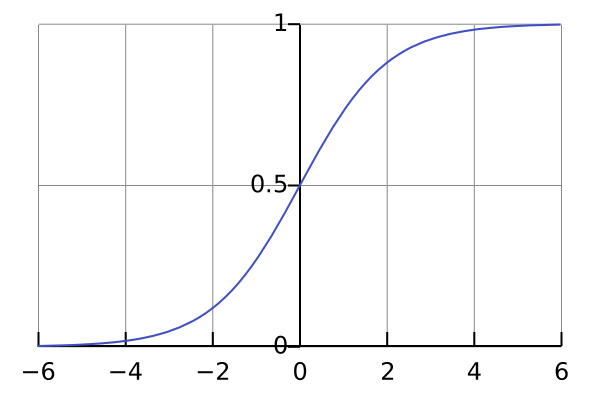
Sigmoid Curve for the rate of change in the
removal of Supply Management from Canada.
Likely, the Chicken Mafia needs to un-learn their old evil ways, and re-learn the correct way of behaving under the new rules. This will likely be the limiting step in this change process.  If we force change upon them too quickly, there will be chaos that everybody will pay dearly for.

The Learning Curve is therefore a necessary part of this change process.  The simple concept is described on Wikipedia, and the more complex version is here. I suggest using a sigmoid curve, slow changes at first, then rapid change as the Chicken Mafia gain experience and competency, then slow change as it becomes more and more difficult once the low hanging fruit has already been harvested from within the fossilized Supply Management system.  That means the use of a Sigmoid Curve.

Here is the solution that meets all 4 of the above criteria, and will eventually solve the Chicken Mafia Fiasco:

The Solution

  1. Announce immediately this entire plan, scheduled to start taking place 6 months from now.  That will give hope to the oppressed, and allow the Chicken Mafia to get ready for what is to come.
     
  2. At 6 months from today, drop the import tariff on chicken from 285% to 265.11%.  That is a 7.5% drop.  The various branches of the Chicken Mafia can fight over who takes the haircut, or whether all of them share the haircut equally.  The most important factor is how much of that tariff reduction gets passed on to the consumers.  If the consumer gets none of the savings because of the continuing unbridled greed of the Chicken Mafia, then US chicken imports will likely accelerate even faster as the US food distribution companies want to establish a beach head in Canada, to get ready for what will soon come.  Passing the savings to the consumer will drop the driving force for the US invasion.
     
  3. The Federal Government holds back a second tariff drop of another 7.5% (from 265.11% to 247.77%) if the Chicken Mafia plays nicely.  However, if they continue to screw the Canadian consumer, the Federal Government will drop the second 7.5% reduction onto their heads sooner rather than later.  The Federal Government can track the drop in tariff and the resulting drop in consumer prices, if any.  It a disconnect between these occurs, the Federal Government can threaten another 7.5% dose of medicine, accelerating the drop in tariff.  The tariff can continue dropping until the Chicken Mafia learn to play ball, and pass the savings onto the consumer.  It's the Chicken Mafia's choice as to which path they take.
  4. Assuming that the Chicken Mafia plays nicely, a sigmoid reduction curve (see above) is used to consistently, predictably, and slowly lower the import tariff from 265.11% to 7.5%.  I believe that a 10 year period should be sufficient timing for allowing the necessary changes to occur without chaos.  Therefore 10.5 years from today, the import tariff for chicken will be 7.5%.
That's it.  Small Flockers 4 point plan for saving the free world from oppression and tyranny from the Chicken Mafia.

What do you think?

Should it be faster or slower?

Will the Chicken Mafia bypass or find a loophole to avoid the plan?

Monday, October 14, 2013

Chicken Mafia causes another disaster

There is a full-blown crisis in the Canadian chicken industry.  Sound the alarms.  This crisis threatens the loss of 56,000 Canadian jobs, and $6.5 Billion GDP.

Spent fowl imports to Canada are probably being used to defraud Canadians, and destroy the Canadian chicken industry.

Spent fowl are female chickens that have spent an entire year laying eggs, are getting worn out, egg production is dropping, and are then only commercially suitable for making chicken soup, pet food, compost fertilizer, or similar fates such as defrauding Canadian consumers.

Fraudulent spent fowl imports are being used to escape paying the 285% import tariffs for broiler chicken at the Canadian border.

Source: http://chickenfarmers.ca/upload/Documents/Spent_Fowl_Imports_webBooklet.pdf

If the current trend of fraudulent spent fowl imports continues, these imports are forecast to double again from the current 16.9% of the domestic broiler production, to 33.76% in just 5.3 years from now, and will reach 50% of Canada's domestic broiler production in just 7 years from now, and 100% of domestic chicken production on or before June 18, 2023 (9.68 years from today).

The data shows a double exponential rate of increase (ie. an exponential of an exponential rate of growth), with a correlation coefficient of 90.48% (ie. the double exponential equation explains 90.48% of the year-to-year variation in the data, with just 9.52% random error).

That means that Canada's entire domestic chicken industry will be wiped out as of 2023, as all the needed chicken will be fraudulently imported into Canada, right under the noses of Chicken Farmers of Canada ("CFC"), the organization who is supposed to be in charge of chicken for all of Canada .

Of course, the Canadian industry for growing and processing chicken, and the growing of grains and making chicken feed for those domestic chickens will likely collapse long before those doomsday dates are reached, due to massive loss of both market share and cash flow.

Note that this dangerous trend is likely created by cannibalism from within the Chicken Mafia (ie. all those who support, use, and benefit from the monopolistic chicken supply management system).  Pure greed likely means that some members of the Chicken Mafia aren't satisfied with a mere 300% markup on chicken in Canada that consumers are forced to pay.  The Chicken Mafia wants more and more profits.  It is likely more than one Chicken Mafia members who are eating Canada's chicken supply management system alive from the inside out, just like in the movie Alien.

Alien monster emerging from inside Astronaut Kane (played by John Hurt) in the 1979 move "Alien"


If something isn't done soon, Canada's entire value-added chicken industry will suffer a similar fate to that of Astronaut Kane, as shown in the above video clip; a sudden, scary, violent, painful, and gruesome death.

Will CFC attack its own members of the Chicken Mafia, so as to save the overall system?  So far, CFC has allowed it to continue.

While Small Flockers don't like the tyranny and oppression of the current chicken supply management system, and we call for dramatic changes, this current crisis isn't our doing, is not what we had in mind, and we do not support letting the current crisis trend to continue.

Somebody needs to do something, and quick.  Perhaps the decades of oppression by the Chicken Mafia has found an outlet, and it is already too late to make amends.

Unfortunately, CFC now wrings their hands in worry and makes pretty brochures about the crisis they created by delay and indifference.

The above graph is taken from a CFC brochure they published as of Sept. 16, 2013.  In a previous Blog posting, I showed how this emerging crisis was detectable back in 2003, but CFC was asleep at the switch, and only realized the trend existed in 2010; which is 7 years behind the times.

Google Internet Search terms for Canada (see graph above) show no interest whatsoever in this topic between 2004 and today.  Shocking and sad!

So that's it? For ten years the problem is allowed to fester, and all CFC can do is produce a 6 page pamphlet on this crisis; a crisis that can and will destroy the entire Canadian chicken industry?

Rip Van Winkle wasn't asleep that long.  Incompetence and negligence by CFC needs to be investigated on this issue.

Perhaps CFC should be taking specific action.  If they don't know what to do, perhaps they should ask somebody who does know.  It appears that all they have done is complain to Minister Ritz, then sit back and wait for a solution from the government.

I find CFC's inaction or glacial pace to be hard to understand.  Talk about fiddling while Rome burns!

You should also be aware of the increasing danger in the Canadian system for supply management of chicken from other sources.  It appears to be approaching the breaking point in multiple area, from stressor originating from multiple sources (see http://canadiansmallflockers.blogspot.com/2013/10/quota-based-chicken-farmer-speaks-out.html )

Today, when a truck of chicken arrives at the US-Canada border, Canadian Border Services Agency ("CBSA") cannot take action on a truck that contains 51% spent chicken that is mixed in with 49% broilers unless they have a scientifically sound, objective method for determining what is a spent fowl and what is a plump young broiler.  I suggest the following 5 step action plan can be in place within 6 months or less if we get somebody competent on the job (ie. not Chicken Farmers of Canada):
  1. Secretly purchase a truckload of 100% verified and certified USA spent chicken , and a truckload of verified and certified USA broilers ( in parts, whole fresh, and frozen).  Statistical analysis of the meat is done to characterize it, and identify the factor(s) that provide the maximum confidence interval for differentiating between spent fowl and plump broilers (eg. weight, density, conductivity, skin/meat durometer, pH, water activity, etc.).  I guess that the weight differential should be adequate, but the other data can act as an insurance policy.
  2. Repeat the purchase and testing from different suppliers and different processing plants so as to build a sufficient database.
  3. The database and testing method is verified for repeatability, reproducibility, precision, accuracy, and predictability through a double blind test of the draft method, data is statistically analyzed for prediction efficiency.
  4. CBSA personnel are trained on the certified testing method.  Method is implemented at all borders.
  5. Random samples are taken by CBSA for all trucks of alleged spent chicken imports into Canada.  Based on these samples, the % spent chicken in the shipment is estimated, and CBSA applies the TRQ or other tariff to the balance of the shipment.  If the importer is able to present sufficient objective evidence to prove a different % spent is in the shipment, then this other data will be considered by CBSA prior to assessing the duty owed.

Friday, June 7, 2013

What changed first, SM or the Tariff?

Last June, Susan Mann of Better Farming wrote about Al Mussell's published report (Sr. Research Associate at George Morris Centre in Guelph ON) suggesting that Supply Management ("SM") didn't need to be scrapped, we just need to allow greater access to the Canadian markets to satisfy our trade partners under WTO (World Trade Organization) and/or TPP (Trans-Pacific Partnership).

The article says that foreign commodity producers want access to Canadian markets, the second largest in the TPP negotiations.  I agree.  However importers don't have access to all of Canada's market.

For chicken as an example, foreign chicken can enter Canada at an import tariff cost of 0% (NAFTA) or 5% (WTO) under TRQ. TRQ quantities are limited to just 7.5% of the total kg consumed in Canada.  After that miniscule market access is exceeded, importer must pay a 285% import tariff cost.

100% of the 2nd largest market is significant, and worth going after under TPP and WTO.  7.5% of the second largest market is more trouble than its worth, for you need bilingual labels, learn all of the intricacies of the Canadian market, form a Canadian supply chain, etc.

All of the above keeps Canadians paying for the most expensive chicken meat prices in the world.

The farmers get some of that gravy as COP (Cost of Production), but the vast majority of those price gouging profits go to others up & down the food chain (ie. chicken feed companies, processors, supplementary processors, distributors, retail, etc.).  Gravy train for everybody, except the consumer, who pays for it all.

If the 285% import tariff was reduced, more foreign chicken would soon enter Canada, and everybody would take a hit to their gravy train.  Eventually, as everybody in the chicken supply chain got hungrier, retail prices would drop.  Anybody working under the arcane rules of SM would be at a considerable disadvantage, and they'd start to drop like flies, or be bought up by foreign suppliers for pennies on the $, because an asset caught in SM's web of fossilized bureaucracy is close to worthless as the import tariffs drop farther & farther.

Dropping import tariffs without first removing SM is a good way to kill the entire domestic chicken production system.

I think we need food security first & foremost, which means we want to ensure we can feed ourselves, even when imported chicken is no longer available.


Same logic applies to all other SM commodities.

That means we must keep the 285% import tariffs on chicken until something else is changed first.  I wonder what that something else will be?  Do you think it might be SM?

Thursday, February 28, 2013

Playing Chicken with Ontario's Premier Wynne

Are the Small Flock Farmers playing chicken with Ontario's new Premier, Kathleen Wynne?

Premier Wynne has decided to take on the Ministry of Agriculture & Food ("OMAF") portfolio in addition to her duties as Premier.  That decision may be the acid test for defining the difference between the former regime of McGuinty, and the new Premier Wynne.

The Small Flockers didn't waste any time in ruffling the feathers of Premier Wynne by pressing their longstanding issues with the new Minister of OMAF.

One Small Flocker, Glenn Black from Providence Bay Manitoulin Island said,

"Premier Wynne stated that the rural and farming communities need to be listened to, and that their voices count.  We take her at her word.  Now is Premier Wynne's opportunity to demonstrate her solidarity with that community, as well as all the consumers of poultry in Ontario.  Now is the time to act."

There are over 13,000 Small Flock Chicken Farmers in Ontario.  Under Ontario's Supply Management system, they are only permitted to raise up to 300 meat birds per year.  The Small Flockers are asking that this limit be raised to 2,000 birds, and to be given back the right to raise, slaughter, and sell their poultry from their farm gate.  Farm gate meat sales were banned in 2005 unless those birds were slaughtered and inspected by a government licensed abattoir.  Many areas of Ontario have no government licensed abattoir that processes poultry, thereby placing them in a Catch-22, shutting down the farmer's opportunity to raise a flock and earn a living.

Various food banks and "Eat Local" food advocacy groups want more locally grown foods such as poultry to be available.  Small Flock Farmers, spread far and wide throughout Ontario, meet that definition, and are ready to serve that need for locally grown food.  Practical Farmers of Ontario, a family farm advocacy group, is also supporting these efforts.

On behalf of himself and all Small Flock Poultry farmers, Glenn Black has sent a letter to Premier Wynne detailing how farm-gate poultry sales can occur, while minimizing any food safety risks.  This farmer's group believes that farm gate poultry sales will offer chicken to Ontario citizens that is equal or better quality and food safety than what is currently available in grocery stores.