Google+
Showing posts with label backyard chicken. Show all posts

Tuesday, October 13, 2015

Minto Chicken Exemption

Connie, a long time resident in town of Clifford, part of the Municipality of Minto Ontario, can now apply (and hopefully receive) an exemption from the Exotic Animal By-law.  This will hopefully allow her family of 5 people to continue to enjoy and benefit from the fresh eggs from her 3 backyard chickens.

This Blog previously covered the struggles of Connie trying to keep her 3 backyard chickens for family egg supply (see here, and here).  The application form, photographs, letter to neighbours, City annual inspection and $50.00 per year license fee seems like a lot of bureaucracy to me for just 3 chickens, but it's a start.

You can read Minto's new chicken exemption By-law here.

Minto's CAO is pleased they have kept the bureaucracy to an absolute minimum.  I had quite a laugh at how the same words have such different meaning for two different people.

At least Minto has allowed an exemption that differentiates chickens from lions, bears, poisonous snakes, and other exotic animal.

Figure 1:  Which animal is least exotic and least dangerous than all the other exotic animals shown above?Minto Council studied carefully, and successfully answered the Exotic Animal Quiz, permitting the
obtaining of a safe and sane exemption for backyard chickens from this Municipal By-Law.
Below is the video of Minto Council when they discuss the options arising from the public consultation meeting on backyard chickens for the Municipality of Minto.  The backyard chickens discussion starts at 39 minutes, 55 seconds (video automatically starts at that point), and runs until 1:12:42, a total of


Here is a listing of the arguments used by Minto Council to shoot down Connie's request for backyard chickens, and Small Flockers response.


Concerns of Minto Council
Small Flocker’s Comments
Therapeutic Pets
Connie has her backyard chickens for the nutritional advantages, and the therapeutic psycho-social interactions between people and animals.  Council seems to accept this as soft emotional justification, but favours hard “facts”.

Just because something can be easily counted does not make it more important.
Noise
Somebody stated “chickens make no noise”, and this was properly rejected by Council.  I previously showed that 1 vs. whole flock of chickens isn’t much more noise.

Everybody seems to agree that with adequate separation, hens don’t produce excessive nor disruptive noise.
Smell
Somebody stated “chickens don’t smell”, and this was properly rejected by Council by saying any animal that produces 2 lbs. of poo per week will have a smell.  Everybody seems to agree that with adequate separation and proper compost management, hens don’t produce excessive nor disruptive smells.  Anaerobic rotting is very smelly, but high oxygen composting has minimal smells.  People regularly use manure on their lawns and gardens.  This isn’t specially regulated by municipality, why then is chicken manure a problem?
High Phosphorous manure
Council stated that chicken manure is high in phosphorous, causing composting to be killed.

Chicken manure is 2.7 times higher in Phosphorous as compared to cow manure.  I use wood shavings in my chicken coop as litter, source of carbon for composting, and get a high heat composting of the chicken litter.  Perhaps if someone tried “composting” 100% chicken manure it would fail, but that isn’t composting if your C:N:K:P balances are off.

Chicken manure readily and easily composts, and produces excellent natural fertilizer.  All manures smell, and chicken is far less of a nuisance than swine or beef for bad or excessive odors.
Predators (skunks, raccoons, weasels, etc.)
Council raised issue of skunks attracted into urban areas by eggs and hens.

Council acknowledged that skunks, raccoons, etc. are already in Minto urban areas, removel of all backyard chickens will not likely reduce urban predators, but it is unknown if backyard chickens would cause urban predators to increase.

Chickens need to be protected from predators, and owners naturally do this via chicken coops and/or chicken wire pens.

If it becomes a problem, Council can always act when that risk arises.  There is little sense to legislate every possible risk, or prohibit based on all possible negatives that might occur.
Health risks (bacteria, viruses, worms), 60 diseases carried by chickens.

Bird flu risks and costs
Yes, like all living creatures, chickens carry, contain, or excrete bacteria, viruses, and/or worms.  Council also stated that chickens carry 60 different diseases.

I suggest there may be 60 major diseases, but many more minor ones.  Biosecurity precautions need to be taken for chickens, similar to pregnant women that could be exposed to Toxoplasmosis by a cat litter box, or ring worm from a dog’s droppings.

Council suggested a commercial chicken farmer would never wear their barn clothes or boots off-farm due to biohazard risks.  I would agree, as CAFO chicken farms are a biosecurity powderkeg due to wild pathogens that could enter the farm and kill massive numbers of chickens.

The risk is significantly less with backyard chickens.  For example, there are about 20 to 50 times more small flocks than CAFO chicken factories.  However in N. America, about 85% of all avian influenza cases are on CAFO chicken factories, indication CAFO chicken factories are about 42 times greater biosecurity risk than backyard chickens (50*0.85= 42)
Better nutrition from small flock eggs
Council mentioned that Connie claimed this, but it was rejected as Council could not find any source to substantiate this claim.

Mother Earth News had free range and backyard chicken eggs tested by accredited labs, and found that there are significant nutritional advantages, up to 7 times more, from non-CAFO factory eggs (see http://www.motherearthnews.com/real-food/free-range-eggs-zmaz07onzgoe.aspx )
Hens less disruptive than dogs & cats
While Council agreed with this statement, they dismissed it because dogs & cats are an accepted part of urban life.

If a particular dog is creating a nuisance, the city will soon receive a complaint, then they can act based on that complaint.  The same can be said about a chicken nuisance.
Enforcement of By-law
Council was worried about the potential red tape and cost of By-law enforcement.

The more complicated it is made, the greater the risk of someone discovering a work-around.  I had previously suggested deleting “chicken” from the exotic animal By-law, thereby extracting the municipality from the issue, cost, and risk.
Keep it Simple
Council wants to keep it simple.

Unfortunately, the proposed chicken exemption application form is onerous, long, and complicated, has a $50/yr fee, and annual inspections in perpetuity.  Few backyard chicken wanna-be’s would go through this long process, especially with no guarantee of success.
Kids & animal benefits
Council recognized the benefit of getting kids involved at a young age with animals, far better than cell phones, video games, or TV.

Council suggested no urban chicken is necessary, as the urban resident can ask a farmer to keep the urban resident’s chickens at a nearby farm.

I know of nobody doing that today, likely because it’s not readily feasible
Farmer vs. urban divide, Expectations of people who move to Town
Council noted that farming should stay on farm land, and high density commercial and residential areas should be separate and apart from farms.

Urban planning based on highly structured separation of uses and buffer zones was the standard in the 1940’s.  Today, modern planning is based on multi-use so that an individual can be born, grow, school, eat, work, play, retire, get medical treatment, and most other activities of life while remaining on the same city block or neighbourhood.

This more modern concept of urban planning favours urban food production via gardens and backyard chickens.
Neighbour gets coop
Council said they would be most concerned is a neighbour got a coop.

Fear is almost always the natural outcome of ignorance.

However, By-laws and Councils should not be fearful reactions to all the potential risks in this world.  By-laws should restrict themselves to real, significant risks, not fears and phobias.
Animal welfare

Omnivore chickens need protein & vegetables
Council was concerned about animal welfare.

Previously, Council accepted that backyard chickens are somewhat family pets, above and beyond a cold farming business transaction for eggs.  It seems reasonable that family pets would likely be better cared for than mere farm animals.

Most backyard chickens receive kitchen scraps in addition to their regular chicken feed, and can hunt backyard bugs as well.
Mixed message to those currently non-compliant to Exotic Animal By-law
The Exotic Animal By-law has been in place for some time.  Those who wish can apply for an exemption.  Until they apply, and the application is accepted, then they are prohibited from having backyard chickens.
Hormones in eggs
Council rejects the argument than backyard eggs are hormone-free, as all eggs and meats in Canada are free from artificially added hormones.

There are numerous reports of drugs, chemicals, vaccinations, antibiotics, and other additives that are fed to commercial chickens (eg. caffeine, Gravol, antihistamines, anti-depressants, dyes, painkillers, etc.).  Any one of these additives are of questionable health effects that should be accepted as sufficient reasons to shun commercial CAFO chicken factory eggs.
Enforcement of By-law (active/aggressive vs. Complaint & Request)
Council was concerned about the cost and loss of tranquility by being forced into an adversarial role of By-law enforcement for backyard chickens.

Council admitted that most citizens supported backyard chickens, and only a few voices spoke against it.  It is suggested that good governance occurs when the majority gets their wish, provided the rights of the minorities are protected.
Unknown risks and effects from urban chickens
Council admitted that they have no way of knowing all of the potential or likely risks that may occur.

Council also mentioned that if any issue subsequently comes to light, they can then examine that issue, and all By-laws can be repealed.
Large land area needed to break parasite cycle
Council felt that a 1.5 acre lot could successfully handle a small backyard flock, as the pastured area could be adequately rotated so that excessive parasite loading from over-use of the same ground would not occur.

Rotational grazing is far superior, but is not always feasible.  There might be just a few lots within the municipal limits that have interested owners and a lot size of 1.5 acres or more.  By placing multiple mandatory requirements that are too restrictive, an enabling & permissive By-laws is mutated into a restrictive By-laws for which there is no feasible implementation.


Saturday, September 13, 2014

Cities Feed Cities

"Farmers Feed Cities" is now a passé slogan, recently abandoned by Grain Farmers of Ontario in favor of "Good in every Grain"

Intense agriculture requires huge capitalized investments, specialization, and deep expertise, hence requiring farmers.  Intense farms can't be done without farmers.

Can we cut out the Middleman?  Can we make it possible for Cities to Feed Cities?

Let's do a simple calculation based on the following facts:
  • Bird finished weight is 2 kg. live weight.
  • Birds grow cycle is 8 weeks, 6.5 grow cycles per year is 52 week year.
  • Bird's eviscerated weight is 68.6% of its live weight.
  • Chickens raised for meat or eggs need coop space so they aren't crowded or overly stressed.  The minimum space is dependent on age of the chicken, breed, weight, and temperature-humidity.  CFO's Reg 183-2012, Section 3.17 on page 8 sets a maximum bird density of 2.88 kg/sq.ft.  Assuming bird's maximum weight is 2.0 kg, that max. limit is equivalent to 1.44 birds/sq.ft.  CFO's limit is for birds who never see grass, nor the sun, nor feel the wind on their wings.  If you are free range, with the bird inside their coop only during the night or foul weather, you may be able to stock at higher densities.  I suggest that 1.0 sq. ft. per bird is reasonable, which is 44% better than the #ChickenMafia's mega chicken factory stocking density.
  • Canadians eat 37.5 kg of chicken per person per year.
  • A 10' x 10' shed can be build anywhere in Ontario without a building permit.  If a small green area can surround the shed, all the better.
  • Many cities are now permitting backyard chicken coops.
If a 10' x 10' chicken coop is installed somewhere in a city, how many people can be fed by the chicken produced within that 100 sq. ft. coop?  We calculate as follows:

Max # Birds in Coop= 10'x10'/1 sq.ft./bird= 100 birds
Max. Birds per Year= 6.5 grow cycles/yr * 100= 650 birds/yr.
Max. Live weight of chickens per yr= 650 * 2= 1,300 kg/yr
Max. eviscerated weight of chicken produced per year= 1,300 * 0.68628= 892.16 kg/yr
# People Fed per year= 892.16/37.5=   23.79 persons/yr.

Therefore a 10'x10' chicken coop can feed 23.79 people per year for their annual chicken needs.

To me, this example seems to indicate that small spaces within cities can be used to feed a neighbourhood.

Are chickens the best choice for Cities Feed Cities?

The table at right shows the FCR (Feed Conversion Ratio) for various animals.  An FCR of 1.66 means that it takes 1.66 kg of feed to add 1.0 kg of weight to the animal.  As you can see, chickens have the lowest, most efficient FCR; even better than crickets ( the latest proposal for feeding 9 Billion people).

A simple example to show that we the people don't need farmers, nor intense agriculture.

Look out Big Ag.  Your end may be near if you continue to push your own agenda ahead of the needs of your customers.


Wednesday, June 25, 2014

Backyard Chicken: Win in Whitehorse

Keeping up to 6 female chickens in an urban backyards of Whitehorse, Yukon is now legal.

CBC News and others report that Kristina Calhoun has spent the last 3 years on a long, painful saga:
CKRW Radio did an interview of Kristina as well.

Kristina also happens to be the leader of the Green Party in Yukon.  In the Green Party's policies, they clearly support sustainable, affordable, nutritious food for Canadians.

It is interesting that when City Council was debating the current and proposed By-law, some felt that the permission of neighbours should be obtained before someone is allowed to have chickens within city suburbs.  Kristina rightfully responded:
"That's unrealistic and unfair.  I just think, you know, nobody had to come to me and ask if they could have a dog, nobody had to come to me and ask if they could have a cat, tune up their ATV in their yard and have exhaust and noise - nobody comes and knocks on my door and asks 'Oh, is it okay if I start up my leaf blower now?' It just seems a little bit much."
In the Yukon-News coverage of this victory, Kristina reminds people what happens when food trucks can't make it up the Yukon Highway due to weather or other issues.  Food security for Kristina and her family is important.  She said,
 "I think its really important that municipal, federal, and territorial governments remove as many boundaries as they can to allow people to be as self-sufficient as they can, especially in an isolated community like this.”

Kristina eventually wants to be able to raise meat birds during the summer, and layers year-round.  That will require another By-law change.

Kristina waxes on about the mini local food economy that has flowered and flourished in the neighbourhood.  One neighbour bakes bread, which are exchanged for eggs.  Backyard vegetables could also come into the mix soon enough from another neighbour's backyard greenhouse.

The Yukon has a portable abattoir for processing chickens in all the remote communities.  Kristina helped process 220 chickens in a Saturday afternoon; now food in citizen's freezers, ready for winter.

Ontario, as a "Have-Not" province, doesn't have portable abattoirs to service its Small Flockers in remote and Northern communities.  Hopefully we can soon be successful enough as a Province so we can afford portable abattoirs too.

In a previous post (see Health Consequences of Food Monopolies ), I Blogged about the 28% food insecurity in Nunavut, a neighbouring territory to Yukon.  In Nunavut, 75% of pre-school children don't get to eat on any particular day due to food insecurity.

Backyard chicken could help make those sad statistics a thing of the past.

A tip of the hat to Kristina and all others like her who struggle on for years, fighting for their rights, and the greater good of the people.  It isn't an easy battle, but it's worthwhile.


Saturday, December 28, 2013

Urban Farming Guerrillas for Chickens

On June 5, 2013 CBC Radio in Montreal spoke with a family that received a chicken eviction notice for harboring 4 chickens in their backyard.

Pierre Provost with his wife Sophie Séguin state it's a "way of life".  Note that SFPFC's Philosophies Item # 15 speaks of "a way of life" too.

Small Flockers understand and supports, even if few others do.

There is talk of an underground movement for supporting and defying the Montreal by-law.  In June 2013, this issue was the first to be able to activate the municipal public meetings and review of the By-law by the huge response to the petition in support of backyard chickens.

What should this say to government officials?

Saturday, October 12, 2013

Backyard Chicken + SFPFC Membership

According to Google Adwords, "backyard chicken" is hottest in British Columbia, followed by Ontario with half interest compared to BC.

If you believe in backyard chicken, and believe it can help your family to better nutrition, improve the planet, and perhaps your friends and neighbours can also benefit from your backyard farming, then we want you as a member of SFPFC.

Join SFPFC for just $1.00 per year.  See Join SFPFC
or use our SFPFC Membership Application Form

Tell your friends about your decision to join.

Donate to our worthy cause. 

Friday, October 11, 2013

Pharaoh Kathleen Wynne: Let my people go!

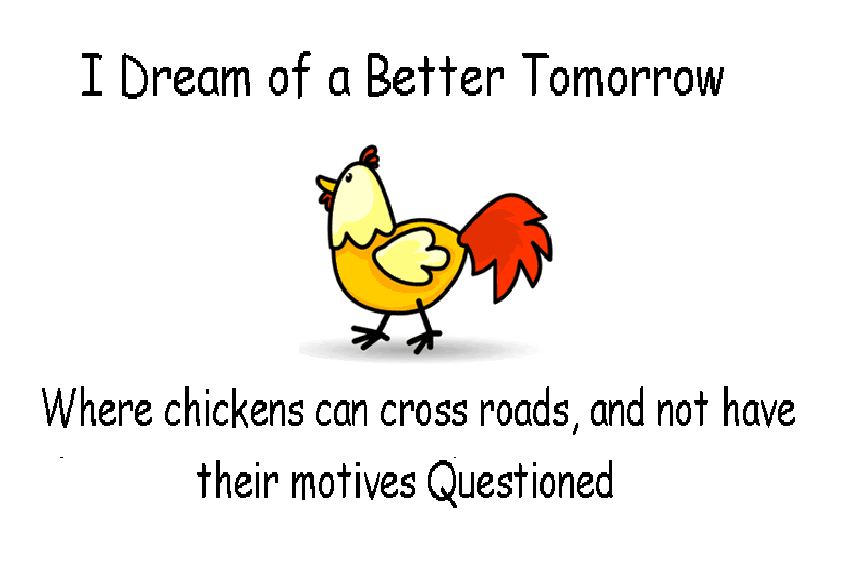
Vision and Dreams: "I dream of a better tomorrow, where chickens can cross roads, and not have their motives questioned.
Ontario's Premier and Agriculture Minister Kathleen Wynne has challenged Ontario's agriculture, food, and beverage sector to double its agri-foods exports by 2020.

Her government's press release notes that the agri-food sector has grown by a little more than 10% since 2002.  In 11 years, that's an average annual growth rate of 0.87% per year.

That's pretty weak performance, I'd say.  However, we have to admit that 6 of those years were through one of the biggest economic shocks since the Great Depression in the 1930's.

If we are going to double again between now and 2020, just 7 years from now, that would be an average growth rate of 10.41% per year.

Interesting!

China, the world's greatest exporter, and their historic
GDP quarterly growth, 2007 - 2013
The graph at the right from Trading Economics shows what China achieved in their GDP annualized quarterly growth rate.  As most people know, China has been one of the world's most powerful exporters in the last decade.

China's arithmetical average GDP growth over this period was 9.08%/yr, and the geometric average (probably a more useful statistic than the simple arithmetical average) was 8.96%/yr.

After recovering from the world-wide Great Recession in 2007, China had its very best GDP growth of 11.9% during Q2 of 2010.

Realize also that these results were produced only because China's government was laser beam focused on manufacturing and exporting, regardless of the environmental, health, safety, or social risks that this focus may have caused.

So our Premier wants us  to achieve growth in exports equal or better than the world records set by China when the world economy was booming.  Very interesting!

Growth is always a risky period for a business, as you have significantly higher costs for months or years, and you have to hope and pray that that huge investment in money and people can be recouped before something changes.

What happens if an ag-food business decides to take on this challenge for the good of Ontario, and the government changes its mind half way towards the goal, or a new government is elected and the policy changes?  You would be left high and dry, and nobody would come to rescue you.

Under the Green Energy Act, people got a guaranteed, no cut contract for 20 years, and about a 12% return on their investment.  What is the ag-food sector being offered?

Ontario's Premier has proposed this challenge to the ag-food industry, but it seems she neither offered nor provided any resources or plan with which to accomplish this challenging goal.

Just how dumb does she think farmers are?

However, for the sake of politeness, we will set aside for the moment any concerns about the advisability of this goal, or the potential of creating a severe overbuild of ag-food capacity (just like the Ontario government created in their electrical energy production system via the rapid priority shift via the Green Energy Act), or the social costs, or the inefficiencies created by last minute 90 degree turns in government policy.

In the interest of helping and supporting the Premier's goal, Small Flockers would like to offer a suggestion to the Premier of Ontario:
Pharaoh Kathleen Wynne,
Premier for the Province of Ontario, Canada

Pharaoh Wynne:   Let my people go!


I don't want the job of Moses leading his people out of Egypt from the oppression of the cruel Pharaoh, but neither did Moses when God called him to the task. Unlike Moses, I didn't even get the call.

However in Jan. 2012, I became concerned about some of the government policies and actions affecting small flock farmers, so I spoke up and asked for changes. Since then, I've learned that it's far worse than the relatively small issues that got me started on this quest. Now, as I learn more and more, I'm becoming more and more pissed off at all the craziness that has been going on for decades.

In a previous Blog posting, I suggested that the current Supply Management system be re-directed to focus on exports, and small flockers need to be freed up to supply the local domestic market in Ontario.

Today, Ontario has a debt of $252 Billion.  We pay $10.6 Billion per year in interest on that debt, rising at 5.5% per year.  Debt interest is now the 3rd. largest item on the provincial budget.

Enabling Ontario's small flockers can provide a significant part of the necessary hope and plan for getting Ontario the extra jobs it needs, the economic stability to get the huge provincial debt paid down, and eliminate Ontario's $9.2 Billion/yr deficit.

Small flockers have been badly wounded by severe wing clipping done to us by the Government and the Chicken Mafia over the past 3 decades. I believe there is still a spark within Ontario's small flockers that can be fanned and nurtured back into a vibrant roaring fire to warm Ontario's economy.

Let my people go, Pharaoh Wynne! Let us help you to help all of Ontario. Let small flockers supply safe, nutritious, affordable, locally grown poultry meats and eggs for our family, friends, and neighbours.

Small Flockers have suffered decades
of abuse at the hands of these two
co-conspirators
As an example, let's look at what Ontario has already done to create province-wide freedom.  In April 2008, Ontario used the Green Energy Act to pass Regulation 97/08 which now prohibits the banning of clotheslines for the drying of laundry by most building owners, condominiums, subdivision land covenants, or municipal bylaw. That broke 50 years of wrong-headed precedence to look "pretty" in spite of the cost and rights violations that had slowly creped into our society.

Ontario should now do a similar regulatory rationalization and standardization across Ontario for backyard poultry, in both municipal and rural areas.

Small Flockers suggest that if  municipalities insist on continuing restrictions for backyard poultry, then the municipality must show cause for any restrictions it imposes (ie. the burden of proof that the restrictions are necessary rests on the municipality), and those restrictions would have to be renewed every 5 years or they would automatically terminate.

For farmers, the Chicken Mafia and the Government need to release their death grip on the throats of small flock poultry farmers.

Small Flockers are currently prohibited from raising more than 300 birds per year.  That limit needs to be immediately raised to 2,000 chickens per year without quota.

The government must also relax the Meat Regulations so that on-farm poultry processing can occur in a safe manner; especially in remote and under serviced areas where there is no local government-approved abattoir that does custom processing.

Premier, let my people go, and you might be surprised at how close you come to your ag. doubling goal by 2020.
Paul Robeson (1898 - 1976), African-American
  Lawyer, Actor, All-American
Football Player,Social Activist, and Singer.

Oh! Let My People Go

The Lord, by Moses, to Pharaoh said:
Oh! let my people go.

If not, I'll smite your first-born dead—
Oh! let my people go.

Oh! go down, Moses,
Away down to Egypt's land,
And tell King Pharaoh
To let my people go.