Google+
Showing posts with label disease. Show all posts

Monday, November 9, 2015

Flawed CAFO Chicken

The Chicken Mafia promote and use flawed CAFO (Cincentrated Animal Feeding Facilities) as the one and only system for raising chickens.

For example, CAFO methods require or strongly recommend "All In, All Out" methods.  This means than the chicken barns are cleaned, scrubbed, washed, and sanitized so as to remove all microbes from the barn.  The empty barn is then filled with day old chicks.  People coming in are required to wear sterile boot covers and coveralls, some CAFO farms mandate that workers wear surgical masks, ensuring minimal or no chance of introducing microbes (both helpful and pathogenic) to the chicks.  The chicks in this "sterile" environment are raised to full age, then all of the birds are harvested and taken to slaughter.  All the birds move together as one flock.

This concept prohibits the separation of a flock into separate sub-flocks, prohibiting the harvesting of part flocks at separate timing.

The "All in-All Out" concept proposes that biosecurity is optimized under the following scenarios:
  • Preventing new chicks from introducing infections to an existing flock;
     
  • Existing older flocks likely have disease pathogens, for which the older birds have developed immunity or adequate defenses.  These potential diseases from older birds are prevented from being passed to new day-old chicks who have little or no immunity.
  • Catching a flock introduces pre-used cages into a "sterile" barn; cages that may be disease laden.  Many sub-contractor persons who have just finished catching a flock at another farm and may be carrying pathogens are introduced into a "sterile" barn.  For those birds caught and immediately slaughtered, there is insufficient time for those caught birds to become ill from the catching process, but the stress does taint the resulting meat.  There is also extreme stress to the birds not caught (they see and hear the screams and flapping of the birds that are caught).  They are also exposed to the crates and the catching crew, and have time for those exposures to start incubation.  When stressed, most digestive and other hormonal systems are dramatically changed and disrupted.  Prior medical conditions and pathogens that had been dormant or in remission suddenly come alive with a vengeance (eg. you tend to develop a cold sore on your lip after being emotionally stressed, lack of sleep, or other illness, even though we usually have adaptive immunity and the virus usually lays dormant within our bodies). The catching process significantly exposes the remaining uncaught birds, and they are left to deal with the consequences, often deadly.
If you drink of the CAFO Kool-Aid offered by the Chicken Mafia, all of the above might seem reasonable at first blush.  However, as you dig deeper, the dysfunction and wrong-headed assumptions in the Chicken Mafia's CAFO fairy tale become more and more evident.

Alternatives to CAFO Dysfunction

The alternative viewpoints against "All-In All Out" are as follows:

Chicken eggs are sterile, free from disease, bacteria, or viruses by definition.  If that wasn't true, the eggs would rot and turn bad long before they hatch during a 30 day incubation at warm and moist conditions.

When the fertile & sterile egg eventually hatches, the chick is also free from any microbes.

A "biome" is defined as the complex family of digestive system microbes that live on the feather or skin of the chicken, and/or inside the gut of every member of the flock.  There are more cells within the biome than the cells that make up the chicken (eg. feathers, brain, kidney, skin, etc.).  If it was majority rule, the biome would win, and the chicken would lose.

In natural chicken life, chickens normally eat chicken poo; their own, their parent's poo, or that of siblings or neighbours.  This especially occurs is CAFO chicken factory barns, as the chickens live on top of the poo for their entire life.  You may feel that is gross, but that is the life of chickens, and exists for good reasons.  It's not only chickens.  Dogs will naturally eat horse manure, and sometimes chicken manure.  Pigs will eat chicken manure, or cow dung.  On feedlots of today, 25% to 75% of a steer's diet is chicken manure or litter (manure and wood shavings scraped from a chicken coop).

On the first pass through the digestive system, only about 33% of the nutrients from the food have been extracted by a chicken's digestive system.  The first pass frees up and makes more nutrients bioavailable.  Re-eating chicken manure ensures a flock extracts maximum value from the available food.

When a chicken eats chicken poo, this also inoculates every bird's digestive systems, helping share and re-invigorate their digestive systems (ie. thing probiotic, similar to eating yogurt with an active bacterial culture),keeping all members of the flock "normalized".  If anybody is exposed to a new microbe, they are all soon exposed to it, so they all develop a shared biome of gut bacteria.

By chicks living under the wing of Mom, they are exposed to the biome on Mom's feathers.

By a chick eating a little of Mom's poo soon after birth (a natural and "planned" occurrence), the chick's digestive system is welcomed to the flock, sharing in the wealth of microbes that the flock has developed over the years.

Flocks with bad or inefficient digestive biomes tend to die off, and are replaced by other flocks with better biomes. Darwin's Law of Natural Selection.

When fertilized eggs are snatched from Mom, and incubated in "sterile" environments, there is no biome available to these chicks.  When the day-old chicks are placed in "sterile" barns, they are again denied a natural biome.

The more perfect the hatchery and the CAFO system enforces their biohazard prevention protocols, the more severe and longer in duration is the chick's denial of their biome birthright.
Figure 1: Image from the movie based upon the life of
David Vetter, the "Boy In A Bubble".  David suffered
from severe combined immunodeficiency (SCID),  and had
no viable alternative to his bubble.  Unfortunately, CAFO
chicken farmers choose this type of "biohazard bubble
technology", a questionable approach when many
better alternatives exist for biohazard risks.

Do you remember David Vetter (1971-1984), better known as the "Boy In The Bubble".  David had a congenital disease (SCID) where he had to be protected from every microbe, or die; for David had no immune system.

Why does CAFO chicken technology try to raise millions of chickens inside a biohazard bubble suit?

Would it not be better for all chicks to be allowed to spend some time with their parents, enabling them to receive their birthright biome system from their parents and relatives?

Alternatively, that birthright biome could be cultivated and standardized in the same way that yeast is developed and grown for the bread, beer, yogurt, cheese, and other fermented foods, which is then fed to the chicks soon after they hatch.

Another alternative is the free range or pastured poultry system where the biome is naturally accepted, and shared from one generation to the next by shunning the misguided and dysfunctional systems proposed by CAFO chicken factories.

Dr. Martin Blaser wrote the book Missing Microbes which discusses the growing evidence that modern food and medicine have destroyed the human biome for millions of people, causing or contributing to the growing epidemics of auto-immune diseases (eg. such as Addison's Celiac, Dermatomyositis, Graves', Hashimoto's thyroiditis, Multiple sclerosis, Myasthenia gravis, Pernicious anemia, Reactive arthritis, Rheumatoid arthritis, Sjogren syndrome, Systemic lupus erythematosus, Type I diabetes, etc.), obesity, asthma, cancer, allergies, and possibly many others.

Dr. Blaser discusses the questionable practice of agricultural antibiotic use, and the terrible consequences for humans.  It isn't difficult to extrapolate from biome deprived human diseases in his book, to the CAFO chickens who suffer similar fates in CAFO factory barns.

The biome depletion theory (a.k.a. The Hygiene Hypothesis) for humans has been around since 1989 formally, but has been anecdotally discussed for decades before that.  The Hygiene Hypothesis has been independently studied and judged to be statistically credible based on known evidence of allergies and morbidity in humans.  It is suggested a similar effect can be demonstrated in chickens. 

I am not suggesting that farmers should be lazy and leave their animals ankle deep in manure.  If the pads on the chicken's feet are ulcerated from standing in manure all day, that is not what I'm suggesting, and is unacceptable conditions that should not occur.

For example, Merck Vererinary Manual states:

 "True age-immunity does not occur, but older birds are usually more resistant than young birds because of earlier exposure to infection."
 and
"A species-specific immunity develops after natural infection, the degree of which largely depends on the extent of infection and the number of reinfections. Protective immunity is primarily a T-cell response."
However, if CAFO "Bubble Boy" biohazardous isolation techniques are done in a half baked, slipshod, lackadaisical manner, it might achieve acceptable results; as this would approach what I am suggesting is natural.  The more a farmer perfects and is in full compliance with CAFO "Bubble Boy" biohazardous techniques, the greater the risk to humans, and the greater the risk of catastrophic death rates to the chickens if there is one slip-up by the farmer.  Hence we see HPAI (Highly Pathogenic Avian Influenza) that kills one third of the US layers flock across hundreds of CAFO farms.

Doesn't seem like CAFO "Bubble Boy" biohazardous isolation techniques can work too well in the real world.

While the chickens are raised inside their biohazard isolation bubble, they must be fed massive doses of antibiotics on a regular basis to help ensure the profits of the CAFO farmer and better "seal" the biohazard isolation bubble around the chicken factories.  Those antibiotics often create Superbugs, and infect people, often fatally; for the retail customers cannot and will not live in a bubble.  Sooner or later, consumers pay the price for this CAFO Craziness.

Dr. Mercola seems to agree, recommending against CAFO chicken.

Why does CAFO chicken factories insist this flawed approach must be used and further perfected?

Like Canada's Supply Management system, CAFO chicken factories are based on flawed, dysfunctional, and dangerous technologies.

Most small flock farms do not attempt to put chicks into biohazard bubbles.  Our chicks get the biome inheritance of their ancestors.  Small flocks live clean and healthy lives.  There is rarely a need to medicate any individual.  There is never a need for massive, continuous dosing with antibiotics.  There is no need for a sterile biohazard bubble around free range or pastured poultry.

Wednesday, October 8, 2014

Deadly Canadian Chicken

Is Canadian chicken safe?  Seems like a simple question, but there is a huge debate about the correct answer to that simple question.

Better Farming posted a story in June 2014 on the increasing market share of chicken, consumer's desire to buy Canadian chicken, and the affordable chicken prices.  I found that posting recently, and added some comments about "affordable chicken" being #ChickenMafia propaganda.  An anonymous poster questioned my concerns about retail chicken prices, as they felt that CFO doesn't control retail prices.  I responded and again with some facts, trying to show that CFO had absolute power to ensure affordable chicken if they chose to exercise that power. Stephen Thompson jumped into the conversation in support of my position that Supply Management ("SM") regularly takes advantage of the Canadian consumer. I decided to add some objective evidence previously researched for this Blog on the unaffordability of chicken in Canada when compared to LICO (Low Income Cut-off poverty level) and Ontario's Minimum Wage. An anonymous poster complained about the use of minimum wage.  I responded with justification of the use of Minimum Wage as a benchmark, and reminded people that the unaffordable and poor quality chicken in Canada was causing or contributing to Canadians are dying every day.  Of course, those statements were jumped and resisted here and here, supported hereResponding to the Cost of Production ("COP") issue, I shared the secrecy that CFO uses for setting the farm gate price for chicken.  Raube Beuerman reminds the previous poster that the issue was chicken feed costs, not all costs nor all animals.  Then, the worm on the hook is dropped into the stream of questions, asking for me to justify my statement that poor quality, high priced chicken was causing and/or contributing to deaths in Canada.

With all these postings, it's a wonder any farming is getting done in Canada.

Having had the door opened, I shared the source of the disease and death from Canadian chicken.  I told them about the 4 million cases of foodborne illness in Canada, the chronic contamination of chicken with deadly pathogens, the chemical soup that is fed to the chickens so as to reduce the risk and costs of the #ChickenMafia, and the Frankenstein meat that results, with high Omega-6:Omega-3 ratios worse than slow grow and pastured poultry.

Stephen Thompson replied  that there was only weak, circumstantial, or no proven relation between Canadian chicken and disease or death.

In response to Stephen's doubt about cause-effect for deaths from Canadian chicken, I supplied the following (the central theme of this Blog posting):
The cause-effect data for Canada is not readily available at this time. CFIA has started  a Pathogen Reduction Initiative (PRI) for chicken, and is studying the baseline contamination level.
This Canadian program started in 2012, and follows the same format as what the USDA completed in 2008.  The USDA study showed a major problem for raw chicken, mainly from salmonella and campylobacter.  Unfortunately, Canada is 4 yrs behind times.

CDC estimates that 22% of all foodborne illness and 29% of foodborne deaths come from contaminated meats.

Chicken is chronically contaminated, while pork and beef are usually periodically contaminated.

CDC estimates that poultry caused somewhere between 5% to 20.6% of all foodborne illnesses in the USA between 1998 to 2008 (see Table 3 ).  That analysis is based on 4,589 illnesses during that period.

Poultry is blamed for 9.8% of all foodborne outbreaks and illnesses, 11.5% of all foodborne illnesses that required hospitalizations, and 19.1% of all foodborne diseases that resulted in death.

Until Canada catches up on solving the lousy Canadian chicken issue, I suggest that these US percentages are applicable for Canada, until proven otherwise.  Do you agree?  If not, why not?

Do you still insist that my previous posting was "overly dramatic"?

Is my previous posting so easily dismissed as exaggeration and hyperbole?

If you base your opinion on other data that conflicts with this data, please provide the links and explain further so we can all better understand the source and justification for your jaded doubts.

Have I convinced you that we have a problem with poor quality chicken in Canada?

Friday, May 23, 2014

Sick Chickens Go To Market

When a flock gets sick, the fastest and lowest risk solution is to send those birds to slaughter, passing the problem off onto unsuspecting consumers.  Is this standard procedure for the Chicken Mafia, or just the actions of a rogue chicken farmer?

The reading of government records can yield interesting questions and glimpses behind the curtain.  Sometimes CFIA takes actions, and lays charges against a member of the Chicken Mafia.  The member of Chicken Mafia wants to escape censorship and the resulting fine (2 tickets @ $6,000 per ticket= $12,000 total fine), so they often plead and whine, promising anything that will get them off the hook.  In spite of this, sometimes CFIA sticks to their principles, and won't let the issue die.  The Chicken Mafia member then often chooses to appeal the CFIA charges to the Canada Agricultural Review Tribunal ("CART").  That is where the public gets to see behind the Chicken Mafia curtain of secrecy.

In one case, of which I know nothing except what I read of  the CART decision, a farmer (Peter and Lisa Rombouts, whose farm is located at Bosanquet, ON) was having 80 chickens die per day from some unknown cause.  After suffering these huge losses for a week, the farmer decided to ship his problems off to the abattoir, crystalizing his profits to cash before the whole flock ended up dead.

The farmer called a company (Greidanus Poultry Service Ltd. ) that is in the business of catching birds, loading the chickens into cages, putting them on a truck, and shipping them to the chosen abattoir.

After the first of two trucks were shipped, the farmer disclosed to the trucker that he had had a huge death rate in his flock the week before.  The trucker then examined the farmer's records, and confirmed that this was substantiated.  There is a responsibility that a sick or fragile bird  should not be loaded.

Because this critical info was withheld by the farmer, and/or due diligence by the trucker was delayed or done out of sequence, it is questionable if the birds were properly assessed prior to shipping.

From CRAC's decision, we learn:
"Buttar [an employee of the trucker] told the Tribunal that on that night he did discuss flock health issues with the producer and the producer informed him that there had been a big death loss the week before the loading, up to 80 bird deaths per day during that period, which was verified when Buttar reviewed the producer’s log on the day of the loading."
In cross-examination, Buttar told the Tribunal that the increased mortality at the Rombouts’ farm in the days before the loading was not brought to his attention until the end of the loading process. While this increase was a concern, one of the loaded trucks had already left when this fact was brought to his attention and at any rate he told the Tribunal the decision to send or not to send the truck would be the producer’s or the processor’s. However, Buttar said that as foreman he has an obligation to only load birds that are fit for transport.

Buttar said that the crates into which these large chickens were being loaded that night would hold about nine 4-kg birds, and so, with loading instructions to load only six to seven birds per crate, there would have been room for up to two more birds in each crate.

When asked under cross-examination, Greidanus
[the owner/manager of the trucking company] agreed that about 9,600 chickens were loaded by his crew in around two hours and that it was possible for a loader to load a chicken into the crate on its back, particularly with the heavier chickens. Greidanus added that he would not leave a chicken on its back in a crate but that “everyone is human and it is possible to miss [righting] a chicken [back onto its feet]”.

total length of time from beginning of loading to beginning of processing: 15 hours 45 minutes for first trailer and 18 hours 35 minutes for second trailer

Buttar also stated, however, that at the end of the loading he chatted with the producer and noted that there were at least 60 dead birds and 10 smaller, injured or frail live birds in the producer’s barn which were not loaded for transport by his crew.

The evidence is equally clear that on January 20, 2011, when the birds were unloaded for processing, 334 of the 9,599 birds were dead and of these 156 were found dead on their backs.

"Greidanus told the Tribunal that his company had experienced a lot of problems shipping birds to Quebec because of the increased transport distance and the heavy size of birds that are shipped. The birds now grow so rapidly that they are stressed and it takes so little to make them die, he stated. Greidanus testified that he has seen birds dying in a crate and has seen a bird flip over and die in its crate."

Do other possibilities exist for where and how the injury and death of the chickens took place? Yes, the chickens might have been in a fragile state before loading, as indicated by the producer log sheets, showing a higher than normal mortality rate in the days and weeks before the shipment. The chickens might have experienced increased stress due to their heavy weight, the long distance and the long period of time between the farm of origin and the abattoir, which could have resulted in increased mortality while en route.

Greidanus has his theory that the chickens were large stressed birds that travelled a very long distance and died of a heart attack en route, which may or may not be consistent with the rare phenomenon mentioned by Lefebvre
[chicken Vet] and Fortin [Chicken Vet], which has been observed in chickens called “flip-over disease”.
From all of this, we learn about the razor edge that has been created by the Chicken Mafia's search for maximum profit.

Birds grow so quickly, they face the daily risk of dying from too rapid of a growth.  About 560 birds died the week before shipment (ie. 80/day * 7 days= 560).  Another 334 were DOA (Dead On Arrival) at the abattoir, and 70 birds were left behind as too sick or too frail to ship, and 9,265 made it to the abattoir alive to reach their ultimate purpose of going to slaughter.

It is unknown how many were approved or condemned at the slaughter stage, but I previously showed that it's typically 1.26% (see Condemned Chicken Blog posting of 2013/03/14), where I show that Ontario has a condemnation rate that is "23.3% worse than Atlantic Canada, and 21.7% worse than BC".  If that holds true in this case, 117 birds were condemned during the slaughter process as unfit for human consumption.  Therefore we have a total death or ill toll of 1,081 birds with 9,148 becoming chickens sold, so a loss rate of 10.57%.  In addition, we would have the losses in the early life stage (ie. day old chicks to 5 weeks of age, which can be equally horrific under the Chicken Mafia's system of pseudo agriculture animal husbandry.

When will be learn that the current system designed and practiced by the Chicken Mafia  has become more and more broken as we go down the wrong road.

This is not right, nor sustainable.


Sunday, April 20, 2014

Finally! CFC Bans Ceftiofur Injections in Eggs & Chicks

The use of the powerful antibiotic Ceftiofur in chicks and eggs has finally been banned by Chicken Farmers of Canada ("CFC").  CFC's new rule takes effect on May 15th 2014.

CFC's private glacier must have melted a little recently.   CFC, long ago frozen in administrative suspended animation, has finally decided to act for the good of Canadians.  Previously, it seemed as if CFC would rather focus their efforts on themselves and their millionaire, greedy chicken farmer stakeholders.

My heartfelt congratulations to CFC for joining the rest of us who live in the real world, rather than CFC's delusional and self-serving assumptions.

Chicken farmers have a long history, over 60 years, of using drugs, chemical, and yes, even poisonous and cancer-causing arsenic in the chicken feed and water supply for their factory farmed foul chickens,  This crazy scheme of the Chicken Mafia helps them to maximize their profits and reduce their business risk; regardless of the possible impact on people who would eventually eat their chicken as food.  Sounds crazy, but it's true.

For ceftiofur, factory chicken farmers ordered the hatcheries to have robots inject ceftiofur into millions of hatching eggs so that the chickens would be tainted before they were born.  In other cases, the newly hatched chicks were sexed, then injected with their vile antibiotic fluid so as to maximize their profits and minimize their business risks.

Once Public Health Canada identified the rising tide of superbugs in retail chicken, all broiler chicken hatcheries in Québec voluntarily stopped all use of ceftiofur in February 2005.  The superbug incidence rate started dropping shortly after this voluntary ban.  The hatcheries ended their voluntary ban, and the superbugs on retail chicken were back soon thereafter.

I previously reported on, complained, and warned about these issues as early as March 2, 2013 which is just 3 days after starting this Blog (see Eating Farm Gate Chicken? ).  This Blog's all time winning Blog post for reader activity is Choose: Frankenstein Chicken, or Naturally Raised Chicken? from April 2, 2013.  Also see here, here, here, here, here, and here.  Do you think any of that commentary helped throw CFC over the cliff to abandon their foolish scheme?

Naw, I doubt it.

Is Quebec an isolated case?  No, it's Canada-wide.  Dr. Nancy de With, DVM MSc, Epidemiologist with BC Ministry of Agriculture and Lands gave a talk on this very subject on April 18, 2006 called "Antibiotic resistance of enteric bacteria in commercial broiler chickens in the Fraser Valley, BC" (original MS Powerpoint slides), or a DocStoc on-line version. Here is Slide 16 which shows up to 96% of the samples of the chicken's intestinal bacteria having SuperBug resistance to Class I (very high importance for humans), II (high importance for humans), or III (medium importance for humans) human antibiotics.

Broiler Chicken Bacteria have gained significant resistance to human antibiotics, likely due to the chronic
use of antibiotics to inject eggs, in the feed, and the water of chicken factories so as to maximize the profits
and reduce the business risk of millionaire chicken producers, regardless of the cost and risk to the public.
Unfortunately, all of these antibiotics, drugs, and chemicals in the feed &/or water fed to factory farmed foul chickens have created superbugs on retail chicken sold in grocery stores.

In 2010, Public Health Canada reported an extremely strong linkage (ie. the correlation describes 90% of all variation between ceftiofur-resistant Salmonella enterica serovar Heidelberg isolated from retail raw chicken and incidence of ceftiofur-resistant Salmonella serovar Heidelberg infections in humans across Canada.

Most people think of hospitals when they think of exposure to superbugs (ie. nosocomial infections ); some that cause life-long infections, or death.  However, today it is likely that the raw chicken in the grocery store is the greater threat, not hospitals.

The majority of households do not have repeated visits to the hospitals; most people are generally healthy.  However, virtually every family makes a weekly trip to the grocery store.  The higher frequency of exposure via the grocery store may make this the #1 risk to your family from Superbugs.

You may be a vegetarian, and never go near meat.  I hope you don't think that being a vegetarian will protect you from a Superbug infection originating from raw chicken?

Most people eat meat, and after they touch packages of raw chicken, they touch just about everything else in the grocery store that vegetarians and everybody else touches too; like the grocery carts, food display cases, and the handles on the freezer cases in the grocery stores.  Now that you also touched those same surfaces, that Superbug slime from the chicken wrapper is all over your hands too.  You'd better be careful what you touch next.

Oops!  You touched your lettuce in your cart when you re-adjusted its position so it wouldn't get squished by your other groceries.  The lettuce is now contaminated with chicken Superbug ooze, and those Superbugs won't fully wash off even if rinsed under running water at home.  Your salad now has an extra, secret ingredient that you did not intend to add.  Say thank-you to the Canadian factory farmed foul (chicken).

This story was initially broke by Margaret Munro's story in The StarPhoenix and/or O.Canada.com  (more comprehensive version).  Click the link and read the excellent history that puts the "smoking gun" in the hands of the CFC, while they stand over the dead bodies of their alleged victims, the Canadian public).  These stories seems to have been based on a related story in the Ottawa Citizen.

Ceftiofur antibiotic use causes the corresponding growth of superbugs
on chicken, and in human infections.  Quebec banned the use of
ceftiofur in chickens, and the superbug problem disappeared; first on the
chicken, then in humans, so Quebec allowed ceftiofur to start being used again.
The superbugs soon came back again, so Quebec banned ceftiofur  again.
Meanwhile in Ontario (also a superbug hotspot), neither the Ontario
government nor CFO did anything, as usual.  Above graph is from
http://www.ncbi.nlm.nih.gov/pmc/articles/PMC2871348/
The Canadian Veterinary Journal and Public Health Canada sheds some additional light on the subject here, here, here, here, here and  here.  Here is the graph showing the Superbug hotspot data from Quebec and Ontario.

Searching CFC's website for "ceftiofur" so as to confirm this news flash yields nothing.  Searching for "antibiotic" gives CFC's standard propaganda justifying their fossilization and suspended animation of their self-serving and wrong headed policy on the permitted and recommended use of antibiotics to maximize chicken farmer profits; in spite of the growing evidence of their wrong-headed policies.
After May 15th, it is hoped that CFC and all other SM Mafia personnel will actually audit their henchmen to ensure their compliance with the new rules.  The greatest risk of all is some renegade chicken farmers who are greedy enough to continue buying their drug of choice on the black market, or ordering their corporate veterinarian to prescribe the drug of choice, or personally importing it, and feeding it to their flocks; callously continuing the risk for Canadian consumers.

US Centre for Disease Control released the following video in Sept. 2013 about antibiotic resistant diseases spreading throughout North America.


In the interim, here are SFPFC's recommendations to protect yourself from chicken superbugs in the grocery store and when you bring them home to your unsuspecting, innocent family members.

So CFC finally took action on this huge Superbug risk. Why did CFC take this action now?

Was it the end consumer's demands for change?  Was it CFC's deep empathy and caring for the needs and priorities of these potential victims of CFC's crazy plans?

Don't make me laugh!

CFC is a narcissistic organization, like the rest of the Chicken Mafia (see Individual and Organizational Narcissism ).

Narcissistic organizations tend not to identify and correct their previous errors.

I can only assume that behind the scenes, the Chief Vets of the Provinces and Federal Government, and/or Health Canada and Public Health Canada twisted CFC's arm, by saying "Take appropriate action to this threat to public health, or else!".

Maybe someday, we will know for sure.

Will CFC give Canadians their assurance that they will adequately police their members and ensure Mafia-style compliance with the Chicken Mafia Don's orders against the use of banned antibiotics?

If CFC is unwilling or unable to give us that assurance of comprehensive auditing to ensure compliance, then their banning of ceftiofur is a mere smokescreen to distract and mislead Canadians; true to their narcissistic character.

Don't hold your breath.

Friday, March 14, 2014

Factory Farm Antibiotics

Q:   How did farmers get addicted to feeding antibiotics to their farm animals?

A:   Money

In a recent New York Times article, The Fat Drug, we get a history lesson on how Lederle Laboratories started feeding its antibiotic Aureomycin to chickens to test it effects in 1948.  The chickens who got their regular feed plus the antibiotic grew faster, and gained twice the weight of the control group.

Faster and greater weight gain is equivalent to money.  Further testing on pigs, cows, and sheep proved it was universal.  Soon, they learned that they could keep the expensive drug for humans willing to pay the big price, but the waste products produced during the manufacturing of the antibiotics were equally potent for the animal feed supplement market.  The drug manufacturing wastes that previously had to be disposed at additional cost could now be sold to farmers as a feed additive; thereby giving the pharmaceutical companies a double dip of profits.

It was a marriage made in heaven.  Farmers couldn't get enough of it.

Unfortunately, few thought about the negative consequences or side effects; neither for the animals, nor those humans who would eventually eat those animals as food.

We know that there are about 1,100 different species of bacteria in the human gut around the world.  Most of those species are localized to certain geographical regions, groups, or families.  Each individual has a sub-set of around 150 species in their gut.  Those species form a community of around 100 Trillion bacteria in the typical human gut; called a microbiome.  Most of these bacteria need very specific growing conditions, and are unable to live a normal life outside the human gut, nor away from all the other microbes in the gut.

E.coli is one of the exceptions to this rule, and is quite happy living anywhere as long as you feed it.  That is why it becomes a problem when our food or hands become contaminated with E.coli.  We tend to be infected by huge colonies of E.coli that overwhelm the microbiome in our gut, giving us food poisoning.

Over time, as the experiment continued, tragic failures with many victims taught us some of the consequences for the farmer's greedy actions.  The government soon passed regulations about drug withdrawal times, so that minimal or no antibiotic residue could be found in the meat.  However, the meat that was grown under this antibiotic-induced altered state still remains on the animal.  How has the meat been changed by these life-long dosing of antibiotics?

Changing the gut changes everything.  For example, there is a recognized human medical treatment called Fecal Bacteriotherapy, or "stool transplant".  This is where stool (ie. feces) is transferred from one person to another so as to inoculate their bowl with different microbes, so as to help cure the recipient of some disease (eg. treating C. difficile  infections with over 90% success, when all available antibiotics have failed).

It has been found that if you do a stool transplant from a fat person to a skinny person, the skinny person will start to rapidly gain weight.  Similarly, if you do a stool transplant from a skinny person to a fat person, the fat person will rapidly begin to lose weight.  The gut, and the type and strength of microbes present there effect everything else in our bodies.

When farmers are messing with the microbes in the gut of farm animals, it's like the Sorcerer's Apprentice; they have no clue about what they are messing with.  Dr. Blaser and his colleagues have been studying these issues for decades, which will be summarized in their book “Missing Microbes” due out in April 2014.

Remember, there are about 100 Trillion bacteria cells in our gut, but our human body is estimated to have just 37.2 Trillion cells, so "we" (the human cells) are only 27.1% of "WE" (gut bacteria + human cells)   ie. 37.2/(37.2+100)*100%= 27.1%
 
The normal microbiome of a farm animal is totally disturbed when you feed it antibiotics.  That upset has been found to continue for weeks, months or years after the antibiotic doses have been stopped.  The entire metabolism of the animal is disrupted when antibiotics are fed.  It truly becomes "mystery meat", possibly quite different from what we have evolved and grown accustomed to eating for the last 300,000 years of human existence.

Some of those metabolic changes can be tested for today, but our knowledge is very limited.  A mere 60 years of experience compared to 300,000 years of human evolution is less than a blink of an eye.  We are truly conducting a live experiment with ourselves as the human guinea pig.

Unfortunately, the antibiotics allow faster weight gain, and also allow the raising of the animals in congested, un-natural housing on un-natural feed so as to maximize factory farm profits.  Without these necessary ingredients, factory farms would never exist.

Perhaps we will soon learn our lesson about settling for the cheapest, the lowest common denominator, and the propaganda of Big Food advertising.

Wednesday, January 1, 2014

Vegetable Oils

Previously on this Blog, we discussed the dietary fat mis-information that has been circulating since the early 1950's.  Yesterday's Blog posting discussed the pros, cons, comparisons, and contrasts between the animal fats from beef, pork, and chicken.

Today, we can discuss the known facts for vegetable oils.   Most everybody agrees that trans-fats are bad for us.  These are mainly formed by taking vegetable oils and reacting them with hydrogen under high temperature, vacuum, and usually with a catalyst, to create cheap, semi-liquid fats that can be used in margarine and prepared foods.  In other words, avoid partially hydrogenated oils, and the margarines that contain them.

Oil expressed from olives, nuts, and other fruits were made from before the Pyramids were built.  Generally, these are preferred.

Olive oil (depending on its source and manufacturing methods used) is composed of:
  • 55% to 83% oleic fatty acid, a mono-unsaturated Omega-9 fat.
  • 3.5% to 21% linoleic fatty acid, an Omega-6 poly-unsaturated fat.
  • 0.3% to 3.5% palmitoleic fatty acid, an Omega-7 mono-unsaturated fat
  • <1% α-Linolenic acid, an Omega-3 poly-unsaturated fat 
 The USDA provides the following as typical olive oil in N. America:
  • 73% mono-unsaturated fat
  • 14% saturated,
  • 11% poly-unsaturated fat
The 73% mono-unsaturated fat in olive oil simultaneously raises HDL ("good cholesterol"), and lowers LDL ("bad cholesterol"), which has significant beneficial dietary health effects.   The 14% saturated fat simultaneously raise both HDL and LDL, somewhat cancelling each other out as to the health effects.
Cottonseed Oil + P&G= Crisco
Cotton seeds were a waste product from the cotton gins that produced raw cotton for making cloth.  In 1911, Proctor & Gamble collected these cotton seeds for free, developed a process to extract the oil, clean it, hydrogenate it, and created Crisco shortening.

In 1930's soybeans were imported from China to N. America  for the first time.  By the 1950's soybean oil was a popular vegetable oil.  Today, soybean oil is virtually tied for 1st place with palm oils for world-wide consumption.

In the 1980's canola oil rapidly increased in popularity in N. America as a light, low taste oil, "perfect" for salad dressings, frying, and factory processed foods (eg. muffins, boxed cereals, etc.).

Some vegetable oils (eg. corn oils, soybean oil, etc.) are extracted from their seeds, nuts, and fruits by using petroleum solvents such as hexane (similar to gasoline).  Virgin olive oil means that no solvents were used.  There is a growing concern today about the residual effects from these solvents.  Use of petroleum solvents is not permitted for organic certified foods.

Triglycerides are the main constituents of vegetable oil (which are typically more unsaturated) and animal fats (which are typically more saturated).  Many people remember the warnings against all forms of cholesterol, said to be artery clogging.  That was the quackery of Ancel Keyes which is still with us today.  The science is a little more complicated that Keyes' simple, but wrong, hypothesis.

There are 4 major types of cholesterol in our blood:
  • VLDL (Very Low Density Lipoprotein), which is used by the body to enwrap and carry most of the triglycerides flowing with the blood.  VLDL is "bad" cholesterol, created by the liver as a triglyceride and cholesterol transport mechanism.
  • IDL (Intermediary Density Lipoprotein), which is a VLDL that has discharged most of the triglycerides and cholesterol that it had previously contained. Some IDL get absorbed by the liver, while others lose further triglycerides while in the bloodstream, and eventually become LDL.

  • LDL (Low Density Lipoprotein), a.k.a. "bad" cholesterol.  LDL is the format where most of the cholesterol in the blood can be found.  There are 7 sub-types of LDL.  The small-dense LDL particles are the ones that cause the greatest cardiovascular damage.  See Krauss

  • HDL (High Density Lipoprotein), a.k.a. "good" cholesterol

Ancel Keyes, the quack, measured total cholesterol in the blood (ie. HDL+LDL+IDL+VLDL), as this was easy to do in 1950's, and he couldn't differentiate (it was total cholesterol measurements, or nothing, so that is what he used).  Some doctors continue to do total cholesterol measurements today, only because they can still do so cheaply and easily; even though the total cholesterol levels has little or no predictive power for future health or disease; and is therefore a dis-service to their patients.

In 1956, American Heart Association's journal Circulation published a minority report by Dr. Gofman at USC Berkley, which reported that adding the blood's concentration of VLDL + LDL was the best predictor of future heart disease (ie. the Atherogenic Index).  Today, the best known indicator is VLDL + LDL+Triglycerides in the blood.  Alternatively, HDL:Total (the algebraic equivalent proxy measurement) is highly predictive of disease and mortality.

What Causes HDL, LDL, VLDL to Vary?
  • HDL ("good cholesterol") is increased by physical exercise, weight loss, and a low carbohydrate diet.
  • LDL ("bad cholesterol") is increased by dietary saturated fat consumption.
  • VLDL (""bad cholesterol") is increased by dietary carbohydrate consumption
Therefore simultaneously eating saturated fats plus carbohydrates (eg. deep fat fried doughnuts with a sugar glazing) would simultaneously drive up both VLDL and LDL, thereby compounding the risk of heart disease many times over.

Today, many medical doctors who are behind the times will take the ratio of HDL:LDL as being indicative of health, and prescribe medications (ie. statins, or other cholesterol lowering medications) when this ratio goes out of whack. Again, this is a bad habit, as taking the ratio of LDL to total cholesterol would be a far better predictor of health (ie. the lower the ratio of LDL:Total Cholesterol .  Secondly, total triglycerides in the blood would also be a better indicator of health than the HDL:LDL ratio.

In reality, dietary triglycerides are highly correlated with cardiovascular disease, while the relationship between cardiovascular disease and total cholesterol is slight to non-existent.  Generally, most foods that contain triglycerides also contain some cholesterol, and most triglycerides are transported in the blood by lipoproteins than contain both triglycerides and cholesterol, and it is believed that these two facts account for that slight secondary effect.  The main killers are triglycerides, and the small, dense sub-type of LDL cholesterol.

Omega-6 fatty acids come mainly from vegetable grains such as palm, soybean, sunflower, canola, corn, safflower, etc.  These oils are relatively cheap, and are therefore heavily used in factory prepared foods, and restaurant foods.  Omega-6 oils have been associated with causing or contributing to inflammation diseases (eg. rheumatoid arthritis, inflammatory bowel syndrome, etc.).

Excess dietary Omega-6 fats are said to interfere with the health benefits of Omega-3 fats.  Therefore Omega-6 to Omega-3 ratios have become an important indicator of acceptable dietary fat intake.

Yesterday's Blog posting discussed the ideal Omega-6 to Omega-3 ratios of  less than 4:1, but the typical N. American diet is between 10:1 to 30:1; well away from the ideal.  We eat way too much processed, factory foods for our own good.

Way too much vegetable oils in our diets are one of the leading causes of these poor Omega-6:Omega-3 ratios.

By eating more chicken rather than vegetable oils, our Omega-6:Omega-3 ratio can be significantly improved.  By eating pasture-raised chicken rather than #ChickenMafia raised chicken, our Omega-6:Omega-3 ratio is maximized.

All of this should lead to better health and less disease.


Monday, November 11, 2013

Health Consequences of Food Monopolies

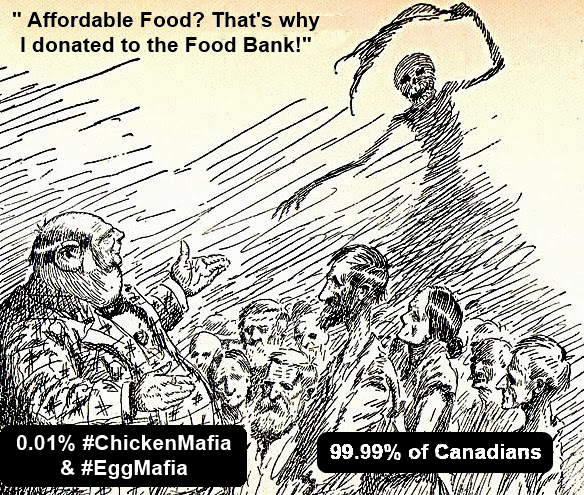
Obese man representing the 0.01% #ChickenMafia & #EggMafia tell the hungry 99.99% of Canadians, "Affordable Food?  That's why I donated to the Food Bank!"
The local food bank near my home reports that food bank usage by their clients has increased by 75% in the last 3 years.  This represents an average annual growth rate of 20.51% per year, or a doubling and then re-doubling every 3.5 years.

I'm sure your region has similar scary news.

Health Canada has reported that 7.6% of Canadian families can't afford the food they need to feed their families (ie. "food insecurity"); as high as 28% in Nunavut (ie. the Far North of Canada).

What are the consequences of this food bank trend for Canadians?

I wanted to get some hard facts, rather than just my intuition.

I had done linear programming in Engineering at University some 35 years ago.  I had used it time and again during my career to solve complex optimization problems.

I remember reading George Dantzig's historical review on the development of the Simplex method in the 1930's at the US Bureau of Labor Statistics, Urban Study of Consumer Purchases.  The US Army needed to know what was the cheapest meal they could feed to soldiers in the field while ensuring they were adequately nourished ("The Diet Problem").  The rest, as they say, is history.  The Simplex method of linear programming was born.

Solution for Diet Problem with between 0 to 300
grams of carbohydrate for a meal cost of US$0.956
Today, there is a web site that provides a simplified model of the Diet Problem.  The on-line Modified Simplex optimization engine simulator is available here for anybody to use.

The model uses a subset of foods and their nutrients from the USDA database here.  Many of the foods used here are typical of N. American diets, and are one of the causes or contributing factors to our rising tide of disease (eg. obesity, diabetes, cardiovascular disease, high blood pressure, rheumatoid arthritis, stroke, dementia, etc.).  I accepted and used this default subset database.

My intuition says, that when chicken and eggs are too expensive, people are forced to "dumb down" their food purchases, resulting in more and more carbohydrates in the shopping baskets.  I therefore ran a number of simulations to see the impact of more or less carbohydrates in the permitted diet.  A typical output is shown at the right.  Click on it for a bigger version.

The lowest possible carbohydrate diet I could find that met the RDA (Recommended Daily Amounts) was 243 grams of carbohydrates, with the minimum cost being US $8.3288 per day.  It is not clear when and where these default prices for the simulator database originate, but I assume the are a snapshot in time from somewhere in the USA, and are consistent within themselves.
Minimum cost of a nutritious meal vs.
the maximum permitted carbohydrates.

Any attempt to construct a lower carb. meal was impossible with the foods in this subset database.  With the whole USDA database, I'm sure other alternative menus will become available.  I leave that more comprehensive exercise to others, as I think what I have done here proves my intuition to be sufficiently accurate and useful..

I ran simulations from 243 gram/day, to as high as 10,000 grams of carbohydrate per day, seeking low cost meals.  The resulting series of minimum meal prices is in the graph to the right.

The lowest carbohydrate level with the same or lower $/day cost was found at 312 grams of carbohydrate with a meal cost of $0.9303 per day.  If you try to lower the carbohydrates below 312 grams, the meal cost goes exponentially higher in price from there on as you lower the carbohydrates.

Remember, this is US data, where chicken is 1/3 less expensive than in Canada, and eggs are 65.5% cheaper than in Canada.  That means chickens and eggs are not affordable choices for Canadians, and we are pushed harder and sooner toward high carb., unhealthy meals.

It should be noted that Dr. Jay Wortman, a physician in British Columbia, has successfully maintained himself symptom-free (ie. diabetes Type II remission) by a ketogenic diet of 10 grams carbohydrate per day for more than 12 years.  CBC TV did a documentary on his success, My Big Fat Diet.  Fortunately, as a medical doctor, the higher scale income he enjoys allows him to better afford the gouging prices imposed by the #ChickenMafia and #EggMafia.  For a quick summary, see a YouTube interview of Dr. Wortman here or watch it here:


By their monopolistic greed and uncaring actions, the #ChickenMafia and #EggMafia steal this cheap, effective, and healthy low carb. solution (ie. chicken and eggs) from most Canadians.

Meals with excessive carbs (ie. low carb is 10 to 60 grams of carb per day, the RDA is 130 g/day, while a typical North American diet has >300 g. carb. per day) usually cause or contribute to weight gain.  Most people become more sedentary when consuming more carbs as a portion of their diet, causing a lower energy expenditure; compounding the weight gain effect.  This high carb diet can partially explain the consistent increase in obesity in Canada, as reported by Health Canada.

Health Canada graph showing obesity rate (BMI >=30) rising from 14.9% to 17.2% for 2003 to 2009


The 243 g. carbohydrate daily intake menu at a cost of $8.3288 per day is as follows:

Optimum Meal Menu and servings for 243 g. of carbohydrate
at a cost of US $8.3288
 The 306 gram of carb. daily intake menu seems starvation to me, at a cost of $0.9303 per day is as follows:
Optimum Meal Menu and servings for 306 g. of carbohydrates
at a cost of US $0.9303
Remember, this is all you get for the entire day (breakfast, lunch, supper, & snacks).  Ouch!

Which daily meal menu would you and your family prefer if you didn't have to pick up the cheque?

Note that the food prices go up by 895.3% if we try to drop the carbohydrate consumption by 25.9%.

Can Canadians and the world now see clearly why we have a huge problem?  Canadians are forced, out of economic necessity, to eat more carbohydrates, rather that the astronomic prices we are charged for chicken and eggs.

Who will stand with Small Flockers to expose this crime against the Canadian people?

If you will not stand with us now, I suggest you lose the right to complain as hospital waiting rooms explode with sick people and taxes go through the roof to pay for all the sick people and the lost productivity.


Monday, March 4, 2013

Condemned Chicken

CFO (Chicken Farmers of Ontario) say they are all about quality and continuous improvement.  Do they offer any proof of their accomplishments which is independently verifiable ?  There does seem to be lots of effort at CFO, and some changes, but I wonder if their focus is in the right area.

To me, CFO's prime role is to serve the greater good of the public.  One of the most important aspects of serving the public is having safe chicken of excellent quality.  To maximize the safety and quality of chicken, you have to have healthy birds.  Just how healthy are the birds raised in Ontario?

The following table is derived from data provided by CFIA (Canadian Food Inspection Agency) here.  I confirmed with a CFIA DVM (Doctor of Veterinarian Medicine) who is in charge of producing the reports that the numbers presented there are correct, and I was understanding them.


I see that in 2012, Ontario's Federally Inspected slaughter plants received about 370,000 dead or diseased chickens from chicken producers. That is a defect rate of 1.26%.

In addition, I observe that Ontario's chicken crop is 23.3% worse than Atlantic Canada, and 21.7% worse than BC.

I wonder why?

If chicken farmers in BC and the Atlantic Provinces can deliver fewer dead and diseased chickens to the slaughter plants, why can't Ontario?

If CFO (Chicken Farmers of Ontario) has their "Team Ontario" trained to be the best they can be, then why is Ontario significantly worse in bird health than what the farmers in BC and the Atlantic provinces can achieve?

If anybody knows the answers to these puzzling and disturbing results, I'm interested in learning why.