Google+
Showing posts with label animal welfare. Show all posts

Saturday, June 27, 2015

Is "Humane Certified" Really Humane?

Foster Farms is the most
recent accused for chicken
abuse by the Chicken Mafia
The public is getting more and more enraged by clear violations of humane treatment and reasonable animal welfare for farm animals, including chickens. This time it was Foster Farms, a member of the US Chicken Mafia.  The Chicken Mafia can and should be preventing these incidents from occurring, then promptly responding to these incidents when their prevention efforts were insufficient.  Instead, the Chicken Mafia, whether in the US or Canada, prefer to delay, deny, distract, defend, destroy, deride, and deflect; rather than make the necessary changes to their dysfunctional systems.

Mercy for Animals enlisted Bob Barker, the former "Price Is Right" host, TV personality, and animal rights advocate for more than 30 years, to host and narrate this shocking video.


If the above video is reliable evidence, something in this commercial chicken system is broken, and needs to be fixed.

The above video is alleged to have been shot in California USA, at Foster Farms poultry slaughterhouse in Fresno, and their three poultry farms in Fresno County.  Once the undercover video was published, Foster Farms suspended 5 employees, and are doing re-training for the other employees in the areas investigated. The allegations received an immediate knee jerk reaction by the management of Foster Farms, blaming their employees.  Foster Farms response to the video is here.

Foster Farms says that every employee has animal welfare training every year.  If that's true, how do we explain the actions shown in the video?  Does management give mere lip service in this training (ie. rolling their eyes, cracking jokes, turning it into a farce)?  On the other hand, is every employee required to do a comprehensive comprehension test at the end of the training, to prove that they were paying attention, and fully understood?  Using dummy chickens, can each employee demonstrate what they understand to be acceptable animal treatment at their work station, and what is unacceptable (and might lead to them being fired)?

In spite of Foster Farms putting 100% of the blame onto the employees in their press release, does the management of Foster Farms have any blood on their hands?

I have posted previously that all management, whether on chicken farms or aerospace manufacturing, have the following duties owed to each and every one of their employees:

Duties that Managers Owe to All Employees

  1. Ensure each employee knows exactly what is expected from them;
  2. Provide each employee with all the necessary resources to readily achieve what is expected (eg. money, training, equipment, data, feedback, recognition, dignity, respect, supervision, tools, etc.).
  3. Ensure each employee can (and does) measure and understand the difference between what is expected and what actually occurred.
  4. Ensure that all employees take prompt corrective action to close the gap(s) between what is expected & what actually occurred.
  5. Ensure that risks and non-conformances are promptly identified, and actions are taken to prevent their occurrence (or re-occurrence).
To run an organization without these 5 managerial duties, is to abdicate management's responsibilities.  For example, if the driver of a vehicle suddenly decided to close their eyes and let go of the steering wheel of their moving vehicle while driving on a busy street, should society hold that driver responsible for the subsequent carnage?  Without these 5 duties, the management has similarly let go of the corporate steering wheel and closed their eyes, and subjected all those nearby to the gruesome consequences.

Did the management of Foster Farms do any of those 5 steps?  If they didn't do all 5 steps in a comprehensive and effective manner, then the blame for the animal abuse sits on the shoulders of both Foster's management and the employees who actually did the abuse.

One news report on this scandal raised the issue of the poor working conditions suffered by the employees working at Foster Farms.  If the employees feel abused in their jobs at the hands of Foster management, some employees may lash out at the animals they are forced to process at break neck speeds.  As a hands-on employee on the chicken processing line, how do you keep your empathy and sanity in spite of the thousands of animals you send to their death every day, and avoid becoming desensitized to the animals' welfare?

In the video, Bob Barker (and/or Mercy of Animals) also blame the American Humane Association ("AHA") for enabling this abuse by falsely certifying Foster Farms and their chicken processes as "humane".

The Chicken Mafia is rich.  Foster Farms is one of the biggest chicken producers in the US, with 10,000-employees, operations in California, Oregon, Washington, Colorado, Arkansas and Alabama, a comprehensive line of products that's sold globally, with over 100 producers on more than 7,000 farms. Foster Farms says they employ two full-time avian veterinarians and a poultry nutritionist.  Where were these professionals when these abuses were ongoing? Did these professionals know about, suspect, or turned a blind eye to this abuse? I believe any corporation that big should have known better, and taken better care to prevent these issues from occurring.

The American Humane Association ("AHA") has an ongoing need for $12.8 million per year in funding their charity.  Can the Chicken Mafia purchase and use the good name of AHA Certified Humane as a smoke screen?  AHA says:
"Since 1877 the historic American Humane Association has been at the forefront of every major advance in protecting children, pets and farm animals from abuse and neglect."
AHA doesn't own nor operate any animal welfare shelters.  AHA has drafted a document of best practices and minimal accepted standards to which about 300 animal shelters have voluntarily endorsed, follow, and pay AHA to audit their compliance.  AHA also has the exclusive contract to ensure that animals are well treated in all Hollywood movies and similar artistic productions.
There are others who also certify animal welfare excellence.  For example, Animal Welfare Institute (AWI), this label has the most stringent guidelines. It is only issued to meat that comes from independent family farms.

Humane Farm Animal Care has Certified Humane, which USA Today called the "Gold Standard" for animal welfare.

According to Charity Navigation, AHA has recently suffered a 16.3% drop in funding to its charitable programs for animal welfare.

PetSmart Charities (a recent spin off of the US for-profit pet store chain that has a similar purpose to AHA) has a 22.9% better charity effectiveness score that AHA, and a $51 Million per year budget; almost 4 times bigger than AHA.  Obviously, older isn't necessarily better.

Does this loss of market share and exclusivity explain why AHA supported Foster Farms and the Chicken Mafia in their time of need, so as to obtain some quick cash for the AHA?

To become AHA certified for animal welfare, AHA requires an application, payment of a fee to AHA, an on-site audit by a certified ISO auditor who also has animal species-specific expertise, a review and approval of the audit results, employee training, and annual re-certification.  Sounds pretty good to me.  But is it effective, or a smoke screen?

The AHA standard for broiler chickens is 136 pages in length.  I haven't read the entire document, but I skimmed through it, as well as fully read and analyzed a few key sections.  There are a few typos, a few unclear sentences here and there, but for the most part, it seems to be a good standard to help ensure animal welfare.

Red Rover says that AHA's certification system is not as thorough as the other two major animal welfare certification bodies.  Is that why Foster Farms chose AHA's system?  Perhaps Foster Farms couldn't be bothered, or couldn't achieve compliance to the higher standards?

Whatever the answer, it seems to me that if a farm or chicken processing plant was fully compliant to the spirit and letter of AHA's standard, most people would find it acceptable.  The Mercy for Animals video shown above is clearly in violation of all three standards for animal welfare.

Therefore we are left to question the AHA auditors that were sent to Foster Farms, the auditing process, and compliance by Foster Farms' employees to the defined animal welfare standard.

During AHA's audits, do the auditors seek objective evidence that Foster Farms' management has consistently and effectively implemented all 5 steps listed above?

Paper documents, by themselves, don't keep animals safe and well cared for.  Many ISO-based quality management systems are bureaucratic, bloated, and ineffective; in spite of gold stars on their audit reports.  I know, as I spent 27 years as a certified ISO auditor.

Management must be engaged, and vigilant to ensure they build a culture that believes, supports, and practices the applicable standards every hour of every day.  Does Foster meet that criteria?  If they did, they would have been aware (or suspected) the potential for abuse portrayed in the video, and stopped it from occurring (or re-occurring) long before the Mercy for Animals undercover operative arrived with their video camera.

It takes time, skill, and significant effort to do a comprehensive audit, looking for evidence of what occurs when the auditor is there, as well as what happens between audits.  Are the auditors given sufficient time?  Are auditors encouraged and supported to dig deep and have the confidence to report fully and honestly, in spite of cajoling and attempts at manipulation of audit results by the employees and management?

Are verification and validation audits done by outside auditors (separate from both the company being audited, and AHA as well)?  This could be used to see if AHA auditors are doing full and comprehensive audits with consistent and repeatable results.

Hopefully, in time, we we learn the full details, and will be reassured how both Foster and the AHA certification process will both be improved.

Could we expect the same or similar results if Mercy for Animals did more undercover work in a factory farm and/or processing plant inside Canada?  Unfortunately, based on my research on the Chicken Mafia in Canada, I'm sad to say it's likely as bad or worse in Canada as what Foster Farms got caught doing in the USA.

What are the opinions of CFC, CFO, and all the other provincial Chicken Boards about the incidents described in the video?  It is a long standing legal precedent that silence should be interpreted as acceptance.  Who will ask each and every one of these Canadian Chicken Boards, as well as the provincial and Federal supervising commissions what they have done (or will start doing) so that similar animal abuse in Canada's system will be prevented, and/or detected and remedial actions taken to prevent re-occurrence?

Today, I sent a link to this posting for both Foster Farms and the AHA, requesting their comments.  If I receive anything (which I doubt), I will post it so the world can clearly know their positions on the issues raised in this Blog posting.

Small Flock Poultry Farmers of Canada ("SFPFC")  has clearly defined its expectations for animal welfare.  See Clauses 2 and 3 of SFPFC's Principles.  Why hasn't the Chicken Mafia been able to do similarly?

Unfortunately, the Chicken Mafia gives all chicken farmers and chicken processors a bad name, even Small Flockers.

Tuesday, January 6, 2015

Fatal Factory Farms

The investigative journalism TV show 60 Minutes Australia says the biggest animal welfare issue in Australia today is the raising of roasting chickens ("roast chook" in Australian lingo).

Whether the chicken factories are in Australia or Canada, they are more or less the same:  plain wrong and un-necessary.  Small flocks of pastured chicken are a clear alternative that's better; for you, the chicken that becomes your food, and the chicken during their lives.

There is a world-wide rejection of housing thousands of chickens in a factory barn, where they never feel grass  under their feet, never feel the gentle breezes in their feathers, nor see the sun in the blue sky.  The factory chicken farm is designed so the chickens waddle between the water spout and the feed bin, then sit down in their own manure, as they can't easily stand due to their extreme rate of growth that collapses their legs.

The factory chickens of today are designed to grow faster than cancer tumors.  Not only is it unhealthy for the chicken, it's unhealthy for the food that results from that explosive, exponential growth.

When the chickens grow too big, too quickly, they often have massive coronary heart attacks, and suddenly keel over dead.

If a heart attack doesn't get them, the toxic dust, fumes, heat, and humidity they are forced to live in every day of their tortured lives takes its toll.  The feathers on their bellies and rear end are literally burned off their bodies by the corrosive environment from which there is no escape.  If not their feathers, then the soles of their feet are blistered and scarred by the toxic ooze upon which they continuously walk.

Watch this 14 minute video, then decide if this is the system that is OK to produce food for you and your family.


Saturday, June 7, 2014

Chicken Factories: New Heights of Depravity

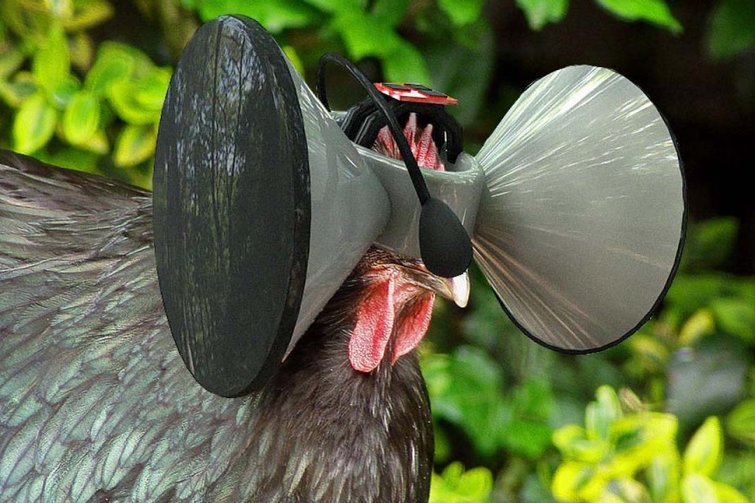
Chickens in battery cages inside chicken factories have a poor life experience.  There is now a depraved proposal to use virtual reality headsets on all imprisoned chickens, so as to allow chicken factories to continue undisturbed in its dubious or depraved methods.
An illustration of what a virtual reality headset might look
like as worn by a chicken kept inside a battery cage within a
chicken factory.  This idea is proposed as
"The Matrix meets Chicken" so as to fool a chicken into
believing it has quality of life.

What an imprisoned chicken would see through their
virtual reality headgear.
Prof. Austin Stewart at Iowa State University has proposed virtual reality lifestyle for imprisoned chickens so that factory chicken producers can get maximum profits while criticisms by animal rights activists are deflected.

A more detailed description of a chicken's proposed virtual world is described here.

Interesting idea, but can we all agree that this is a bad solution to a bad problem that can more easily be solved by small flock, free range, pasture perfect chicken?

This crazy proposal has gone viral.  Even the highbrow The Economist has covered this "important development", as they said,
"Chicken scientists have worked on a variety of ways to minimise the harm to chickens from this factory environment, basically all of which are horrifying to some degree. They include the breeding of blind chickens, which apparently are less bothered by cramped environments, or the production of headless chickens, in which part of the brain or the entire head is removed but the body is kept alive to fatten up and haunt the dreams of everyone who learns of the technique."
Thanks for sharing your ideas.

Instead of decapitated chickens on life support, or virtual reality chickens, I vote for small flock, free range chickens.

I hope you do too.


Monday, November 4, 2013

Can CFO Prevent &/or Detect Animal Abuse?

Can CFO prevent animal cruelty, similar to what allegedly occurred (or is still occurring) at two Alberta #EggMafia chicken factories?

In a previous Blog posting on Animal Welfare, we noted that Chicken Farmers of Canada ("CFC") had reached an agreement in July 24, 2012 with all provinces to adopt CFC's animal welfare system (ACP).  Only six provinces (BC, AB, SK, MB, ON, PE) have made ACP mandatory for their #ChickenMafia members.

To see what this is all about, we used Ontario as a test case.  Anybody can volunteer to do the same for all the other jurisdictions, send it to me, and I will post your results.

Chicken Farmers of Ontario ("CFO") has a new policy to implement ACP. CFO's new Policy 195-2013 for Food Safety & Animal Welfare was passed by the CFO Board on  Mar. 7, 2013 and came into force on April 21, 2013.  According to this policy, all #ChickenMafia farms in Ontario were to be audited and found to be compliant, or ready to be compliance audited on or before April 20, 2013.

This new policy has a few interesting or questionable features, as follows:
  1. To have and keep quota allocation (ie. be licensed to produce chicken), the #ChickenMafia member must be compliant with this Policy.

  2. CFO adopts CFC's On-Farm Food Safety Assurance Program, except that administering of vaccinations and medications to the birds must be documented and reported on Form 3, including those done at the hatchery.  According to Regulation 2446-2013, “Form 3” means a Flock Production and Marketing Form completed by a producer prior to processing as prescribed on the form. Under CFO's General Regulation 2422-2013, this Form 3 has to be filed with CFO within 10 business days (ie. 14 calendar days) after the birds arrived at the slaughter plant.  If the form(s) aren't filed or filed late, the #ChickenMafia members quota could be reduced by 100 kg. (ie. 50 birds, or $166 in gross sales, or about $30.00 in profit, or 0.2% of gross sales $).  In other words, a nuisance wrist slap.

  3. If you are a brand new #ChickenMafia member, you get to practice on the Ontario public with the first 3 flocks your produce (ie. about 18 weeks, about 4.5 months), and will only be audited at the end of your practice period.  Guess where the most mistake and non-compliances are likely to occur?  I would think it would be a good idea that somebody from CFO was auditing 100% of the flocks at the beginning, middle, and end of the first three flocks so as to protect the #ChickenMafia member, as well as the public.  This seems to be very shortsighted, risky, and questionable practice by CFO.

  4. CFO places each chicken factory on a 3 year audit schedule.  In the first year, CFO audits both the chicken factory and the documents produced and records kept by the site.  In year 2, CFO doesn't come to the chicken factory, they just look at the documents & records that are submitted for their inspection.  In year 3, CFO doesn't do anything, the #ChickenMafia member just sends CFO a letter telling them that everything is fine, and CFO takes their word for it.

    So let's assume that things start to go terribly wrong right after the CFO Auditors leave the chicken factory after Year 1 audit.  Of course, in Year 2 the farmer, knowing he is in trouble, will fudge the documents so as to keep CFO in the dark and keep those monthly cheques coming like clockwork.  In Year 3, the farmer sends the letter to CFO, and CFO files it.  In Year 4, CFO finally comes to the chicken factory and is shocked to see how bad things are.

    By that time, 3 years have gone by, and 650,000 chickens have been produced by this renegade farm, and eaten by the public in spite of their questionable quality.

    The big issue of course, is the torture that those 650,000 bird might have to suffer through before the renegade #ChickenMafia member is caught.  Is that an acceptable risk those chickens are willing to take?  Will the animal rights people allow the CFO to put that many birds at risk for that long with little or no hope of being rescued from their fate?  To me, this doesn't seem acceptable.

    The only additional system is that CFO will randomly select 10% of the #ChickenMafia members who are in Year 2 or Year 3 of the cycle for an on-farm audit.  Not very good odds of finding that renegade farm.

    In comparison, under the international quality standard ISO 9001 and ISO 16485 which are used to manufacture good like TV's and cars, an annual on-site audit by an independent third party auditor is mandatory.  No exceptions.  But alas, we're only going to feed the chicken to our family.  CFO must assume that the quality of our TV picture is far more important to get right than the quality of chicken.

  5. If a #ChickenMafia member is found to be non-compliant, a corrective action request can be issued.

  6. The #ChickenMafia member can appeal an audit result, and get an overturning of audit results in 10 days, or confirmed.  I wonder how often that overturning of audit results happens?  Sorry, that's top secret too.

  7. The #ChickenMafia member is required to agree in writing that they will stay compliant to the requirements between audits.  A promise easily made, and easily broken; especially when it's 4 years to the next verification audit.

  8. Unfortunately, there is no requirement for a #CHickenMafia member to inform CFO prior to making any change in their approved process.  This has a significant risk associated with keeping CFO in the dark.

  9. The #ChickenMafia member is only required to keep books and records available for 2 years.  What?!?  We just showed above that it can be 4 years between on-site auditing.  All the past sins can be hidden by disposal of the records just before the auditor shows up for the next on-site audit.  The Year 2 audit specifically states that it is a partial or subset audit, not a comprehensive document audit.  This appears to be the Achilles' Heel of the CFO compliance and auditing system.

  10. There is no defined criteria for CFO's auditors.  Do they have the attitude, education, skills, and experience to be an effective auditor?  Did they receive any training in chickens, and/or auditing?  We'll never know, for CFO's system is silent on this issue.  For all we know, CFO had an excellent janitor who cleaned the offices, and the next day they were promoted to be Chief Auditor for CFO.  Another huge weakness in the system.  I suggest all audits and auditors must be done in compliance with ISO 19011:2011 or equivalent.

  11. If a #ChickenMafia member is unwilling or unable to meet these standards, they can always request to have the requirement waived by the CFO Board by filling in a form.  Of course, this is top secret, and nobody is permitted to find out how often this has occurred.  Only the CFO Board knows for sure.

Conclusion

CFO's animal welfare system is better than nothing, but has some very significant holes in it, thereby putting the animals, CFO, the #ChickenMafia members, and the public at significant risk.

CFO's system need immediate and significant improvements.

Questions

  1. Are you satisfied with CFO's current system for preventing and/or minimizing the severity and duration of animal abuse within the #ChickenMafia system?
  2. Do you support the comments and recommendations I have made on CFO's ACP system?
  3. Do you have additional recommendations for improving CFO's ACP?
Comments section below is now open.  Operators are standing by to receive your comments, emails, faxes, or phone calls.

Friday, November 1, 2013

Animal Welfare vs. Big Food Profits

We posted previously about recent allegations of animal abuse at two Alberta chicken farms in our Blog

Small Flockers has attempted to set a standard for animal welfare by our Small Flock Principles

Fortunately, there are others that support the concept of animal welfare.

In Canada and around the world, we have:
As far as I can determine, the #EggMafia and the #ChickenMafia have no policy or procedures for ensuring animal welfare, other than suggesting that their members consider voluntarily applying animal welfare principles to their operation, such as NFACC's .  If this is incorrect, please send me a copy of the document so I can see for myself.

[Update 2013/11/2]:  I now understand that a secret agreement has been reached by CFC, and all provincial chicken authorities, signed by them as of July 24, 2012.  See Better Farming's description here  It appears that as of Aug. 2012 only 65% of all #ChickenMafia members in Canada were certified to the Animal Care Program ("ACP") standard (100% of #ChickenMafia members in Alberta and PEI are certified).  CFC alleges that ACP has been made mandatory by 6 provincial boards (BC, AB, SK, MB, ON, PE).  We'll soon see about that, stay tuned. [End Update 2013/11/2]

Perhaps that explains why Maple Lodge Farms was fined $264,000 after truckload after truckload of spent hens were shipped in the middle of winter without adequate protection for the birds, resulting in hundreds of birds freezing to death during transport.

Whole Foods Markets, the world's largest organic foods grocery store has mandated GAP's 5 Step Program for all poultry they sell.

When will the Big Food Mafias get their act together on animal welfare?

It isn't enough to post pretty pictures of cute animals on their websites, nor to make bald assertions that "animal welfare is our #1 priority".

If they don't have independent, third party, objective evidence to back up their claims, then it is an attempt by the Big Food Mafias to mislead, deceive, or outright lie to the public.

In that case, somebody should file a formal complaint against them with the government for illegal trade practices.


    Monday, March 4, 2013

    Condemned Chicken

    CFO (Chicken Farmers of Ontario) say they are all about quality and continuous improvement.  Do they offer any proof of their accomplishments which is independently verifiable ?  There does seem to be lots of effort at CFO, and some changes, but I wonder if their focus is in the right area.

    To me, CFO's prime role is to serve the greater good of the public.  One of the most important aspects of serving the public is having safe chicken of excellent quality.  To maximize the safety and quality of chicken, you have to have healthy birds.  Just how healthy are the birds raised in Ontario?

    The following table is derived from data provided by CFIA (Canadian Food Inspection Agency) here.  I confirmed with a CFIA DVM (Doctor of Veterinarian Medicine) who is in charge of producing the reports that the numbers presented there are correct, and I was understanding them.


    I see that in 2012, Ontario's Federally Inspected slaughter plants received about 370,000 dead or diseased chickens from chicken producers. That is a defect rate of 1.26%.

    In addition, I observe that Ontario's chicken crop is 23.3% worse than Atlantic Canada, and 21.7% worse than BC.

    I wonder why?

    If chicken farmers in BC and the Atlantic Provinces can deliver fewer dead and diseased chickens to the slaughter plants, why can't Ontario?

    If CFO (Chicken Farmers of Ontario) has their "Team Ontario" trained to be the best they can be, then why is Ontario significantly worse in bird health than what the farmers in BC and the Atlantic provinces can achieve?

    If anybody knows the answers to these puzzling and disturbing results, I'm interested in learning why.