Google+
Showing posts with label carbohydrates. Show all posts

Tuesday, November 12, 2013

Bring it to the Poor

Yesterday's Blog posting showed the health consequences of unaffordable food prices created by the #ChickenMafia and #EggMafia of Canada inflating food prices by up to 300% .

In the last 24 hours, I have been privately attacked with malice and spewing venom for yesterday's Blog posting; far more so than anything else I have posted here in the last 8 months.

I wonder why?  Is it that yesterday's posting hit a nerve for these #ChickenMafia and #EggMafia members and their supporters?

Perhaps so.

They accuse me of smearing their good reputation with pseudo-science, rumor, wild accusations, and make-believe. I have been told to drop this Blog and get a real life.  They feel that I am so far into outer space that I have no credibility whatsover, and therefore get rejected as a quack and nut job, which then ends up painting the #ChickenMafia and #EggMafia as the more reasonable and moderate parties around whom all Canadians should rally and defend.  My critics say that I am a fool, and therefore a tool for the #ChickenMafia , pushing people to join forces and defend those whom I attack in an unreasonable manner.

Very interesting.  Thanks for your feedback.

Well, here are some more facts from the government and university academics who have researched the subject far more than I.  I focus for the moment with Metabolic Disease, but there are many similar indicators; all of which point to the same culprit:  excess carbohydrates.  Perhaps you will believe them. 

Geographical distribution of Metabolic Disease in Canada
Metabolic Disease for men in Southern Canada.  I guess they thought
Yukon, NWT, and Nunavut aren't important enough to study.  Too bad.
The graph above is 1986 - 1992 data analyzed by Queen's University for men showing as much as 22.4% of them have Metabolic Syndrome.  Note that ON, SK, NB, NS, and NL are the worst off.  Men are worse off than females, so I focus our attention there, but you can click on the link above and see the whole report.

As income increases, prevalence rate of
Metabolic Disease consistently decreases
For those who are better educated, they
consistently have lower rates of Metabolic Disease
Still not convinced this is a real problem that needs a real solution?  They also show that it seems to be consistently correlated with income level, as shown in this graph.

The higher the education you achieved, the lower the risk of Metabolic Disease.

Still not convinced?

Here is data showing that Metabolic Disease is related to education level.  Note the similar relative heights for the three bars, the same shape for all regions of Canada.  This is a Canada-wide issue.  I assume it would be the same or worse for Yukon, NWT, and Nunavut.

I have no proof, but I'll suggest that poor education makes it hard to find a good paying job.  Without a good paying job, it's hard to afford the gouging monopolistic prices charged by the #ChickenMafia and #EggMafia, so you are forced to dumb-down your food purchases to what you can afford, which usually means an excess of carbohydrates.

There is solid scientific proof that too many carbohydrates tends to cause you to have low energy as your body thinks it's nutritionally starving and therefore needs to conserve energy in spite of too many calories from too many carbs.  Poor nutrition in the past causes you to eat more carbs (ie. you can never get enough of what you don't really need), compounding the problem.  The low energy you feel causes a more sedentary lifestyle, further compounding the problem.  Over eating of carbs and less exercise primes you for Metabolic Disease.  See Dr. Lustig, Professor of Clinical Pediatrics, University of California; and Director of Weight Assessment for Teen and Child Health (WATCH) Program, and his series of UCTV videos on The Skinny on Obesity

Still not convinced?  Here is  is some more info from Public Health Canada for 2007 to 2009.

Canadians and their scores on the
5 precursor diagnoses that make up Metabolic Disease for 2007-2009
This data is 4 years old.  Guess what, it's probably much worse today, and gaining speed like a runaway train.  Canadians know what happens with runaway trains, don't we?  This will not end well.

Somebody needs to do something about the #ChickenMafia and the #EggMafia, and soon.  I'm doing my part, for I have brought this issue to your attention.  Now it's your turn to do something.

What will you do today to help?

I hope this is adequate for you to agree that these are not wild rantings and baseless accusations I have posted in this Blog.

If you have alternative facts by credible, unbiased sources that you wish to use to counter Small Flocker's position, then type it up, send it to me, and I will post it here unedited, then we can have some balanced discussions of both viewpoints.

If instead, you just want to be angry, or stubborn, or don't want to listen to facts, then I think that goes to prove one of my other points I have made against the arrogance and hubris of the #ChickenMafia , #EggMafia , and their supporters.


Monday, November 11, 2013

Health Consequences of Food Monopolies

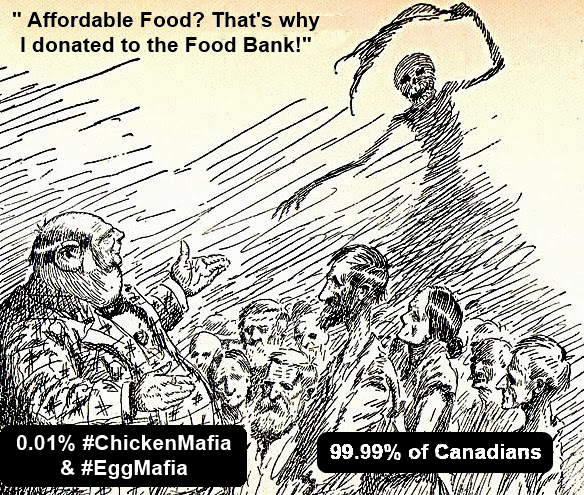
Obese man representing the 0.01% #ChickenMafia & #EggMafia tell the hungry 99.99% of Canadians, "Affordable Food?  That's why I donated to the Food Bank!"
The local food bank near my home reports that food bank usage by their clients has increased by 75% in the last 3 years.  This represents an average annual growth rate of 20.51% per year, or a doubling and then re-doubling every 3.5 years.

I'm sure your region has similar scary news.

Health Canada has reported that 7.6% of Canadian families can't afford the food they need to feed their families (ie. "food insecurity"); as high as 28% in Nunavut (ie. the Far North of Canada).

What are the consequences of this food bank trend for Canadians?

I wanted to get some hard facts, rather than just my intuition.

I had done linear programming in Engineering at University some 35 years ago.  I had used it time and again during my career to solve complex optimization problems.

I remember reading George Dantzig's historical review on the development of the Simplex method in the 1930's at the US Bureau of Labor Statistics, Urban Study of Consumer Purchases.  The US Army needed to know what was the cheapest meal they could feed to soldiers in the field while ensuring they were adequately nourished ("The Diet Problem").  The rest, as they say, is history.  The Simplex method of linear programming was born.

Solution for Diet Problem with between 0 to 300
grams of carbohydrate for a meal cost of US$0.956
Today, there is a web site that provides a simplified model of the Diet Problem.  The on-line Modified Simplex optimization engine simulator is available here for anybody to use.

The model uses a subset of foods and their nutrients from the USDA database here.  Many of the foods used here are typical of N. American diets, and are one of the causes or contributing factors to our rising tide of disease (eg. obesity, diabetes, cardiovascular disease, high blood pressure, rheumatoid arthritis, stroke, dementia, etc.).  I accepted and used this default subset database.

My intuition says, that when chicken and eggs are too expensive, people are forced to "dumb down" their food purchases, resulting in more and more carbohydrates in the shopping baskets.  I therefore ran a number of simulations to see the impact of more or less carbohydrates in the permitted diet.  A typical output is shown at the right.  Click on it for a bigger version.

The lowest possible carbohydrate diet I could find that met the RDA (Recommended Daily Amounts) was 243 grams of carbohydrates, with the minimum cost being US $8.3288 per day.  It is not clear when and where these default prices for the simulator database originate, but I assume the are a snapshot in time from somewhere in the USA, and are consistent within themselves.
Minimum cost of a nutritious meal vs.
the maximum permitted carbohydrates.

Any attempt to construct a lower carb. meal was impossible with the foods in this subset database.  With the whole USDA database, I'm sure other alternative menus will become available.  I leave that more comprehensive exercise to others, as I think what I have done here proves my intuition to be sufficiently accurate and useful..

I ran simulations from 243 gram/day, to as high as 10,000 grams of carbohydrate per day, seeking low cost meals.  The resulting series of minimum meal prices is in the graph to the right.

The lowest carbohydrate level with the same or lower $/day cost was found at 312 grams of carbohydrate with a meal cost of $0.9303 per day.  If you try to lower the carbohydrates below 312 grams, the meal cost goes exponentially higher in price from there on as you lower the carbohydrates.

Remember, this is US data, where chicken is 1/3 less expensive than in Canada, and eggs are 65.5% cheaper than in Canada.  That means chickens and eggs are not affordable choices for Canadians, and we are pushed harder and sooner toward high carb., unhealthy meals.

It should be noted that Dr. Jay Wortman, a physician in British Columbia, has successfully maintained himself symptom-free (ie. diabetes Type II remission) by a ketogenic diet of 10 grams carbohydrate per day for more than 12 years.  CBC TV did a documentary on his success, My Big Fat Diet.  Fortunately, as a medical doctor, the higher scale income he enjoys allows him to better afford the gouging prices imposed by the #ChickenMafia and #EggMafia.  For a quick summary, see a YouTube interview of Dr. Wortman here or watch it here:


By their monopolistic greed and uncaring actions, the #ChickenMafia and #EggMafia steal this cheap, effective, and healthy low carb. solution (ie. chicken and eggs) from most Canadians.

Meals with excessive carbs (ie. low carb is 10 to 60 grams of carb per day, the RDA is 130 g/day, while a typical North American diet has >300 g. carb. per day) usually cause or contribute to weight gain.  Most people become more sedentary when consuming more carbs as a portion of their diet, causing a lower energy expenditure; compounding the weight gain effect.  This high carb diet can partially explain the consistent increase in obesity in Canada, as reported by Health Canada.

Health Canada graph showing obesity rate (BMI >=30) rising from 14.9% to 17.2% for 2003 to 2009


The 243 g. carbohydrate daily intake menu at a cost of $8.3288 per day is as follows:

Optimum Meal Menu and servings for 243 g. of carbohydrate
at a cost of US $8.3288
 The 306 gram of carb. daily intake menu seems starvation to me, at a cost of $0.9303 per day is as follows:
Optimum Meal Menu and servings for 306 g. of carbohydrates
at a cost of US $0.9303
Remember, this is all you get for the entire day (breakfast, lunch, supper, & snacks).  Ouch!

Which daily meal menu would you and your family prefer if you didn't have to pick up the cheque?

Note that the food prices go up by 895.3% if we try to drop the carbohydrate consumption by 25.9%.

Can Canadians and the world now see clearly why we have a huge problem?  Canadians are forced, out of economic necessity, to eat more carbohydrates, rather that the astronomic prices we are charged for chicken and eggs.

Who will stand with Small Flockers to expose this crime against the Canadian people?

If you will not stand with us now, I suggest you lose the right to complain as hospital waiting rooms explode with sick people and taxes go through the roof to pay for all the sick people and the lost productivity.