Google+
Showing posts with label poor. Show all posts

Tuesday, December 16, 2014

Imported Foods: Is Free or Fair Trade a Solution to Affordable Food?

Can Canada's Supply Management ("SM") system be replaced (or co-exist) with free trade or fair trade chicken?

There are small flock farmers in third world countries who would benefit from additional opportunities to sell their chicken, eggs, and other agricultural products.  Since Canadians pay one of the highest prices for SM products, likely these third world suppliers can produce those products far cheaper than Canadian suppliers.

I believe Canadians want more affordable food, provided it is safe, dependable, and nutritious.  I also believe that Canadians prefer to buy from and support Canadian producers, but are not prepared to be gouged in pricing, or held hostage so as to support Canadian suppliers.

In yesterday's Blog posting (see Import Chicken: Help the Poor in both Canada & the World? ), I presented Mr. Cline's research that says the poor, both the first world poor customers and the third world poor suppliers, would benefit from free trade in agriculture products.  Expensive, unaffordable food is regressive, as the poor have to pay a far greater percentage of their income to buy that food than what is paid by the rich.

If income taxes are adjusted based on an individual's income and wealth, why not food?

The Guardian in its Sept. 2008 article Free trade can mean the poor stay hungry challenges the agricultural free trade proposals of Mr. Cline.  This article presents evidence that the majority of the benefit from third world free trade is gained by the intermediaries and the 1st world suppliers of the 3rd world producers.  For example, asparagus from Peru for importation to the USA is presented:
"A hearing of the US Congress's Ways and Means committee in 2006 unintentionally provided one of the most succinct accounts of the problem I have come across. The Peruvian asparagus industry was up before the house to reassure representatives that any growth in imports to the US from Peru would be in US interests.

For every dollar spent by a US consumer on imported asparagus from Peru, 70 cents stayed in the US, the industry explained. The money goes not to Peruvian farmers but to US supermarkets and wholesalers, and to US shippers, distributors, importers, and storage owners. Just 30 cents stays in Peru. (The UK too imports most of its out-of-season asparagus from Peru.)

But Peru doesn't even get the full benefit of that 30 cents, because a large portion of the 30 cents Peru makes comes back to the US anyway: it is spent by Peruvians on US seed, US materials for processing, US fertiliser and US pesticides. US-based vegetable corporations, Del Monte and General Mills Green Giant, have been able to enjoy lower land values, cheap labour and low environmental costs by moving some of their production to Peru. The handful of corporations that dominate the global markets in seed, fertiliser, pesticides, trading, distribution and retailing take care of the rest.
Increased agricultural exports have indeed contributed to a growth in Peru's GDP, but the benefit to the poor of its population is hard to see."
One Ag. expert thinks that as soon as a WTO trade agreement is announced that allows for free trade agriculture imports, all of the multi-national billionaire Big Ag. companies will use huge amounts of cheap foreign money to buy the best farm land.  Next, they would build food production and processing systems in third world countries to export to their sister branch plants in Canada and elsewhere.

It is unclear if the third world poor would see any benefit.  Perhaps they would get slave labor wages working in those new farms and food processing plants.

If the supply chain can get free trade food from third world sources at a small fraction of domestic sources, their profits magnify greatly if they can sell at the same domestic price.  Since Big Ag. tightly controls the domestic food distribution system in an oligopoly, there is little competition, so there is no significant downward force on domestic retail prices.

Therefore, as long as Big Ag. has tight control of the food distribution systems, there is likely marginal benefits from agricultural free trade, neither for the domestic poor nor the third world poor.

So what is the solution?

Can "Fair Trade" be better than "Free Trade" ?

Perhaps Small Flockers in each domestic market are the best answers.


Monday, December 15, 2014

Import Chicken: Help the Poor in both Canada & the World?

Some experts think the best way to help the poor, both in Canada and around the world, is to allow free trade in agricultural products to occur.  Supply Management is the worst offender to this goal, and is therefore a prime target for change.

In a recent Blog posting SM is Dead: Mulroney's Trial Balloon, or Loose Cannon?, I raised the question about Mulroney's meaning and purpose on his suggestion to end Supply Management in Canada.  In the news media reporting on Mulroney's speech, it also said,

"...those in favour of reaching a deal [ie. reducing agricultural subsidies and import barriers through free trade treaties] say it would be worth many times as much as all of the foreign aid to the world’s developing nations."

Not being an expert in international trade (who is?), I didn't understand what this meant.  Today, after re-reading the mainstream media reporting on Mulroney's speech, I noticed all of them included this cryptic comment, but nobody explained what it meant.  As I dug deeper and deeper, I finally developed a child-like understanding of this issue.  Perhaps I need to research this much more, but I will share what I have discovered so far.  If I am all wet, perhaps those in the know will see my obvious error, take pity, and guide me in the right direction.

It appears that this statement refers to a study done and book published in 2004 by William R. Cline (a US economist and a Senior Fellow at the Peterson Institute for International Economics) who wrote Trade Policy and Global Poverty

Mr. Cline seems to propose that the fastest and easiest way to reduce poverty on a world-wide basis is to allow free trade for agricultural products.  Of course, agriculture is the global-wide bastion of the most pernicious protectionism.

In support of Mr. Cline's theory, he presents the following evidence:

  1. World-wide poverty (ie. the "Poor") is generally defined as someone earning less that US$ 2.00 per day ($730/yr).

  2. There are 3 billion Poor in the world.  75% of these Poor live in a rural setting. [I assume that means people living in a rural setting of a developing nation have the means to grow food, and might be able to sell some of that food as an exportable product.]
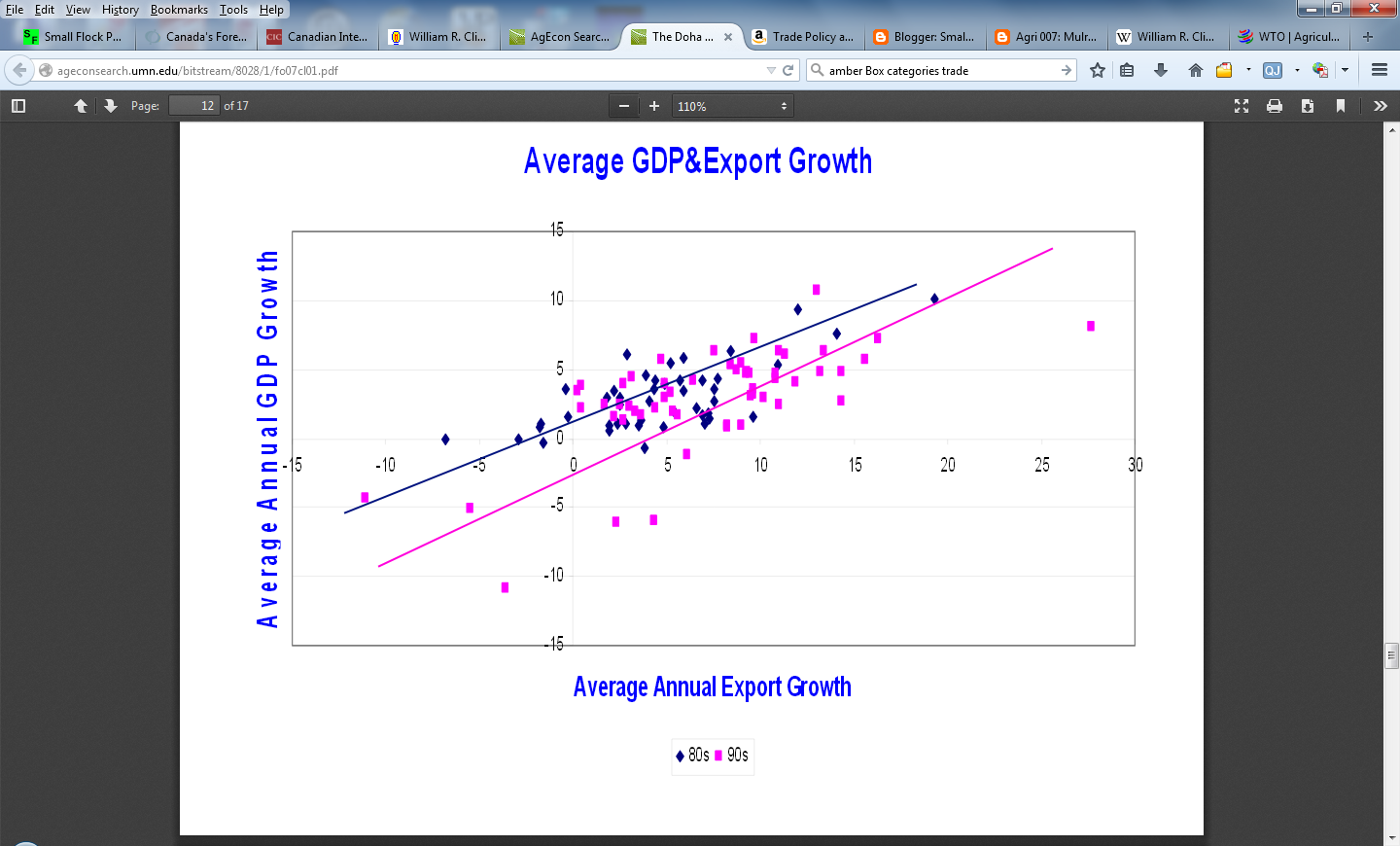
  3. Figure 1:  Mr. Cline's datapoints showing the correlation
    between a developing country's GDP vs. the growth in
    their exports.  The lines were added by me.

  4. In developing countries, data from the 1980's and 1990's suggest that as their exports grow, local GDP grows also.  See Figure 1.

  5. That boost to the economies of developing nations via free trade could be as much as $200 Billion per year.  Half of that boost would be from free trade for agricultural commodities.  The other major sectors for boosting their economies would be from exporting textiles and apparel.

  6. Global free trade would raise the GDP by 1.5% to 2% directly.  The dynamic (ie. spin-off) effects would more than double the direct effect, so the total effect (ie. both direct and indirect) would be more than 4%.

  7. While the average effect on people would be 4%, the poorest of the poor are estimated to receive the biggest impact of free trade, estimated by Mr. Cline to be double of the average effect (ie. 8% for the Poor vs. 4% on average for all citizens in a developing country).

  8. In Mr. Cline's 2007 paper to a USDA conference, he states:   "...the broad empirical relationship between poverty and income shows that the “poverty elasticity” – the percent by which the number of poor declines for a 1 percent rise in their income– is about 2. So multiply once again by 2 and you get a total of 16 percent reduction in the number of poor. Apply that to 300 million [sic, appear he meant 3 Billion] in poverty and you get about 500 million reduction in global poverty."  Therefore, Mr. Cline concludes that free trade would raise the income of Poor people sufficiently to remove 500 million people from the poorest category (ie. earn $2.00/day or less).

  9. Free trade for agriculture is essential to achieving these positive effects for the world's poor.  See Figure 2.  WTO defines ag. subsidies as colour-coded boxes, similar to traffic light colours (red= prohibited, amber= caution or subsidies that are to be reduced, green= OK in unlimited quantities, plus blue=amber with conditions that limit the quantities that farmers can produce.  The protectionism of Japan's farmers is legendary, estimated to be equivalent to an 82.1% import tariff when you count true tariffs (76.4%) and domestic subsidies (3.2%).  Canada is the 2nd worst villain in ag. tariffs and subsidies at 52.3%.  The EU is 46.4%, and the US is just 19.9%.  The weighted average for all industrialized nations is 36%.  No wonder Canada is in such huge trouble in trade talks with the US, EU, TPP, and WTO; we're 45% higher in ag. trade barriers than the world average for industrialized nations.

  10. Figure 2:   Mr. Cline's estimates of barriers to free
    trade in agricultural.  Japan is seen as the worst, with a
    total of 82.1% tariff-equivalent import barrier, with Canada
    in 2nd place of this Rogue's Gallery at 52.3% tariff-
    equivalent barrier to ag. imports from developing nations.
So that is Mr. Cline's theory in a nutshell.  I assume that is what was being referred to in the story about Mr. Mulroney's call for the end of SM when it said removing ag. subsidies and protectionism would have a greater effect than foreign aid.

In 2012, Canada spent $5.67 Billion on foreign aid according to CIDA's data, which is stingy when compared to our relative wealth and the aid by other OECD nations.  About 69% of Canada’s aid in 2012 was channeled through the Canadian International Development Agency (CIDA), 9% through Finance Canada, and 8.2% through the Department of Foreign Affairs and International Trade, while the International Development Research Center (IDRC) accounts for 3.5%.  About 33.4% of that aid went to Least Developed (or poorest) Countries, another 2.5% went to other Low Income Countries, and 16.8% went to Lower Middle Income countries (41% is not coded by income group). Africa received the highest share at almost 42%, followed by Asia (22%), and the Americas (17%).  Following nearly a decade of sustained increases, Canada's aid spending has stalled and is set to decline in the coming years.
About 69% of Canada’s aid in 2012 was channeled through the Canadian International Development Agency (CIDA), about 9% through Finance Canada and 8.2% through the Department of Foreign Affairs and International Trade, while the International Development Research Center (IDRC) accounts for 3.5%. - See more at: http://cidpnsi.ca/blog/portfolio/canadas-foreign-aid/#sthash.5R7LsQkW.dpuf

As a Small Flocker in Canada, there are a few issues of which I am concerned.

First, I have seen the jars of pickles on my local grocery store shelves that have been imported from India.  I have eaten some of those pickles, as they are significantly cheaper than N. American pickles and seem to have reasonable quality.  I also fret about "what is this world coming to" when Canadian pickle producers have permanently shut their doors, and we are now forced to import from elsewhere.  I assume I would feel equally conflicted about SM products of dairy, chicken, and eggs being imported into Canada at the expense of domestic production.

Secondly, the quality of N. American chicken is a disaster, with bacterial contamination (including superbugs), bad Omega-3 to Omega-6 fatty acid ratios, bad bird welfare habitats, etc.  I assume that 2nd and 3rd world imports might be significantly worse; witness the recent news reports of falsified species in fish imported from South-East Asia, melamine tainted milk in China, and many similar events. As an example of a disaster going someplace to happen, live US chicken was proposed to be exported to China, slaughtered in China, processed and further processed in China to create boxed chicken, then import those packaged chicken products back into the US with no review whatsoever of that entire international supply chain by USDA inspectors (see Blog posting COOL Blowback ).  Canadians need higher quality products, not lower.  Can we be assured of this quality if we are importing SM replacement products from the developing world?

Thirdly, I am cautious of Free Traders and others who pretend to be helping the poor, when in reality they are propaganda shills for Big Ag., the PTB ("Powers That Be"), the NWO ("New World Order"), and the 0.01%'ers.  Exactly who is this Mr. Cline?  CIC (Canadian International Council) seems to support Mr. Cline's research.  Is Mr. Cline a master manipulator, or a straight arrow?  For me, it's too soon to tell, but I am wary about trusting too quickly.

Fourthly, if SM will not yield any ground to domestic Small Flockers, I assume that international small flockers don't have a chance.  I would assume that the poorest of the poor would be small flockers in chicken, and small market gardeners in fruits and vegetables.

Fifthly, if WTO, TPP, and EU trade talks achieve agricultural free trade by some miracle, how long before Big Ag. moves in to their third world countries where they create a monopoly for themselves via unfair or predatory trade practices so as to steal the free trade opportunities away from those who need them most.

By slowly and carefully reducing Canada's import tariffs and subsidies to Canada's #ChickenMafia, I believe that would be beneficial to Canada's consumers and small flockers alike, and would eventually force Canada's #ChickenMafia to dramatically improve, or die.  However, is there a tariff level below which no Canadian chicken farmer can compete, and dropping import tariffs below this threshold will surely kill all the #ChickenMafia, and possibly even Canada's small flockers?  If yes, what is that critical tariff level?

A lot of questions, conflicts, and inconsistencies currently exist inside of me on these SM trade issues.  I assume each of you has a similar list.  These are complex issues, and we need to get them right the first time.  That is exactly why those acting against the best interests of the majority purposefully cloud the issues so as to protect their special interests.

Hopefully with additional study by myself and other, the mud will settle and we can see clearly on the best path to take.


Thursday, October 16, 2014

SM Screws the Poor

Another study has found that Canada's Supply Management is a regressive policy which hurts the poor significantly more than the rich.  Canadians in major Canadian cities are forced to pay up to 69% more for whole chickens that the nearby US cities.

Canadian Public Policy ("CPP") has accepted the manuscript of Ryan Cardwell, Chad Lawley and Di Xiang; all Professors of Economics, Department of Agribusiness and Agricultural Economics at the University of Manitoba.  That journal is expected to come out in December 2014.  In the interim, the Winnipeg Free Press has summarized the soon to be published paper.

Ontario Farmer added:
"They say the price differences amount to 2.3 per cent of the annual income of Canada’s poor people, but only half of one per cent of annual income for the rich.
This means supply management is what economists call a 'regressive' government policy, hitting the poor harder than the rich."
Whole chickens should be ubiquitous, the lowest common denominator, the primary resource from which all other chicken products are derived.  As such, it should be the cheapest, generic form of chicken.  How do we explain that what should be the cheapest, generic form of chicken has a 69% price differential between Canada and US, just on the other side of the border?

The SM boys are quick to shoot holes in the papers data and arguments.  For example, the #CHickenMafia claim that SM has been unfairly singled out, for no matter what the poor buy, it will consume a larger portion of their available income.

That is the reason I took a different approach.  Rather than comparing the rich to the poor, I compared each strata to themselves over time.  Chicken has become up to 31.7% less affordable for minimum wage earners between 1995 and 2005 (see SFPFC's Blog Posting "Unaffordable Chicken In Ontario" ).  Notice that the SM boys haven't attacked that sad statistic because there is no easy method to dismiss.  I'm sure the #ChickenMafia research labs are toiling night and day to find a propaganda solution to that sad fact that I have uncovered.  In the interim, it exposes the Supply Management System for what it is; a method to make a few millionaires from the price gouging paid by all Canadians.


Saturday, April 6, 2013

Captain Canada Champions Chicken

If God keeps me, I will make sure that no peasant in my realm will lack the means to have a chicken in the pot on Sunday!” - King Henry IV of France (1553 - 1610)

Here we are, 413 years later, and many Canadians can only hope for the return of Good King Henry's ideals.

The Salvation Army sponsored the April 2011 survey of Canadians by Angus Reid.  This survey found that 22% of Canadians had received help from a food bank or a charity.  When you look at those who earned $50,000 per year or less, 36% of those people had received help from a food bank or a charity.

I see a linkage here between locally produced, affordable food and Small Flockers.  Once Small Flockers are able to break the Canadian chicken monopoly, everybody will have the right to produce poultry for themselves, their family, and neighbours.  Once that has been achieved, prices should become more and more affordable.

US Government poultry advertisement during World War I (1914-1918)
I attended the Manitoulin Community Food Network meeting this week to make a short presentation about Small Flock Poultry Farming. I was pleased with the reception I received.  I was also quite impressed with this dynamic group meeting of 14 people, making a difference for local food.

The advertisement on the left was from 1917, and is as true today as it was then.

Perhaps we can get Captain Canada to re-issue a new version of this ad for us today.


Feel free to lift anything from this Blog, print it out, and give it to a neighbour or a local community group, hopefully sparking a conversation about these issues for your community.