If the Chicken Mafia are surviving and prospering by spewing their propaganda far and wide, what can a consumer do to overcome the lies, half truths, and misleading omissions by the CAFO chicken factory owners and their henchmen?
Consumers must fight back with due diligence.
The above clip from the TV show Portlandia satirizes what well informed restaurant staff must go through to make a sale to overly conscientious guests who must know the provenance of the chicken on the menu.
It's funny because it went to an extreme. It's sad, because that is what consumers are being forced to do more and more so as to overcome the Big Food propaganda machine.

A blog to communicate, discuss, and advocate for the civil rights and important role Small Flock Poultry Farmers can play (and should play) in Canadian Society. Small Flockers are on the side of justice & truth, and against privilege & power. Unfortunately, the more we compromise with privilege and power, the more we reduce the capacity for truth and justice.
Showing posts with label propaganda. Show all posts
Showing posts with label propaganda. Show all posts
Thursday, January 28, 2016


Wednesday, May 13, 2015
Power of the Powerless
The Chicken Mafia, their bureaucrat supporters and enablers, and the cheerleading politicians believe that Small Flockers and consumers are powerless. They believe that they own and control Small Flockers and consumers as their pawns, to be used and abused as they please.
They may want to reconsider their flawed assumptions.
Just because we all feel powerless, doesn't mean it's true.
Humans naturally go along to get along. It's easier that way. It's protective. It's less complicated.
If there is any path through the woods, regardless if it goes in the right direction or not, it's easier to follow the path, rather than blazing a new trail through the woods. Once we've gotten to the other side of the woods, we can always circle around to go the direction we had wanted to travel in the first place. Somehow, that makes sense to most people.
However, that logic doesn't work forever.
Eventually, things get so bad that we are no longer willing to travel the path of least resistance in the wrong direction. Sooner or later, we realize this is just wrong, and somebody has to do something about this terrible situation.
That moment comes every century or so, when things are so screwed up, somebody eventually decides to push the reset button.
Adam & Eve had it happen to them.
Babylon had their moment.
The Pharaoh thought everything was going great, then this guy called Moses showed up.
Even the Romans had the Visigoths get uppity in 376 AD, sacking Rome. Who saw that coming?
After World War II, the Russian Empire took over many small countries and force them under Communist governments. The people were terribly oppressed, but the oppression continued, firing squad ran up a huge bill for bullets, so they eventually invented Gulags and slave labour, reducing the cost of munitions and getting free stuff from political prisoners and their families imprisoned for the slightest, whimsical reason.
People under Communist rule were propagandized, and told what to think and believe. Slogans and right thinking was freely provided. If you were a little slow on coming up with the right answers, a few decades in a Gulag were applied to sharpen your skills with constant remedial training programs.
People put the right signs with the right slogans in their windows, because they had to. At the public meeting they were coerced to attend, they were expected to say the right thing. They were required to vote the right way in "free" elections where the outcome was known years in advance. Kids were taught to watch their parents, and turn them in to the government Secret Police if they spoke against the government's official position. Like in George Orwell's novel 1984, war was peace, truth were lies, freedom was slavery, and so on. People were forced to live lies.
Some people got so good at living the lies, they no longer were aware of the truth.
People learned to say and act exactly as they were required to do. Go along to get along.
Fortunately, they didn't yet have the Thought Police.
Family and friends sometimes spoke in double entendres, to hide and share their true feelings. They came to know and trust each other more and more, having sufficient incrimination on each other that they could not expose the other without convicting themselves. Eventually, they risked smuggled books, listening to forbidden free radio broadcasts, and the creation of Samizdat by secretly copying and sharing these forbidden thoughts.
Finally, in Oct. 1978 Vaclav Havel wrote his famous and powerful essay "The Power of the Powerless"
This essay helped people to understand the lies they lived, and why they did it. It showed them a way out.
The people thought they were weak, but in reality they were powerful.
Eventually people realized that some truths were worthy enough to suffer for. They were no longer willing to go along to get along.
Eventually, thousands of people were in the streets every evening, protesting these lies they had been forced to live. The government sent their elite troops to quell the demonstrations. The government ordered these troops to fire on the crowd so as to end the protests, but the troops refused to obey the orders. The government fell within the week. Next, the Berlin Wall was breached, and existed no more.
We are not yet at one of those crossroads, but we passed the big yellow diamond road sign alerting us to the intersection that we are quickly approaching.
Supply Management ("SM") for dairy, eggs, chicken, and turkey in this great country of ours is a lived lie, deceiving thousands of Canadians, if not millions. The SM system doesn't live up to the SM Mafia's propaganda. The henchmen of the SM Mafia live the lies and promote the lies every day, for that is how they earn their pay cheques.
This Blog of Small Flockers is similar to the secret writings of Samizdat. Nobody admits they read this Blog, but the Internet pageviews keep counting up as these ghosts come back for the latest sample is cooked up and served to them via this Blog.
We have not yet had the galvanizing essay on SM that rallies and catalyzes the public. When that essay appears, the SM goons will feel forced to react. They will attack without mercy. Fortunately, the sleeping public will be awakened by the noise and confusion created by the SM henchmen. Most people will not see the essay, nor understand the meaning. However, they will know and feel the SM response. That response will be the force that awakens them from their long, 50 year sleep.
That day approaches soon.
We need to prepare ourselves for the day when that event arrives.
They may want to reconsider their flawed assumptions.
Misguided Assumptions
Many people feel they are powerless.Just because we all feel powerless, doesn't mean it's true.
Humans naturally go along to get along. It's easier that way. It's protective. It's less complicated.
If there is any path through the woods, regardless if it goes in the right direction or not, it's easier to follow the path, rather than blazing a new trail through the woods. Once we've gotten to the other side of the woods, we can always circle around to go the direction we had wanted to travel in the first place. Somehow, that makes sense to most people.
However, that logic doesn't work forever.
Eventually, things get so bad that we are no longer willing to travel the path of least resistance in the wrong direction. Sooner or later, we realize this is just wrong, and somebody has to do something about this terrible situation.
That moment comes every century or so, when things are so screwed up, somebody eventually decides to push the reset button.
Adam & Eve had it happen to them.
Babylon had their moment.
The Pharaoh thought everything was going great, then this guy called Moses showed up.
Even the Romans had the Visigoths get uppity in 376 AD, sacking Rome. Who saw that coming?
After World War II, the Russian Empire took over many small countries and force them under Communist governments. The people were terribly oppressed, but the oppression continued, firing squad ran up a huge bill for bullets, so they eventually invented Gulags and slave labour, reducing the cost of munitions and getting free stuff from political prisoners and their families imprisoned for the slightest, whimsical reason.
People under Communist rule were propagandized, and told what to think and believe. Slogans and right thinking was freely provided. If you were a little slow on coming up with the right answers, a few decades in a Gulag were applied to sharpen your skills with constant remedial training programs.
 |
| Two-faced lies and propaganda of totalitarian governments, and Canada's Supply Management System |
Some people got so good at living the lies, they no longer were aware of the truth.
People learned to say and act exactly as they were required to do. Go along to get along.
Fortunately, they didn't yet have the Thought Police.
Family and friends sometimes spoke in double entendres, to hide and share their true feelings. They came to know and trust each other more and more, having sufficient incrimination on each other that they could not expose the other without convicting themselves. Eventually, they risked smuggled books, listening to forbidden free radio broadcasts, and the creation of Samizdat by secretly copying and sharing these forbidden thoughts.
Finally, in Oct. 1978 Vaclav Havel wrote his famous and powerful essay "The Power of the Powerless"
This essay helped people to understand the lies they lived, and why they did it. It showed them a way out.
The people thought they were weak, but in reality they were powerful.
Eventually people realized that some truths were worthy enough to suffer for. They were no longer willing to go along to get along.
Eventually, thousands of people were in the streets every evening, protesting these lies they had been forced to live. The government sent their elite troops to quell the demonstrations. The government ordered these troops to fire on the crowd so as to end the protests, but the troops refused to obey the orders. The government fell within the week. Next, the Berlin Wall was breached, and existed no more.
SM Vs. The Sleeping Powers of the People
So much for the history lesson.We are not yet at one of those crossroads, but we passed the big yellow diamond road sign alerting us to the intersection that we are quickly approaching.
Supply Management ("SM") for dairy, eggs, chicken, and turkey in this great country of ours is a lived lie, deceiving thousands of Canadians, if not millions. The SM system doesn't live up to the SM Mafia's propaganda. The henchmen of the SM Mafia live the lies and promote the lies every day, for that is how they earn their pay cheques.
This Blog of Small Flockers is similar to the secret writings of Samizdat. Nobody admits they read this Blog, but the Internet pageviews keep counting up as these ghosts come back for the latest sample is cooked up and served to them via this Blog.
We have not yet had the galvanizing essay on SM that rallies and catalyzes the public. When that essay appears, the SM goons will feel forced to react. They will attack without mercy. Fortunately, the sleeping public will be awakened by the noise and confusion created by the SM henchmen. Most people will not see the essay, nor understand the meaning. However, they will know and feel the SM response. That response will be the force that awakens them from their long, 50 year sleep.
That day approaches soon.
We need to prepare ourselves for the day when that event arrives.
Friday, March 13, 2015
Paid Skeptics & their Propaganda
I watched Food Inc. again last night with family who had not yet seen this important documentary on commercialized food system in the USA. By watching this movie for a second time, I have thereby renewed my disgust and rejection of the Frankenstein food systems that have become too commonplace today.
Note: The CBC Radio clip embedded below starts playing automatically, and I have no control of this. To stop the audio, scroll down to the CBC Radio embed below and click on the double vertical bars in the bottom left corner of that embedded player.
I bought the movie Food Inc. from the Internet last year after I learned about it during my research for Small Flockers. Food Inc. provided first hand witness accounts about dysfunctional systems in multiple processes and products in United States food systems, from farm to fork.
While the movie was exclusively focused on farms and food in the USA, other research I have done tells me it is the same or similar here in Canada.
Clip from Food Inc.
There was a response to Food Inc., no doubt. One of these can be seen at Safe Food Inc. website. A fast & furious response from the impugned and alleged wrongdoers, even while the filming was actively occurring. Today, the CAFO food industry has many paid skeptics and lobbyists who tirelessly word to un-ring the bell that had been rung by the documentary Food Inc.
Since most people are easily distracted and misled by well researched and promoted propaganda, is there hope for us in the short or long term?
Nazi Germany's Minister of Propaganda, Joseph Goebbels, was an excellent orator, and even better working behind the scenes to shape public opinion. Goebbels learned his propaganda methods from Edward Bernays and his 1928 book Propaganda. Edward Bernays, the nephew of Sigmund Freud, began his seminal 1928 book Propaganda, with these ominous words:
The purpose of paid skeptics and propagandists is to spread doubt, and cause delays in the resolution of social problems that affect the pocketbook of wrongdoers.
Paid skeptics get away with this misdirection because there are fewer and fewer investigative journalists. Combine this with the constraints on the main stream media who are tightly bound to their advertisers, the powerful mega corporations who buy ads and sponsor the media's operations. The remaining media staff at main stream media tend to be forced by their tight 24/7/365 deadlines and their affiliation with their advertisers to accept the press releases sent to them by paid lobbyists and propagandists.
CBC Radio did a short program on paid skeptics and their impact on society. A chilling tool that we all must be aware of, and guard against.
Clip from the documentary Merchants of Doubt
Note: The CBC Radio clip embedded below starts playing automatically, and I have no control of this. To stop the audio, scroll down to the CBC Radio embed below and click on the double vertical bars in the bottom left corner of that embedded player.
I bought the movie Food Inc. from the Internet last year after I learned about it during my research for Small Flockers. Food Inc. provided first hand witness accounts about dysfunctional systems in multiple processes and products in United States food systems, from farm to fork.
While the movie was exclusively focused on farms and food in the USA, other research I have done tells me it is the same or similar here in Canada.
Clip from Food Inc.
There was a response to Food Inc., no doubt. One of these can be seen at Safe Food Inc. website. A fast & furious response from the impugned and alleged wrongdoers, even while the filming was actively occurring. Today, the CAFO food industry has many paid skeptics and lobbyists who tirelessly word to un-ring the bell that had been rung by the documentary Food Inc.
Since most people are easily distracted and misled by well researched and promoted propaganda, is there hope for us in the short or long term?
Nazi Germany's Minister of Propaganda, Joseph Goebbels, was an excellent orator, and even better working behind the scenes to shape public opinion. Goebbels learned his propaganda methods from Edward Bernays and his 1928 book Propaganda. Edward Bernays, the nephew of Sigmund Freud, began his seminal 1928 book Propaganda, with these ominous words:
"The conscious and intelligent manipulation of the organized habits and opinions of the masses is an important element in democratic society. Those who manipulate this unseen mechanism of society constitute an invisible government which is the true ruling power of our country. We are governed, our minds are molded, our tastes formed, our ideas suggested, largely by men we have never heard of."Also see here for an excellent summary of these propaganda techniques and the consequences for society. How do propagandists, lobbyists, and paid skeptics sell their questionable services to wrongdoers?
--- Edward Bernays, 1928, pg. 1, Propaganda
"You can 'Lose Pretty', or come with me and 'Win Ugly'"
The purpose of paid skeptics and propagandists is to spread doubt, and cause delays in the resolution of social problems that affect the pocketbook of wrongdoers.
Paid skeptics get away with this misdirection because there are fewer and fewer investigative journalists. Combine this with the constraints on the main stream media who are tightly bound to their advertisers, the powerful mega corporations who buy ads and sponsor the media's operations. The remaining media staff at main stream media tend to be forced by their tight 24/7/365 deadlines and their affiliation with their advertisers to accept the press releases sent to them by paid lobbyists and propagandists.
CBC Radio did a short program on paid skeptics and their impact on society. A chilling tool that we all must be aware of, and guard against.
Clip from the documentary Merchants of Doubt
Monday, February 16, 2015
Rearranging the Titanic's Deck Chairs
Why has Chicken Farmers of Ontario ("CFO"), the Association of Chicken Processors ("AOCP"), and Ontario Farm Products Marketing Commission ("OFPMC") formed TeamOntario and the Chicken Industry Advisory Committee?
Agri007 correctly noticed that Ontario Independent Poultry Processors ("OIPP") is missing from this group. I also wonder why, especially after CFO says on their website:
What best describes CFO's actions:
Regardless of CFO's intentions, Small Flockers have assumed the best, that CFO has honorable intentions. Therefore, SFPFC has responded with fair comments to improve the Supply Management system in Ontario and Canada.
After attending one of CFO's meetings in Northern Ontario, the following summary was sent to Bryan Boyle, CFO's "Compliance Professional", aka "Meeting Facilitator". All of the comments made here are based upon SFPFC's research, fully described in SFPFC's Blog postings made here over the last 2 years. Our comments on CFO and their Chicken Supply Management System are as follows:
Agri007 correctly noticed that Ontario Independent Poultry Processors ("OIPP") is missing from this group. I also wonder why, especially after CFO says on their website:
"CFO, Association of Chicken Processors and Ontario Farm Products Marketing Commission are jointly committed to working with and encouraging participation by the broadest possible range of relevant stakeholders who have an interest in or who may be affected by decisions resulting from the consultation exercise."At least CFO held a meeting for input from OIPP on Jan. 26th in Burlington ON. Is it because OIPP wasn't sufficiently malleable to CFO's iron will and nefarious strategy? Was there a significant danger of OIPP exposing CFO's plans to manipulate, distract, and control the issues via propaganda in CFO's favor?
What best describes CFO's actions:
- Re-arranging the Titanic's deckchairs?
- Propaganda issued by Compliance Professionals
- Red Herring to manipulate and distract
"to do something pointless or insignificant that will soon be overtaken by events, or that contributes nothing to the solution of a current problem."CFO has been spending bundles of money lately on media consultants. The next step up from media consultants are "Compliance Professionals". A compliance professional is defined as:
"an expert that utilizes and perfects means of gaining media influence. Though the means of gaining influence are common, their aims vary from political, economic, to personal. Thus the label of compliance professional applies to diverse groups of people, including propagandists, marketers, pollsters, salespeople and political advocates."A red herring is defined as:
"something that misleads or distracts from the relevant or important issue "Noam Chomsky has written about the Top 10 Media Manipulation Strategies. Do any of those apply to CFO and their actions in this case?
Regardless of CFO's intentions, Small Flockers have assumed the best, that CFO has honorable intentions. Therefore, SFPFC has responded with fair comments to improve the Supply Management system in Ontario and Canada.
After attending one of CFO's meetings in Northern Ontario, the following summary was sent to Bryan Boyle, CFO's "Compliance Professional", aka "Meeting Facilitator". All of the comments made here are based upon SFPFC's research, fully described in SFPFC's Blog postings made here over the last 2 years. Our comments on CFO and their Chicken Supply Management System are as follows:
SFPFC's Comments
Small Flock Poultry Farmers of Canada has the following additional input as followup to our comments made during the Gore Bay ON session on Feb. 10, 2015 that our representative attended:- Products manufactured by both manufacturing and agriculture
have similar GDP size and impact, contributory margins, value
added, and spin-off effects for the Ontario economy; some of
the best available from all sectors of the economy.
- Unfortunately, Canadian manufacturing has been on decline
for more than two decades, has been significantly wounded, and
will need years or decades of convalescence to recover its
former strength and capacity. That leaves agriculture at the
best available economic driver for the Ontario economy in the
short and medium term. What is good for agriculture is good
for Ontario.
- Throughout North America, we have excessive carbohydrates in
our diet, causing or contributing to numerous, simultaneous
epidemics, such as obesity, diabetes, rheumatoid arthritis,
Metabolic Disease, fatty non-alcoholic liver disease, high
blood pressure, high blood lipids, cancer, Alzheimer's
Disease, etc. It is estimated that 75% of all disease are
caused or contributed to by poor nutrition and/or poor diets.
- The health care budget consumes 42% of Ontario's budget. By
2045, diabetes alone is projected to consume the entire health
care budget (ie. no money left to fix broken bone, birth
babies, car accidents, etc.).
- Animals that are raised whole-life as pastured animals have
meat and eggs with ideal ratios of Omega-3 and Omega-6 fats,
while CAFO (Concentrated Animal Feeding Operations) based
meats have significantly worse ratios. Based on the latest
research, animal protein and fats of pastured animals is now
seen by leading nutritionists and health researchers as a
significant part of the solution to some or most of the above
epidemics.
- Large automated chicken processing lines generally produce
retail chickens which 30% to 80% are significantly
contaminated with deadly food-borne pathogens (salmonella,
listeria, campylobacter, Heidelburg, E.coli, etc.). Of those
pathogens, half are Super-bugs, with 1 or more drug
resistances.
- OMAFRA experts have previously stated that CAFO-based
chicken operations must have and use antibiotics for disease
prevention. Most or all small flock chicken growers do not
use, and have no need for prophylactic antibiotics, thereby
avoiding or minimizing the creation of Super-bugs.
- On-farm, small scale chicken slaughter has been found to
consistently produce chickens with 1/10 the level of
contamination of the automated slaughter factories.
- Ontario's 1,400 commercial chicken producers under Supply
Management are almost exclusively focused in CAFO-based
technologies and systems, and exclusively use automated
slaughter factories. This is a deadly combination, putting
consumers at significant risk.
- Ontario's 15,000 small flock chicken producer are primarily
focused on free range and/or pastured poultry, and can use
manual slaughter systems, with significant advantage for
product quality for consumers.
- Feed Conversion Ratio ("FCR") is the major determining
factor for farm gate pricing of a meat food product.
- Chicken, with a FCR as low as 1.38 (New Zealand commercial
chicken farmers), or 1.72 in Canada, has one of the lowest
FCR's for any animal protein or fat production. Some farmed
fish claim an FCR as low as 1.2 but this accounts only for the
fish farm, not the entire supply chain life cycle (ie. there
are significant input losses to the preparation of fish feed
pellets, and when these are accounted for, the overall FCR is
usually calculated as greater than 1.75 for farmed fish).
- Therefore food produced from pastured chickens are an
important solution for the health of the Ontario public, and
the affordability of nutritious dietary fat and protein.
- By continuing to invest in CAFO-based chicken, Ontario and
quota-based farmers risk significant mal-investment, delay the
conversion to more healthy and affordable chicken production
techniques, and face a write-down or write-off at significant
financial loss of this obsolete technologies and systems.
- By allocating more and more quota, whether by direct
ownership or leasing, to CAFO-based operations will expose
Ontario to long term risks and costs that will not be easily
undone, and delay the launching of subsequent better solutions
without compensating those who were allowed or enticed to
invest in these antiquated systems.
- Of the OECD nations, Canada has just 1.4% market share of
the chicken export market.
- Canada is unable to export chicken in any appreciable degree
due to the potential for accusation of unfair or illegal trade
practices (ie. government subsidies or dumping).
- CAFO-based operations likely have significant advantages for
large export contracts at the lowest available prices,
requiring CFIA-inspected processing. Small flockers and
regionally distributed chicken producers, if allowed more than
300 birds per year can produce as farm gate producers with
prices close to those of CAFO-based retail pricing, and are
likely better suited to locally produced chicken with minimal
transportation of feeds and finished products through use of
OMAFRA-inspected local abattoirs.
- The above facts support a dramatic re-alignment and
rationalization of Ontario's chicken market, sooner rather
than later.
- For TeamOntario to focus on the narrow issue of distributing the annual incremental increases in Ontario's chicken allocation is to ignore these facts and to chronically subject Ontario citizens to the adverse consequences.
Wednesday, January 7, 2015
CAFO Propaganda?
The US Poultry & Egg Association("USPEA") is a lobbying organization that fronts for the chicken factory farms. The CAFO (Concentrated Animal Feeding Operation) industry in the US has produced a series of videos, funded by the International Poultry Expo to explain the chicken factory operations typically used in the USA. The Canadian systems are virtually the same.
Is this video best described as full disclosure in a fair and balanced manner, or industry propaganda?
Listening to Mr. Bredwell (is that his real name? How appropriate!), I am half convinced by what he says that all is in order for CAFO's, and I can go back to sleep. Sounds pretty good the way he explains it.
Unfortunately, while he describes the theory, the day to day practices leave a great deal to be desired. In addition, we must think hard about what he doesn't say.
For example, CAFO's by their very nature, produce mountains of manure that must be disposed. In addition, their ventilation systems spew polluted chicken factory bioactive dust to everybody down wind. That means it contains bacteria, viruses, antibiotics, feces, and other contaminants; all over the neighbouring crops, people, and livestock.
I previously blogged about the resulting water pollution, illustrated by Delmarva Penninsula in the North-East USA. There, chicken operations produce over 90% of the Nitrogen and Phosphorous pollution in land, streams, lakes, and estuaries (see Blog post Buried Alive in Chicken Manure).
What makes it difficult is that there is a grain of truth in everything that he says. Only by hearing the full story for both sides is the public going to understand what to believe.
That takes a lot of time, patience, and effort; something that is in very short supply in everybody's busy lives.
Wednesday, December 17, 2014
Lies and more Lies. Will SM ever tell the truth?
Dave Janzen, Chairperson of Chicken Farmers of Canada ("CFC"), did an Op-Ed piece in the Ottawa Citizen on July 8, 2014. It appears he was prompted by an opinion piece by Kate Heartfield of the Ottawa Citizen.
I have carefully read Kate's Op-Ed essay. I agree with everything she said.
However, Mr. Janzen's response is: "Don't chicken out on Supply Management". It seems he's afraid that both Kate's Op-Ed and the recent trade talks (TPP, EU, and others) are significant threats to the millionaire chicken farmers of Canada and their cozy feather bed called Supply Management ("SM"). Those threats prompted his Op-Ed response.
Maybe he's right about being under attack on two separate fronts, a dangerous position to be in.
Let's review what he said in defense of SM.
Mr. Janzen said "As a Canadian chicken farmer, I can assure her [Kate Heartfield] that supply management is alive and well and, frankly, should stay that way."
I agree that SM is alive, but is it "well"? I have documented issue after issue of brain dead flatlining by CFC and its provincial counterparts, and the terrible toll inflicted on consumers and Small Flock chicken farmers. It appears obvious that SM isn't well, it's dysfunctional. Yet the millionaire chicken farmers continue to deny, avoid, and resist. So sad.
Mr. Janzen said, "Supply management contributes more than $25 billion to Canada’s GDP every year, directly supporting more than 300,000 jobs, while ensuring robust growth for our fellow farmers in the livestock, oilseed and grain sectors."
I won't argue his statistics, but I do take exception to the invalid assumptions behind those statistics. SM is big, on that we agree. However, SM strangles the chicken industry in Canada by killing off any hope of significant chicken exports. If SM didn't exist tomorrow, the Canadian chicken market would increase significantly. Secondly, if SM didn't exist, or it let the non-SM system some freedom, those jobs and GDP would still continue, as Canadians would still want to buy and eat chicken. So how does Janzen take credit for jobs and GDP that will exist whether or not SM exists? That is a classic fallacious argument.
Janzen said, "For more than 40 years, this system has ensured the success of our country’s dairy and poultry industries by setting optimal production levels and ensuring fair returns for farmers."
It is almost 50 years that Canadian consumers have been chained to the wall in the SM dungeon. When do we get paroled? Murderers have shorter sentences than what we have to suffer. It's been so long, it more than meets the definition of cruel and unusual punishment.
Janzen says they set "optimal production levels". Check on CAMI Poultry in Burlington ON who can't get sufficient supply of chicken to meet the consumer's need for Hong Kong style chicken (see here, here, here, and here). Have you tried buying pastured poultry? Not available, except from a small flock farmer in the most part, but SM severely restrict small flockers from adequately serving this market. SM doesn't want that pastured poultry market, but they won't let anybody else have it either. That's greed and spite, through and through.
Janzen says "fair returns for farmers", but I have shown that his millionaire chicken farmer members got that way by gouging Canadians with bogus FCR charges for 10 years (see here), and premium profits, 21% higher than any other farmers in Canada, whether it's SM or non-SM (see here)
Janzen said, "we do not set the price consumers pay at the stores – retailers do." If it isn't SM millionaires who directly control retail chicken pricing, then it is being done by their friends or accomplices with their help and protection. See the graph of retail chicken prices for the last 17 years (the data for 2012 - 2014 is similar, continuing the trend). Just how dumb does Janzen think we are? Pure propaganda!
Janzen says Canada's Federal government "fights for market access where Canadian products are in demand, while sustaining excellence at home for products that Canadians depend upon every day — including those provided under supply management."
Yes, it's a fight, because Canada's SM system puts us way out in left field compared to our trading partners. Canada is the 2nd worst (only behind Japan, see here) for agricultural tariff barriers (as high as 285% to import chicken into Canada), and domestic subsidies for the government's friends in SM,. All of our trading partners are very upset with Canada on a chronic basis about Canada's crazy trade policies under SM.
Janzen claims "excellence". Later on in his Op-Ed piece, Janzen states:
"Supply management assures Canadians that they can get a reliable supply of fresh, high-quality food at a reasonable price."
That's a joke! Canadian chicken is mediocre at best, and getting worse all the time. Our Canadian chicken is often contaminated with deadly bacteria and/or Superbugs (see here ). Our Canadian chicken productivity (as measured by FCR Feed Conversion Ratio, the biggest single factor in determining chicken prices) is 25% worse than comparable chicken grown in New Zealand (see here ), and Canadians pay 50% to 300% more for our chicken than most others in the world. Nothing but crappy lies by Janzen to fool the public.
I hereby challenge Janzen to a public debate of his spurious propaganda against the objective facts and true statistics; whenever and wherever. Is there any national media channel willing to cover and air the debate? I doubt he's foolish enough to accept the challenge.
Janzen said, "we are the world’s 15th largest importer of chicken. Indeed, we import more chicken than six of the TPP members — the United States, Peru, New Zealand, Australia, Brunei and Malaysia – combined! Year in and year out we are consistently the second- or third-most important market for US chicken exports."
Canada has the 6th largest economy in the world, but we're the 15th largest in chicken imports. What does that tell you? It's hard to get chicken imported into Canada. Canada imports about 25% of our chicken from other countries, all done so it maximizes profits for the SM chicken farmers and their close friends. Most of the chicken we import comes from USA, Peru, New Zealand, Australia, etc. We import it because those countries don't have a crazy SM system that prevents them from exporting chicken. Canada has a crazy SM system, so we hardly export any chicken to other countries (ie. we're in last place of the OECD nations, with just 1.4% market share for chicken exports, see here). The countries Janzen lists generally don't import chicken because their domestic chicken farmers supply close to 100% of the domestic market, plus produce more chicken for lucrative exports. Again, twisting the facts to make SM look better than it really is. Lipstick on a pig.
Janzen said, "New Zealand is often cited as the poster child for free trade. But it does not allow a single chicken to be imported thanks to strategically designed non-tariff barriers — in this case, excessively restrictive, so-called “sanitary” rules."
Perhaps Canada should learn from New Zealand. Today, more than half of BC is under quarantine from a H5N2 bird flu outbreak that keeps spreading more and more. The Federal government paid hundreds of thousands of dollars to SM chicken farmers so they could develop and implement bio-security systems to prevent these types of issues. CFC blames wild ducks as carriers who infected the BC poultry farms. However, the bio-security rules are supposed to ensure that domestic poultry are separated and protected from contact with wild birds. Annual audits are supposed to be done on every poultry farm to ensure compliance on this issue. How does CFC explain this outbreak of today, especially after it duplicates the last outbreak in BC in 2004, an outbreak of highly pathogenic avian influenza H7N3 that affected about 1.3 million farm poultry birds; an unmitigated disaster. New Zealand has worked hard to have no poultry diseases, unlike Canada. That's typical of SM and Janzen to smear New Zealand's excellence as a negative event.
Janzen said, "Every country does what it can to keep its agriculture sectors viable. In most cases, that support comes in the form of massive government subsidies to farmers. Not so in supply management."
As mentioned previously, Canada is the 2nd worst for agricultural subsidies (Japan is the worst, US has significantly lower subsidies than Canada). CFC and its SM cronies frequently claim they are 100% self-funded and no funding from the government, which he repeats here as well when Janzen said,
"In Canada, farmers under supply management do not get a dime of subsidies.
As mentioned previously, Canada's SM chicken farmers received a government grant to develop and implement their bio-security system, and CFO received a huge grant from taxpayers' pockets so they could buy German software to help run their office ( see here).
So much for Janzen's SM fairy tales. You can believe the truth of Janzen's propaganda, take your pick.
I have carefully read Kate's Op-Ed essay. I agree with everything she said.
However, Mr. Janzen's response is: "Don't chicken out on Supply Management". It seems he's afraid that both Kate's Op-Ed and the recent trade talks (TPP, EU, and others) are significant threats to the millionaire chicken farmers of Canada and their cozy feather bed called Supply Management ("SM"). Those threats prompted his Op-Ed response.
Maybe he's right about being under attack on two separate fronts, a dangerous position to be in.
Let's review what he said in defense of SM.
Mr. Janzen said "As a Canadian chicken farmer, I can assure her [Kate Heartfield] that supply management is alive and well and, frankly, should stay that way."
I agree that SM is alive, but is it "well"? I have documented issue after issue of brain dead flatlining by CFC and its provincial counterparts, and the terrible toll inflicted on consumers and Small Flock chicken farmers. It appears obvious that SM isn't well, it's dysfunctional. Yet the millionaire chicken farmers continue to deny, avoid, and resist. So sad.
Mr. Janzen said, "Supply management contributes more than $25 billion to Canada’s GDP every year, directly supporting more than 300,000 jobs, while ensuring robust growth for our fellow farmers in the livestock, oilseed and grain sectors."
I won't argue his statistics, but I do take exception to the invalid assumptions behind those statistics. SM is big, on that we agree. However, SM strangles the chicken industry in Canada by killing off any hope of significant chicken exports. If SM didn't exist tomorrow, the Canadian chicken market would increase significantly. Secondly, if SM didn't exist, or it let the non-SM system some freedom, those jobs and GDP would still continue, as Canadians would still want to buy and eat chicken. So how does Janzen take credit for jobs and GDP that will exist whether or not SM exists? That is a classic fallacious argument.
Janzen said, "For more than 40 years, this system has ensured the success of our country’s dairy and poultry industries by setting optimal production levels and ensuring fair returns for farmers."
It is almost 50 years that Canadian consumers have been chained to the wall in the SM dungeon. When do we get paroled? Murderers have shorter sentences than what we have to suffer. It's been so long, it more than meets the definition of cruel and unusual punishment.
Janzen says they set "optimal production levels". Check on CAMI Poultry in Burlington ON who can't get sufficient supply of chicken to meet the consumer's need for Hong Kong style chicken (see here, here, here, and here). Have you tried buying pastured poultry? Not available, except from a small flock farmer in the most part, but SM severely restrict small flockers from adequately serving this market. SM doesn't want that pastured poultry market, but they won't let anybody else have it either. That's greed and spite, through and through.
Janzen says "fair returns for farmers", but I have shown that his millionaire chicken farmer members got that way by gouging Canadians with bogus FCR charges for 10 years (see here), and premium profits, 21% higher than any other farmers in Canada, whether it's SM or non-SM (see here)
 |
| For 20 years, chicken prices have increased at 3.54%/yr, regular as clockwork. Does Mr. Janzen expect us to believe that thousands of retailers from coast to coast are in a giant conspiracy to regularly raise chicken prices as seen here? |
Janzen says Canada's Federal government "fights for market access where Canadian products are in demand, while sustaining excellence at home for products that Canadians depend upon every day — including those provided under supply management."
Yes, it's a fight, because Canada's SM system puts us way out in left field compared to our trading partners. Canada is the 2nd worst (only behind Japan, see here) for agricultural tariff barriers (as high as 285% to import chicken into Canada), and domestic subsidies for the government's friends in SM,. All of our trading partners are very upset with Canada on a chronic basis about Canada's crazy trade policies under SM.
Janzen claims "excellence". Later on in his Op-Ed piece, Janzen states:
"Supply management assures Canadians that they can get a reliable supply of fresh, high-quality food at a reasonable price."
That's a joke! Canadian chicken is mediocre at best, and getting worse all the time. Our Canadian chicken is often contaminated with deadly bacteria and/or Superbugs (see here ). Our Canadian chicken productivity (as measured by FCR Feed Conversion Ratio, the biggest single factor in determining chicken prices) is 25% worse than comparable chicken grown in New Zealand (see here ), and Canadians pay 50% to 300% more for our chicken than most others in the world. Nothing but crappy lies by Janzen to fool the public.
I hereby challenge Janzen to a public debate of his spurious propaganda against the objective facts and true statistics; whenever and wherever. Is there any national media channel willing to cover and air the debate? I doubt he's foolish enough to accept the challenge.
Janzen said, "we are the world’s 15th largest importer of chicken. Indeed, we import more chicken than six of the TPP members — the United States, Peru, New Zealand, Australia, Brunei and Malaysia – combined! Year in and year out we are consistently the second- or third-most important market for US chicken exports."
Canada has the 6th largest economy in the world, but we're the 15th largest in chicken imports. What does that tell you? It's hard to get chicken imported into Canada. Canada imports about 25% of our chicken from other countries, all done so it maximizes profits for the SM chicken farmers and their close friends. Most of the chicken we import comes from USA, Peru, New Zealand, Australia, etc. We import it because those countries don't have a crazy SM system that prevents them from exporting chicken. Canada has a crazy SM system, so we hardly export any chicken to other countries (ie. we're in last place of the OECD nations, with just 1.4% market share for chicken exports, see here). The countries Janzen lists generally don't import chicken because their domestic chicken farmers supply close to 100% of the domestic market, plus produce more chicken for lucrative exports. Again, twisting the facts to make SM look better than it really is. Lipstick on a pig.
Janzen said, "New Zealand is often cited as the poster child for free trade. But it does not allow a single chicken to be imported thanks to strategically designed non-tariff barriers — in this case, excessively restrictive, so-called “sanitary” rules."
Perhaps Canada should learn from New Zealand. Today, more than half of BC is under quarantine from a H5N2 bird flu outbreak that keeps spreading more and more. The Federal government paid hundreds of thousands of dollars to SM chicken farmers so they could develop and implement bio-security systems to prevent these types of issues. CFC blames wild ducks as carriers who infected the BC poultry farms. However, the bio-security rules are supposed to ensure that domestic poultry are separated and protected from contact with wild birds. Annual audits are supposed to be done on every poultry farm to ensure compliance on this issue. How does CFC explain this outbreak of today, especially after it duplicates the last outbreak in BC in 2004, an outbreak of highly pathogenic avian influenza H7N3 that affected about 1.3 million farm poultry birds; an unmitigated disaster. New Zealand has worked hard to have no poultry diseases, unlike Canada. That's typical of SM and Janzen to smear New Zealand's excellence as a negative event.
Janzen said, "Every country does what it can to keep its agriculture sectors viable. In most cases, that support comes in the form of massive government subsidies to farmers. Not so in supply management."
As mentioned previously, Canada is the 2nd worst for agricultural subsidies (Japan is the worst, US has significantly lower subsidies than Canada). CFC and its SM cronies frequently claim they are 100% self-funded and no funding from the government, which he repeats here as well when Janzen said,
"In Canada, farmers under supply management do not get a dime of subsidies.
As mentioned previously, Canada's SM chicken farmers received a government grant to develop and implement their bio-security system, and CFO received a huge grant from taxpayers' pockets so they could buy German software to help run their office ( see here).
So much for Janzen's SM fairy tales. You can believe the truth of Janzen's propaganda, take your pick.
Monday, December 15, 2014
Import Chicken: Help the Poor in both Canada & the World?
Some experts think the best way to help the poor, both in Canada and around the world, is to allow free trade in agricultural products to occur. Supply Management is the worst offender to this goal, and is therefore a prime target for change.
In a recent Blog posting SM is Dead: Mulroney's Trial Balloon, or Loose Cannon?, I raised the question about Mulroney's meaning and purpose on his suggestion to end Supply Management in Canada. In the news media reporting on Mulroney's speech, it also said,
"...those in favour of reaching a deal [ie. reducing agricultural subsidies and import barriers through free trade treaties] say it would be worth many times as much as all of the foreign aid to the world’s developing nations."
Not being an expert in international trade (who is?), I didn't understand what this meant. Today, after re-reading the mainstream media reporting on Mulroney's speech, I noticed all of them included this cryptic comment, but nobody explained what it meant. As I dug deeper and deeper, I finally developed a child-like understanding of this issue. Perhaps I need to research this much more, but I will share what I have discovered so far. If I am all wet, perhaps those in the know will see my obvious error, take pity, and guide me in the right direction.
It appears that this statement refers to a study done and book published in 2004 by William R. Cline (a US economist and a Senior Fellow at the Peterson Institute for International Economics) who wrote Trade Policy and Global Poverty
Mr. Cline seems to propose that the fastest and easiest way to reduce poverty on a world-wide basis is to allow free trade for agricultural products. Of course, agriculture is the global-wide bastion of the most pernicious protectionism.
In support of Mr. Cline's theory, he presents the following evidence:
In 2012, Canada spent $5.67 Billion on foreign aid according to CIDA's data, which is stingy when compared to our relative wealth and the aid by other OECD nations. About 69% of Canada’s aid in 2012 was channeled through the Canadian International Development Agency (CIDA), 9% through Finance Canada, and 8.2% through the Department of Foreign Affairs and International Trade, while the International Development Research Center (IDRC) accounts for 3.5%. About 33.4% of that aid went to Least Developed (or poorest) Countries, another 2.5% went to other Low Income Countries, and 16.8% went to Lower Middle Income countries (41% is not coded by income group). Africa received the highest share at almost 42%, followed by Asia (22%), and the Americas (17%). Following nearly a decade of sustained increases, Canada's aid spending has stalled and is set to decline in the coming years.
As a Small Flocker in Canada, there are a few issues of which I am concerned.
First, I have seen the jars of pickles on my local grocery store shelves that have been imported from India. I have eaten some of those pickles, as they are significantly cheaper than N. American pickles and seem to have reasonable quality. I also fret about "what is this world coming to" when Canadian pickle producers have permanently shut their doors, and we are now forced to import from elsewhere. I assume I would feel equally conflicted about SM products of dairy, chicken, and eggs being imported into Canada at the expense of domestic production.
Secondly, the quality of N. American chicken is a disaster, with bacterial contamination (including superbugs), bad Omega-3 to Omega-6 fatty acid ratios, bad bird welfare habitats, etc. I assume that 2nd and 3rd world imports might be significantly worse; witness the recent news reports of falsified species in fish imported from South-East Asia, melamine tainted milk in China, and many similar events. As an example of a disaster going someplace to happen, live US chicken was proposed to be exported to China, slaughtered in China, processed and further processed in China to create boxed chicken, then import those packaged chicken products back into the US with no review whatsoever of that entire international supply chain by USDA inspectors (see Blog posting COOL Blowback ). Canadians need higher quality products, not lower. Can we be assured of this quality if we are importing SM replacement products from the developing world?
Thirdly, I am cautious of Free Traders and others who pretend to be helping the poor, when in reality they are propaganda shills for Big Ag., the PTB ("Powers That Be"), the NWO ("New World Order"), and the 0.01%'ers. Exactly who is this Mr. Cline? CIC (Canadian International Council) seems to support Mr. Cline's research. Is Mr. Cline a master manipulator, or a straight arrow? For me, it's too soon to tell, but I am wary about trusting too quickly.
Fourthly, if SM will not yield any ground to domestic Small Flockers, I assume that international small flockers don't have a chance. I would assume that the poorest of the poor would be small flockers in chicken, and small market gardeners in fruits and vegetables.
Fifthly, if WTO, TPP, and EU trade talks achieve agricultural free trade by some miracle, how long before Big Ag. moves in to their third world countries where they create a monopoly for themselves via unfair or predatory trade practices so as to steal the free trade opportunities away from those who need them most.
By slowly and carefully reducing Canada's import tariffs and subsidies to Canada's #ChickenMafia, I believe that would be beneficial to Canada's consumers and small flockers alike, and would eventually force Canada's #ChickenMafia to dramatically improve, or die. However, is there a tariff level below which no Canadian chicken farmer can compete, and dropping import tariffs below this threshold will surely kill all the #ChickenMafia, and possibly even Canada's small flockers? If yes, what is that critical tariff level?
A lot of questions, conflicts, and inconsistencies currently exist inside of me on these SM trade issues. I assume each of you has a similar list. These are complex issues, and we need to get them right the first time. That is exactly why those acting against the best interests of the majority purposefully cloud the issues so as to protect their special interests.
Hopefully with additional study by myself and other, the mud will settle and we can see clearly on the best path to take.
In a recent Blog posting SM is Dead: Mulroney's Trial Balloon, or Loose Cannon?, I raised the question about Mulroney's meaning and purpose on his suggestion to end Supply Management in Canada. In the news media reporting on Mulroney's speech, it also said,
"...those in favour of reaching a deal [ie. reducing agricultural subsidies and import barriers through free trade treaties] say it would be worth many times as much as all of the foreign aid to the world’s developing nations."
Not being an expert in international trade (who is?), I didn't understand what this meant. Today, after re-reading the mainstream media reporting on Mulroney's speech, I noticed all of them included this cryptic comment, but nobody explained what it meant. As I dug deeper and deeper, I finally developed a child-like understanding of this issue. Perhaps I need to research this much more, but I will share what I have discovered so far. If I am all wet, perhaps those in the know will see my obvious error, take pity, and guide me in the right direction.
It appears that this statement refers to a study done and book published in 2004 by William R. Cline (a US economist and a Senior Fellow at the Peterson Institute for International Economics) who wrote Trade Policy and Global Poverty
Mr. Cline seems to propose that the fastest and easiest way to reduce poverty on a world-wide basis is to allow free trade for agricultural products. Of course, agriculture is the global-wide bastion of the most pernicious protectionism.
In support of Mr. Cline's theory, he presents the following evidence:
- World-wide poverty (ie. the "Poor") is generally defined as someone earning less that US$ 2.00 per day ($730/yr).
- There are 3 billion Poor in the world. 75% of these Poor live in a rural setting. [I assume that means people living in a rural setting of a developing nation have the means to grow food, and might be able to sell some of that food as an exportable product.]
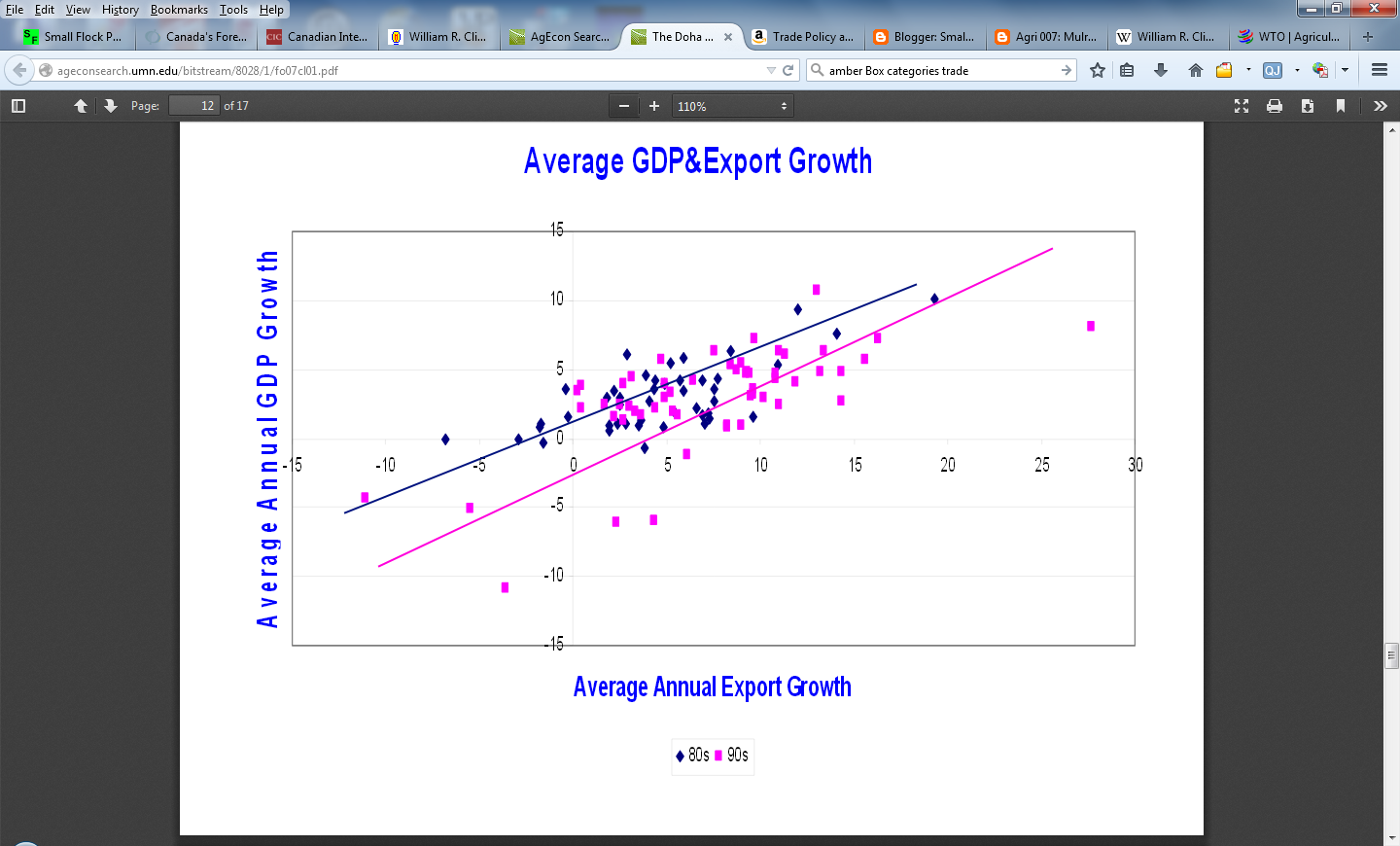
- In developing countries, data from the 1980's and 1990's suggest that as their exports grow, local GDP grows also. See Figure 1.
- That boost to the economies of developing nations via free trade could be as much as $200 Billion per year. Half of that boost would be from free trade for agricultural commodities. The other major sectors for boosting their economies would be from exporting textiles and apparel.
- Global free trade would raise the GDP by 1.5% to 2% directly. The dynamic (ie. spin-off) effects would more than double the direct effect, so the total effect (ie. both direct and indirect) would be more than 4%.
- While the average effect on people would be 4%, the poorest of the poor are estimated to receive the biggest impact of free trade, estimated by Mr. Cline to be double of the average effect (ie. 8% for the Poor vs. 4% on average for all citizens in a developing country).
- In Mr. Cline's 2007 paper to a USDA conference, he states: "...the broad empirical relationship between poverty and income shows that the “poverty elasticity” – the percent by which the number of poor declines for a 1 percent rise in their income– is about 2. So multiply once again by 2 and you get a total of 16 percent reduction in the number of poor. Apply that to 300 million [sic, appear he meant 3 Billion] in poverty and you get about 500 million reduction in global poverty." Therefore, Mr. Cline concludes that free trade would raise the income of Poor people sufficiently to remove 500 million people from the poorest category (ie. earn $2.00/day or less).
- Free trade for agriculture is essential to achieving these positive effects for the world's poor. See Figure 2. WTO defines ag. subsidies as colour-coded boxes, similar to traffic light colours (red= prohibited, amber= caution or subsidies that are to be reduced, green= OK in unlimited quantities, plus blue=amber with conditions that limit the quantities that farmers can produce. The protectionism of Japan's farmers is legendary, estimated to be equivalent to an 82.1% import tariff when you count true tariffs (76.4%) and domestic subsidies (3.2%). Canada is the 2nd worst villain in ag. tariffs and subsidies at 52.3%. The EU is 46.4%, and the US is just 19.9%. The weighted average for all industrialized nations is 36%. No wonder Canada is in such huge trouble in trade talks with the US, EU, TPP, and WTO; we're 45% higher in ag. trade barriers than the world average for industrialized nations.
 |
| Figure 1: Mr. Cline's datapoints showing the correlation between a developing country's GDP vs. the growth in their exports. The lines were added by me. |
 |
| Figure 2: Mr. Cline's estimates of barriers to free trade in agricultural. Japan is seen as the worst, with a total of 82.1% tariff-equivalent import barrier, with Canada in 2nd place of this Rogue's Gallery at 52.3% tariff- equivalent barrier to ag. imports from developing nations. |
In 2012, Canada spent $5.67 Billion on foreign aid according to CIDA's data, which is stingy when compared to our relative wealth and the aid by other OECD nations. About 69% of Canada’s aid in 2012 was channeled through the Canadian International Development Agency (CIDA), 9% through Finance Canada, and 8.2% through the Department of Foreign Affairs and International Trade, while the International Development Research Center (IDRC) accounts for 3.5%. About 33.4% of that aid went to Least Developed (or poorest) Countries, another 2.5% went to other Low Income Countries, and 16.8% went to Lower Middle Income countries (41% is not coded by income group). Africa received the highest share at almost 42%, followed by Asia (22%), and the Americas (17%). Following nearly a decade of sustained increases, Canada's aid spending has stalled and is set to decline in the coming years.
About
69% of Canada’s aid in 2012 was channeled through the Canadian
International Development Agency (CIDA), about 9% through Finance Canada
and 8.2% through the Department of Foreign Affairs and International
Trade, while the International Development Research Center (IDRC)
accounts for 3.5%. - See more at:
http://cidpnsi.ca/blog/portfolio/canadas-foreign-aid/#sthash.5R7LsQkW.dpuf
As a Small Flocker in Canada, there are a few issues of which I am concerned.
First, I have seen the jars of pickles on my local grocery store shelves that have been imported from India. I have eaten some of those pickles, as they are significantly cheaper than N. American pickles and seem to have reasonable quality. I also fret about "what is this world coming to" when Canadian pickle producers have permanently shut their doors, and we are now forced to import from elsewhere. I assume I would feel equally conflicted about SM products of dairy, chicken, and eggs being imported into Canada at the expense of domestic production.
Secondly, the quality of N. American chicken is a disaster, with bacterial contamination (including superbugs), bad Omega-3 to Omega-6 fatty acid ratios, bad bird welfare habitats, etc. I assume that 2nd and 3rd world imports might be significantly worse; witness the recent news reports of falsified species in fish imported from South-East Asia, melamine tainted milk in China, and many similar events. As an example of a disaster going someplace to happen, live US chicken was proposed to be exported to China, slaughtered in China, processed and further processed in China to create boxed chicken, then import those packaged chicken products back into the US with no review whatsoever of that entire international supply chain by USDA inspectors (see Blog posting COOL Blowback ). Canadians need higher quality products, not lower. Can we be assured of this quality if we are importing SM replacement products from the developing world?
Thirdly, I am cautious of Free Traders and others who pretend to be helping the poor, when in reality they are propaganda shills for Big Ag., the PTB ("Powers That Be"), the NWO ("New World Order"), and the 0.01%'ers. Exactly who is this Mr. Cline? CIC (Canadian International Council) seems to support Mr. Cline's research. Is Mr. Cline a master manipulator, or a straight arrow? For me, it's too soon to tell, but I am wary about trusting too quickly.
Fourthly, if SM will not yield any ground to domestic Small Flockers, I assume that international small flockers don't have a chance. I would assume that the poorest of the poor would be small flockers in chicken, and small market gardeners in fruits and vegetables.
Fifthly, if WTO, TPP, and EU trade talks achieve agricultural free trade by some miracle, how long before Big Ag. moves in to their third world countries where they create a monopoly for themselves via unfair or predatory trade practices so as to steal the free trade opportunities away from those who need them most.
By slowly and carefully reducing Canada's import tariffs and subsidies to Canada's #ChickenMafia, I believe that would be beneficial to Canada's consumers and small flockers alike, and would eventually force Canada's #ChickenMafia to dramatically improve, or die. However, is there a tariff level below which no Canadian chicken farmer can compete, and dropping import tariffs below this threshold will surely kill all the #ChickenMafia, and possibly even Canada's small flockers? If yes, what is that critical tariff level?
A lot of questions, conflicts, and inconsistencies currently exist inside of me on these SM trade issues. I assume each of you has a similar list. These are complex issues, and we need to get them right the first time. That is exactly why those acting against the best interests of the majority purposefully cloud the issues so as to protect their special interests.
Hopefully with additional study by myself and other, the mud will settle and we can see clearly on the best path to take.
Friday, September 19, 2014
Militarized Canadian Chicken
BC chicken farms have been militarized as a propaganda tool to distract consumers from the real issues.
BC Chicken Marketing Board and BC Chicken Growers’ Association teamed up to produce this propaganda video Chicken Squad.
With the specially built website for the propaganda video, offering behind the scenes, out-takes, and related clips, we are introduced to real people who starred in the video, people who are just like us, but they just happen to be chicken farmers. All of them seem like very nice people who would be desirable as friends or neighbours. At the end of shooting the video, they bring in the public for a chicken BBQ, show them the barns, the cute day-old chicks, and the video. Nice PR propaganda. I'm sure everybody took lots of pictures and told all their family and friends about their exciting adventure. Excellent tool to avoid the truth and re-assure the public.
I'm not totally comfortable with them depicting the militarization of chicken factory farms. I'm especially upset that they use this powerful tool to deceive and distract the public from the real issues.
Their video is rated as "ST: Shocking Truth", but is it? BC Chicken Growers assure us time and again that chicken farmers have kept both hormones and steroids out of BC's chicken supply for over 50 years. Where is the objective proof to back up that statement?
The movie repeats and repeats again that ever since 1963 it has been illegal to use steroids or hormones in growing chickens. Got it. I understand. No steroids or hormones allowed. However, this begs some questions:
David Janzen, Chairperson of Chicken Farmers of Canada ("CFC") since 2012, in the role of Mentor for the Chicken Squad, says in the video:
The propaganda facade constructed by the #ChickenMafia has some serious breaches and holes. People have looked behind the curtain and don't like what they have seen. No wonder the #ChickenMafia needed a hot, sexy video on social media to shore up their image and protect their monopoly.
Feeding chickens arsenic, banned antibiotics, antihistamines, Prozac anti-depressants, caffeine, and Tylenol have all been standard practices in the mega chicken factories for decades (see Blog posting Choose: Frankenstein Chicken, or Naturally Raised Chicken?). For the #ChickenMafia who chose to do so, some or all of these chemicals and drugs are fed to the chicken so as to help the millionaire chicken farmers increase their profits, and reduce their risks. While the use of drugs and chemicals has been standard practice, there may be a few brave chicken factory farms who minimized the use of these drugs and chemicals, or didn't use them at all. We don't know for sure, as this is a closely guarded secret of the #ChickenMafia.
Little thought is made about the impact these drugs and chemicals have on the quality of the food produced, or the wishes of the consumer. If there was full truth in advertising, and the #ChickenMafia was forced to disclose the chemical soup that some regularly feed to their chickens, how many shocked consumers would still buy that chicken?
If Dave Janzen and CFC want to produce "real food, real chicken", do they carefully audit and test chicken samples throughout Canada to ensure nobody is sneaking any of these drugs and chemicals into the chickens so as to enhance their profits and reduce their business risk? If yes, let them disclose the methods used and the data collected. If not, this Chicken Squad video is mere propaganda meant to deceive, coverup, distract, and mislead the public.
They say it and write it in the video "Chicken growers have kept steroids and hormones out of BC for about 50 years"
Yes, I agree, it has been illegal to use hormones and steroids. Unfortunately, there's significant money to be made by using illegal drugs, hormones, and steroids.
Is BC's Chicken Marketing Board inspecting and testing for illegal substances in the chicken? If not, why not? If they can't back up their statements with objective facts, they shouldn't be making the statements; neither in their video dramatization, nor their website, nor their literature. Again, where's the proof for the statements being made by the #ChickenMafia?
The whole premise of the video is the questionable portrayal of the militarization of food and farm. In case the BC #ChickenMafia forgot, this is Canada, not the United States. Canadians support neither weapons-grade food, nor militarization of farms.
The BC Chicken Growers received a $15,500 government grant from the BC Buy Local Fund to help fund the video. It is interesting to see how the government gushes over the#ChickenMafia in their press release about this grant. Vancouver's Humane Society isn't happy about millionaire chicken farmers getting government grants to create misleading propaganda to hide behind so as to avoid animal rights issues.
I assume the video cost somewhere between $50,000 to $200,000 to make. Our tax dollars part part of the cost, but who gets to pay the rest? Obviously, they didn't do a door-to-door charitable collection to fund their fun little video. They likely took it out of their marketing budget, funding it as a way of promoting chicken. The cost of that video helped raise the price of chicken in the stores, or prevented the prices from dropping. Either way, were they properly spending the public's money? After all, it is consumers who eventually picks up the tab for everything the #ChickenMafia does.
While the chicken farmers have fun pretending they're in Hollywood, we get the bill, we have to explain to our kids and/or grandchildren why there are gunfights and explosions at Canadian chicken farms, and the #ChickenMafia avoid the truth again and again.
BC Chicken Marketing Board and BC Chicken Growers’ Association teamed up to produce this propaganda video Chicken Squad.
With the specially built website for the propaganda video, offering behind the scenes, out-takes, and related clips, we are introduced to real people who starred in the video, people who are just like us, but they just happen to be chicken farmers. All of them seem like very nice people who would be desirable as friends or neighbours. At the end of shooting the video, they bring in the public for a chicken BBQ, show them the barns, the cute day-old chicks, and the video. Nice PR propaganda. I'm sure everybody took lots of pictures and told all their family and friends about their exciting adventure. Excellent tool to avoid the truth and re-assure the public.
I'm not totally comfortable with them depicting the militarization of chicken factory farms. I'm especially upset that they use this powerful tool to deceive and distract the public from the real issues.
Their video is rated as "ST: Shocking Truth", but is it? BC Chicken Growers assure us time and again that chicken farmers have kept both hormones and steroids out of BC's chicken supply for over 50 years. Where is the objective proof to back up that statement?
The movie repeats and repeats again that ever since 1963 it has been illegal to use steroids or hormones in growing chickens. Got it. I understand. No steroids or hormones allowed. However, this begs some questions:
- What were the chicken farmers doing before 1963 that instigated the government to ban the use of steroids and hormones?
- What is your definition of "steroids" and "hormones"? How do those definitions match up with reality, or are these definitions used to create a loophole so as to deceive, mislead, and distract?
- What about the use of antibiotics, chemical, drugs, and other growth promotants in the chicken's feed and water? Why aren't you making a video about that?
David Janzen, Chairperson of Chicken Farmers of Canada ("CFC") since 2012, in the role of Mentor for the Chicken Squad, says in the video:
"They're trying to ruin our chicken. You have to stop them. Don't forget what I've taught you, how we raise real food, real chicken."Interviewing David Janzen about the propaganda video, Canadian Poultry wrote:
“The most concerning statistic is how many consumers believe chicken contains hormones and steroids,” Janzen says, noting a recent survey showed 64 per cent of British Columbians believe that. The videos therefore clearly spell out that the use of hormones and steroids to produce chicken in Canada has been banned for 50 years.Bingo!
Misconceptions are particularly prevalent among the young.
“We looked at the issue of trust between consumers and farmers. Do consumers trust the people who are growing their food?” Janzen asks, adding “there was a direct correlation between age and the level of trust. The younger the consumer, the less the trust.”
 |
| #ChickenMafia's survey of BC consumers found that 63% of consumers believe BC chicken contains steroids and hormones |
Feeding chickens arsenic, banned antibiotics, antihistamines, Prozac anti-depressants, caffeine, and Tylenol have all been standard practices in the mega chicken factories for decades (see Blog posting Choose: Frankenstein Chicken, or Naturally Raised Chicken?). For the #ChickenMafia who chose to do so, some or all of these chemicals and drugs are fed to the chicken so as to help the millionaire chicken farmers increase their profits, and reduce their risks. While the use of drugs and chemicals has been standard practice, there may be a few brave chicken factory farms who minimized the use of these drugs and chemicals, or didn't use them at all. We don't know for sure, as this is a closely guarded secret of the #ChickenMafia.
Little thought is made about the impact these drugs and chemicals have on the quality of the food produced, or the wishes of the consumer. If there was full truth in advertising, and the #ChickenMafia was forced to disclose the chemical soup that some regularly feed to their chickens, how many shocked consumers would still buy that chicken?
If Dave Janzen and CFC want to produce "real food, real chicken", do they carefully audit and test chicken samples throughout Canada to ensure nobody is sneaking any of these drugs and chemicals into the chickens so as to enhance their profits and reduce their business risk? If yes, let them disclose the methods used and the data collected. If not, this Chicken Squad video is mere propaganda meant to deceive, coverup, distract, and mislead the public.
They say it and write it in the video "Chicken growers have kept steroids and hormones out of BC for about 50 years"
Yes, I agree, it has been illegal to use hormones and steroids. Unfortunately, there's significant money to be made by using illegal drugs, hormones, and steroids.
Is BC's Chicken Marketing Board inspecting and testing for illegal substances in the chicken? If not, why not? If they can't back up their statements with objective facts, they shouldn't be making the statements; neither in their video dramatization, nor their website, nor their literature. Again, where's the proof for the statements being made by the #ChickenMafia?
The whole premise of the video is the questionable portrayal of the militarization of food and farm. In case the BC #ChickenMafia forgot, this is Canada, not the United States. Canadians support neither weapons-grade food, nor militarization of farms.
The BC Chicken Growers received a $15,500 government grant from the BC Buy Local Fund to help fund the video. It is interesting to see how the government gushes over the#ChickenMafia in their press release about this grant. Vancouver's Humane Society isn't happy about millionaire chicken farmers getting government grants to create misleading propaganda to hide behind so as to avoid animal rights issues.
I assume the video cost somewhere between $50,000 to $200,000 to make. Our tax dollars part part of the cost, but who gets to pay the rest? Obviously, they didn't do a door-to-door charitable collection to fund their fun little video. They likely took it out of their marketing budget, funding it as a way of promoting chicken. The cost of that video helped raise the price of chicken in the stores, or prevented the prices from dropping. Either way, were they properly spending the public's money? After all, it is consumers who eventually picks up the tab for everything the #ChickenMafia does.
While the chicken farmers have fun pretending they're in Hollywood, we get the bill, we have to explain to our kids and/or grandchildren why there are gunfights and explosions at Canadian chicken farms, and the #ChickenMafia avoid the truth again and again.
Tuesday, June 10, 2014
George Morris Centre: Facts or Rhetoric
George Morris Centre says that it is "Canada’s leading economic agri-food research centre." Is George Morris Centre the leader in agri-food research, or the propaganda centre for Big Food or Supply Management ("SM") rhetoric?
Rhetoric is defined as:
GMC writes research reports, puts on seminars, and provides speakers. They have a significant number of talented people who don't work for peanuts. Finding the revenue each month to keep GMC going is likely not an easy task.
To help fund GMC, they sell memberships (Individual $250/yr, Association $1,000/yr, and Corporate $2,500/yr). Are the opinions, needs, and desires of these GMC members influencing, controlling, or tainting the research and opinions of GMC?
Is GMC an independent, unbiased, and authoritative source than can be relied upon, or a shill and propaganda mouthpiece for Big Food and Canada's Supply Management sector?
GMC recently released a new research report, titled Is Food Really More Expensive in Canada Than the US? This report was written by GMC Staff Members Al Mussell (Senior Research Associate), and
Kevin Grier (Senior Market Analyst). Al has a background in US dairy, while Kevin is more into meat and retail grocery.
It takes brave individuals to write about something that just about everybody "knows" to be obvious, ubiquitous, and long ago assumed to be consistently true. What could you possibly say other than re-hash the same facts over again?
However, these two GMC researchers dove into the deep end, and produced this report. It seems that this GMC paper was prompted by the May, 2014 Commentary by the CD Howe Institute "Sticker Shock: The Causes of the Canada-US Price Differential" by Nicholas Li. The CD Howe report found that consumer prices are broadly higher in Canada, and Canadian food prices purchased for consumption in the home was about 57% more expensive in Canada than in the US in 2011.
GMC's comments on the CD Howe report were:
I wonder how much in charitable donations does GMC receive each year from the Supply Management sector? Since all of those $ eventually come from Canadian consumers of SM products, it is easy to be generous with other people's money, so I bet SM is very generous to GMC. If I am wrong, let GMC and SM disclose the truth so that we all know.
Exactly how many consumers, poverty activists, small flockers, affordable food supporters, and local food groups buy GMC memberships? I doubt it's a large crowd. My guess is that GMC has significantly less than one person in this large group who buys a GMC membership. Also, I doubt any of these people attend GMC seminars. If I am wrong in my assumptions, let GMC disclose the GMC membership data so we all know for sure.
So GMC has an easy choice: support GMC members, and find some way to lessen the blow from the CD Howe report. If you can't fight it with facts, perhaps GMC can muddy the waters so that there is confusion where clarity previously existed on the US-Canada food price differential.
CD Howe used OECD data to prove its case (data that originated from each government, likely Statistics Canada in our case).
GMC used data from US Department of Agriculture- Economic Research Service and an unspecified Canadian source (I assume USDA Table 97_2012, but that hole in GMC's paper is worrisome). GMC determines that in 2012:
Now that we know where GMC gets its numbers from, we can look at GMC's magical thinking more carefully.
The average US household earns 24.4% more than the average Canadian household. In spite of the average US household earning more, it spends less on food, whether in absolute US$ (15.2% less) or as a % of household income (31.25% less). Either way, Canadians earn 24.4% less and pay 31% more for food than our American neighbours. The combined whammy of these two factors produces a 63.3% greater impact of food purchases on Canadian family budgets (ie. 1.244 * 1.3125= 1.633).
Whenever a propaganda pusher wants to create rhetoric (ie. propaganda), changing the basis of comparison, or taking percentages is a favorite ploy. CD Howe says Canadians pay 57% more for food that US households. To disguise this sad fact, GMC changes the basis of comparison and takes percentages.
GMC goes on, in its Table 1, to look at 2009 expenditures for food cooked and eaten at home vs. food eaten outside the home. Here, Canadians eat out less than our US neighbours (6% for US, 3.7% for Canadians, for a 61.7% difference) . Everybody knows it is more expensive to eat out. Most restaurants charge a 200% to 300% markup (eg. if the food ingredients cost the restaurant $10.00 then that meal will sell for $30.00 in a restaurant if a 300% markup is used). If Canadians can't afford the food they need, they certainly won't be maximizing their dining out experiences. For this 2009 data, in-home and out-of-home food is 14.6% for the US, and 15.3% for Canadians, so Canucks pay a grand total of 4.79% more that our US neighbours.
GMC then concludes,
A 4.79% price difference to frugal Canadians is far from zero. Have you seen how far Canadians will drive to buy gasoline at just 0.1 cents per litre cheaper (ie. 0.1 cents is a 0.069% price savings at 140.0 cents per litre)?
Of course, the data in GMC's Table 1 is 2009 data, 5 years old. Does the CD Howe data of 2011-2012 suggest that things have gotten a lot worse for Canadians in those 3 intervening years?
Above is a graph taken from GMC's report. We can see that all prices were indexed as of 2002 (ie. set equal on the index as of 2002). From that starting point, US food prices increased the most, followed by Canadian food prices.
When you start with a small number (ie. US food prices), the same increase creates a huge percentage increase, as we see here for the US food price index. For example, changing from 1 to 2 is a 100% increase, but to change from 100 to 101 is just a 1% increase. This is just another propaganda trick. I'm not fooled by GMC's slight of hand. Were you?
Let's look at something that GMC exposed by their graph, but didn't discuss. Since 2002, Canada's all item prices increased by about 22.5%, but Canadian food prices went up by about 32.5%.
I assume that "all items" includes food, so if we were to compare "All items except food" with "Food", we would get even a bigger price differential. We will ignore this effect for now, but realize that the magnitude of the screwing revealed below is even worse than we state here because of this issue.
When we look at the relative price changes, the 2013 Canadian indexes 32.5% (Food) vs. 22.5% (All) is a 8.16% difference for Food Vs. All. For the US in 2013, the price indexes are 34.8% (Food) vs. 29% (All), which is a 4.5% difference Food Vs. All.
In summary, everything was set equal in 2002, then US food went up 4.5% more than all other US consumer prices. For the same period, Canadian food went up 8.16% more than all other Canadian consumer prices. Therefore Canada has had double the price inflation rate differential (ie. Food Vs. All) of what the Americans experienced. I would suggest this is an apples to apples comparison that clearly shows Canadians are being screwed for food prices.
Just as CD Howe reported, I agree with CD Howe that chicken, eggs, dairy, and turkey represent the leaders in the screwing of Canadians for food prices. That means Supply Management causes or significantly contributes to the screwing of Canadians for food prices.
How can the same data be used to draw totally different conclusions? I would suggest it is because a twisted tale is being created by a propaganda shill mouthpiece in one case.
Is this example enough to clearly show GMC's bias? Are we done here?
Perhaps GMC is in a funding crisis because they are on the wrong side of the issues.
Perhaps if GMC was seen as a protector and defender of all Canadians, then all the governments, citizens, and the entire agri-food industry would support them and take them seriously.
GMC has done great works for Canada and Canadians in the past. Perhaps the Board of Directors of GMC should re-read the bio of their namesake, George Fletcher Morris (1910-1999) and determine if he would approve of this GMC report and its obvious bias against the 38 million Canadian consumers, and in favor of GMC's friends, the Supply Management millionaires.
Rhetoric is defined as:
"language that is intended to influence people and that may not be honest or reasonable."George Morris Centre ("GMC") used to be part of the University of Guelph. Today, it is registered as a non-profit charitable organization. According to its 2013 financial report, it is operating at a $475,000 deficit on a $1.8 Million annual budget; a 26.4% deficit.
GMC writes research reports, puts on seminars, and provides speakers. They have a significant number of talented people who don't work for peanuts. Finding the revenue each month to keep GMC going is likely not an easy task.
To help fund GMC, they sell memberships (Individual $250/yr, Association $1,000/yr, and Corporate $2,500/yr). Are the opinions, needs, and desires of these GMC members influencing, controlling, or tainting the research and opinions of GMC?
Is GMC an independent, unbiased, and authoritative source than can be relied upon, or a shill and propaganda mouthpiece for Big Food and Canada's Supply Management sector?
GMC recently released a new research report, titled Is Food Really More Expensive in Canada Than the US? This report was written by GMC Staff Members Al Mussell (Senior Research Associate), and
Kevin Grier (Senior Market Analyst). Al has a background in US dairy, while Kevin is more into meat and retail grocery.
It takes brave individuals to write about something that just about everybody "knows" to be obvious, ubiquitous, and long ago assumed to be consistently true. What could you possibly say other than re-hash the same facts over again?
However, these two GMC researchers dove into the deep end, and produced this report. It seems that this GMC paper was prompted by the May, 2014 Commentary by the CD Howe Institute "Sticker Shock: The Causes of the Canada-US Price Differential" by Nicholas Li. The CD Howe report found that consumer prices are broadly higher in Canada, and Canadian food prices purchased for consumption in the home was about 57% more expensive in Canada than in the US in 2011.
GMC's comments on the CD Howe report were:
"Meats and the milk, cheese, and eggs group were observed to have the largest cost differential, at 76-77% more expensive than in the US. [Nicholas] Li comes to a familiar conclusion- blame supply management."GMC appears to be great friends with Canada's Supply Management system. Perhaps GMC has a majority of its members in the SM system. When CD Howe complains about SM in Canada, what should GMC do to help its members who use SM proceeds to buy GMC memberships?
I wonder how much in charitable donations does GMC receive each year from the Supply Management sector? Since all of those $ eventually come from Canadian consumers of SM products, it is easy to be generous with other people's money, so I bet SM is very generous to GMC. If I am wrong, let GMC and SM disclose the truth so that we all know.
Exactly how many consumers, poverty activists, small flockers, affordable food supporters, and local food groups buy GMC memberships? I doubt it's a large crowd. My guess is that GMC has significantly less than one person in this large group who buys a GMC membership. Also, I doubt any of these people attend GMC seminars. If I am wrong in my assumptions, let GMC disclose the GMC membership data so we all know for sure.
So GMC has an easy choice: support GMC members, and find some way to lessen the blow from the CD Howe report. If you can't fight it with facts, perhaps GMC can muddy the waters so that there is confusion where clarity previously existed on the US-Canada food price differential.
CD Howe used OECD data to prove its case (data that originated from each government, likely Statistics Canada in our case).
GMC used data from US Department of Agriculture- Economic Research Service and an unspecified Canadian source (I assume USDA Table 97_2012, but that hole in GMC's paper is worrisome). GMC determines that in 2012:
"in the US, food and non-alcoholic beverage purchases consumed at home were 6.6% of consumer expenditures. Canada came in with expenditures of 9.6%. This appears close to the 57% spread from the OECD data quoted by Li."Let's see, 6.6/9.6= 68.75% and 9.6/6.6= 145% and (9.6-6.6)/6.6= 45.45% and (9.6-6.6)/9.6= 31.25% so we have something between 69% and 31% difference, depending on how you calculate it. Oh oh. GMC seems to support CD Howe and their conclusion that Supply Management likely results in higher food prices. GMC goes on to explain it away:
"According to the USDA, US household consumer expenditures were $US 34,541; For Canada it was $US 27,761. This gives total expenditures on food for a US household of $US 2,273 and a Canadian household of $US 2,679. The implication is that, over the course of a year, Canadians spent about $US 406 more on groceries than Americans did. This is just under $US 8/week, or about 18%. The implication is that when we factor in observed differences in consumer spending for all goods, apparently the difference in food expenditures is not quite so egregious."GMC says Canadians pay 18% more, but doesn't say 18% of what. It is incorrect to use percentages unless you clearly state what the percentage refers to. GMC muddies the waters, again. Taking a guess, I find that the US$2,679/yr that Canadians pay for groceries is 17.8419% more than the US$ 2,273/yr that a US family spends on groceries; close to the 18% figure stated by GMC.
Now that we know where GMC gets its numbers from, we can look at GMC's magical thinking more carefully.
The average US household earns 24.4% more than the average Canadian household. In spite of the average US household earning more, it spends less on food, whether in absolute US$ (15.2% less) or as a % of household income (31.25% less). Either way, Canadians earn 24.4% less and pay 31% more for food than our American neighbours. The combined whammy of these two factors produces a 63.3% greater impact of food purchases on Canadian family budgets (ie. 1.244 * 1.3125= 1.633).
Whenever a propaganda pusher wants to create rhetoric (ie. propaganda), changing the basis of comparison, or taking percentages is a favorite ploy. CD Howe says Canadians pay 57% more for food that US households. To disguise this sad fact, GMC changes the basis of comparison and takes percentages.
GMC goes on, in its Table 1, to look at 2009 expenditures for food cooked and eaten at home vs. food eaten outside the home. Here, Canadians eat out less than our US neighbours (6% for US, 3.7% for Canadians, for a 61.7% difference) . Everybody knows it is more expensive to eat out. Most restaurants charge a 200% to 300% markup (eg. if the food ingredients cost the restaurant $10.00 then that meal will sell for $30.00 in a restaurant if a 300% markup is used). If Canadians can't afford the food they need, they certainly won't be maximizing their dining out experiences. For this 2009 data, in-home and out-of-home food is 14.6% for the US, and 15.3% for Canadians, so Canucks pay a grand total of 4.79% more that our US neighbours.
GMC then concludes,
"In other words, it suggests that what Canadians and Americans spend on food in total as a share of consumer spending is about the same."There is still a 4.79% difference in this 2009 data, which is dismissed by GMC as a triviality, so close to equal that GMC dismisses it as zero.
A 4.79% price difference to frugal Canadians is far from zero. Have you seen how far Canadians will drive to buy gasoline at just 0.1 cents per litre cheaper (ie. 0.1 cents is a 0.069% price savings at 140.0 cents per litre)?
Of course, the data in GMC's Table 1 is 2009 data, 5 years old. Does the CD Howe data of 2011-2012 suggest that things have gotten a lot worse for Canadians in those 3 intervening years?
 |
| Graph from Page 4 of GMC's Report, showing price trends in US and Canada for food and all items purchased by households |
When you start with a small number (ie. US food prices), the same increase creates a huge percentage increase, as we see here for the US food price index. For example, changing from 1 to 2 is a 100% increase, but to change from 100 to 101 is just a 1% increase. This is just another propaganda trick. I'm not fooled by GMC's slight of hand. Were you?
Let's look at something that GMC exposed by their graph, but didn't discuss. Since 2002, Canada's all item prices increased by about 22.5%, but Canadian food prices went up by about 32.5%.
I assume that "all items" includes food, so if we were to compare "All items except food" with "Food", we would get even a bigger price differential. We will ignore this effect for now, but realize that the magnitude of the screwing revealed below is even worse than we state here because of this issue.
When we look at the relative price changes, the 2013 Canadian indexes 32.5% (Food) vs. 22.5% (All) is a 8.16% difference for Food Vs. All. For the US in 2013, the price indexes are 34.8% (Food) vs. 29% (All), which is a 4.5% difference Food Vs. All.
In summary, everything was set equal in 2002, then US food went up 4.5% more than all other US consumer prices. For the same period, Canadian food went up 8.16% more than all other Canadian consumer prices. Therefore Canada has had double the price inflation rate differential (ie. Food Vs. All) of what the Americans experienced. I would suggest this is an apples to apples comparison that clearly shows Canadians are being screwed for food prices.
Just as CD Howe reported, I agree with CD Howe that chicken, eggs, dairy, and turkey represent the leaders in the screwing of Canadians for food prices. That means Supply Management causes or significantly contributes to the screwing of Canadians for food prices.
How can the same data be used to draw totally different conclusions? I would suggest it is because a twisted tale is being created by a propaganda shill mouthpiece in one case.
Is this example enough to clearly show GMC's bias? Are we done here?
Perhaps GMC is in a funding crisis because they are on the wrong side of the issues.
Perhaps if GMC was seen as a protector and defender of all Canadians, then all the governments, citizens, and the entire agri-food industry would support them and take them seriously.
GMC has done great works for Canada and Canadians in the past. Perhaps the Board of Directors of GMC should re-read the bio of their namesake, George Fletcher Morris (1910-1999) and determine if he would approve of this GMC report and its obvious bias against the 38 million Canadian consumers, and in favor of GMC's friends, the Supply Management millionaires.
Tuesday, October 29, 2013
A Tale of Two Opinions
#ChickenMafia are alive and well, spewing their propaganda everywhere. When a survey was done by Forum Research, Dave Janzen who is Chairman of the Chicken Farmers of Canada went on the attack.
Dave has a paid subscription to iPolitics, so he gets a nice platform from which to release his indoctrination efforts as a guest article. It is well written, like most propaganda, and therefore seems plausible, and can easily mislead the public; just as intended.
 Small Flockers alternative voice is weak, but clear. We are only allowed to speak from the corner of the room. However we will not be silent. We will persevere.
Our reasoned response to the #ChickenMafia is in yesterday's Blog posting
Dave has a paid subscription to iPolitics, so he gets a nice platform from which to release his indoctrination efforts as a guest article. It is well written, like most propaganda, and therefore seems plausible, and can easily mislead the public; just as intended.

Our reasoned response to the #ChickenMafia is in yesterday's Blog posting
Subscribe to:
Posts (Atom)