Google+
Showing posts with label Big Ag.. Show all posts

Tuesday, December 30, 2014

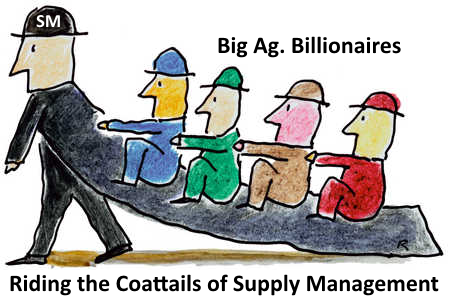
Big Ag rides the Monopolistic Coattails of SM

Big Ag. billionaires ride the monopolistic coattails of Supply Management ("SM").

The Big Ag. Billionaires love riding the coattails of Supply Management. Like most
"Deals with the Devil", both parties benefit from the relationship in the short term.
Long term, losing your freedom and your soul has significant consequences.

The Big Ag. Billionaires love riding the coattails of Supply Management. Like most
"Deals with the Devil", both parties benefit from the relationship in the short term.
Long term, losing your freedom and your soul has significant consequences.

Anonymous comments posted on Better Farming recently postulated that retailers enjoy, benefit, and welcome the price stability of SM commodities (dairy, chicken, eggs, & turkey), as it enables steady profits while minimizing consumer anger at high food prices.  Do big grocery chains ride SM's coattails too?

Big retail grocery chains tend to use 4 basic commodities (bread, milk, eggs, chicken) as "loss leaders" in their advertising and advertising flyers, where they focus their price competition efforts.  This theory assumes that if a grocer has excellent prices on these 4 basic foods, customers flock to your grocery store, then you can charge prices as you please on all the other items on your shelves.

That may be somewhat true, but there are limits to the retail price gouging that can occur under this method.

Groceries have always been a high volume, low margin business, and highly competitive.  More recently, grocers complain that it has become even more cut throat and competitive.  Walmart selling food in Canada has been a major disruptive force in the marketplace.  Some experts feel that Walmart will terminate its grocery sales experiment within the next five years.     

A Feb. 2014 Financial Post article said,
"Quarterly earnings margins before interest, taxes, depreciation, amortization and rent costs at Loblaw, Sobeys and Metro [the three largest grocery chains] have ranged from 6.5% to as high as 9% over the past two years."
I read with interest the recent article on Sobeys in Canadian Grocer.  Mr. Marc Poulin said healthier food products introduced into Sobeys over the past year are part of the reason for the recent profit jump at the stores.  I also note that the same article shared that "Analysts have said Sobeys faces fierce price competition in the grocery business."

On Empire Company Ltd.'s website (Empire is the parent company of Sobeys), it states, "Empire is committed to maximizing sustainable long-term shareholder value by supporting Sobeys’ purpose to help Canadians Eat Better, Feel Better and Do Better while also strengthening our related real estate investments."

Sobeys commitment sounds pretty good to me.  I hope that Sobeys follows through with their commitment.  I asked Empire's Board about that commitment on 2014/09/20 (ie. 100 days ago), and have not yet received a response from them.  They must still be thinking about it.

In 1996, researchers published their price modeling for the relationship  between farm and retail prices for 9 Canadian food staples. 
They found that
  • In 1986, Canada had 101 chicken processing plants.  The four largest processing firms, some of which operate multiple plants, account for at least fifty percent of total Canadian sales for meat (ie. low competition).  For chicken, the Canadian concentration ratio in 1982 was more than twice that in USA.
     
  • SM products sold at retail in Canada completely passed on all of the farm gate price increases to consumers (ie. a 1% increase in SM farm gate price increased retail store prices by 1%),
  • Non-SM foods usually passed on less than half of the farm gate price increase.
While Canada's chicken processor concentration in 1982 was double the US concentration, it has become even more concentrated by plant closures, mergers, and acquisitions.

That research confirms that it isn't just SM farmers who are solely responsible for the unfair gouging of consumers for SM commodities.  Those Big Ag. "friends" of SM who ride on the monopolistic coat tails of SM farmers also play a role in unfairly boosting prices of SM foods at retail stores.

It was reported to me earlier this year by the Meat Department Manager at a local grocery store that he was selling chicken at a price below their cost ($1.88 per lb., or $4.14/kg), which is roughly the same as US retail pricing.  I believe what he told me was true.  While it may not happen every day, it appears to happen at least sometimes that some food items are sold at retail prices that are at or below the retail store's cost.

Chicken Farmers of Ontario ("CFO") seems to have learned the "boiling frog" method of slow steady price inflation of 3.57%/yr as an insidious attack on consumers so as to maximize the profits of their multi-millionaire CFO members and their Big Ag friends. See Chicken Price Parity:  Will It Ever Come?

That "boiling frog" steady rate of price inflation for chicken may help retailers as well, just as the BF poster suggested.

Tuesday, December 16, 2014

Imported Foods: Is Free or Fair Trade a Solution to Affordable Food?

Can Canada's Supply Management ("SM") system be replaced (or co-exist) with free trade or fair trade chicken?

There are small flock farmers in third world countries who would benefit from additional opportunities to sell their chicken, eggs, and other agricultural products.  Since Canadians pay one of the highest prices for SM products, likely these third world suppliers can produce those products far cheaper than Canadian suppliers.

I believe Canadians want more affordable food, provided it is safe, dependable, and nutritious.  I also believe that Canadians prefer to buy from and support Canadian producers, but are not prepared to be gouged in pricing, or held hostage so as to support Canadian suppliers.

In yesterday's Blog posting (see Import Chicken: Help the Poor in both Canada & the World? ), I presented Mr. Cline's research that says the poor, both the first world poor customers and the third world poor suppliers, would benefit from free trade in agriculture products.  Expensive, unaffordable food is regressive, as the poor have to pay a far greater percentage of their income to buy that food than what is paid by the rich.

If income taxes are adjusted based on an individual's income and wealth, why not food?

The Guardian in its Sept. 2008 article Free trade can mean the poor stay hungry challenges the agricultural free trade proposals of Mr. Cline.  This article presents evidence that the majority of the benefit from third world free trade is gained by the intermediaries and the 1st world suppliers of the 3rd world producers.  For example, asparagus from Peru for importation to the USA is presented:
"A hearing of the US Congress's Ways and Means committee in 2006 unintentionally provided one of the most succinct accounts of the problem I have come across. The Peruvian asparagus industry was up before the house to reassure representatives that any growth in imports to the US from Peru would be in US interests.

For every dollar spent by a US consumer on imported asparagus from Peru, 70 cents stayed in the US, the industry explained. The money goes not to Peruvian farmers but to US supermarkets and wholesalers, and to US shippers, distributors, importers, and storage owners. Just 30 cents stays in Peru. (The UK too imports most of its out-of-season asparagus from Peru.)

But Peru doesn't even get the full benefit of that 30 cents, because a large portion of the 30 cents Peru makes comes back to the US anyway: it is spent by Peruvians on US seed, US materials for processing, US fertiliser and US pesticides. US-based vegetable corporations, Del Monte and General Mills Green Giant, have been able to enjoy lower land values, cheap labour and low environmental costs by moving some of their production to Peru. The handful of corporations that dominate the global markets in seed, fertiliser, pesticides, trading, distribution and retailing take care of the rest.
Increased agricultural exports have indeed contributed to a growth in Peru's GDP, but the benefit to the poor of its population is hard to see."
One Ag. expert thinks that as soon as a WTO trade agreement is announced that allows for free trade agriculture imports, all of the multi-national billionaire Big Ag. companies will use huge amounts of cheap foreign money to buy the best farm land.  Next, they would build food production and processing systems in third world countries to export to their sister branch plants in Canada and elsewhere.

It is unclear if the third world poor would see any benefit.  Perhaps they would get slave labor wages working in those new farms and food processing plants.

If the supply chain can get free trade food from third world sources at a small fraction of domestic sources, their profits magnify greatly if they can sell at the same domestic price.  Since Big Ag. tightly controls the domestic food distribution system in an oligopoly, there is little competition, so there is no significant downward force on domestic retail prices.

Therefore, as long as Big Ag. has tight control of the food distribution systems, there is likely marginal benefits from agricultural free trade, neither for the domestic poor nor the third world poor.

So what is the solution?

Can "Fair Trade" be better than "Free Trade" ?

Perhaps Small Flockers in each domestic market are the best answers.


Saturday, September 13, 2014

Cities Feed Cities

"Farmers Feed Cities" is now a passé slogan, recently abandoned by Grain Farmers of Ontario in favor of "Good in every Grain"

Intense agriculture requires huge capitalized investments, specialization, and deep expertise, hence requiring farmers.  Intense farms can't be done without farmers.

Can we cut out the Middleman?  Can we make it possible for Cities to Feed Cities?

Let's do a simple calculation based on the following facts:
  • Bird finished weight is 2 kg. live weight.
  • Birds grow cycle is 8 weeks, 6.5 grow cycles per year is 52 week year.
  • Bird's eviscerated weight is 68.6% of its live weight.
  • Chickens raised for meat or eggs need coop space so they aren't crowded or overly stressed.  The minimum space is dependent on age of the chicken, breed, weight, and temperature-humidity.  CFO's Reg 183-2012, Section 3.17 on page 8 sets a maximum bird density of 2.88 kg/sq.ft.  Assuming bird's maximum weight is 2.0 kg, that max. limit is equivalent to 1.44 birds/sq.ft.  CFO's limit is for birds who never see grass, nor the sun, nor feel the wind on their wings.  If you are free range, with the bird inside their coop only during the night or foul weather, you may be able to stock at higher densities.  I suggest that 1.0 sq. ft. per bird is reasonable, which is 44% better than the #ChickenMafia's mega chicken factory stocking density.
  • Canadians eat 37.5 kg of chicken per person per year.
  • A 10' x 10' shed can be build anywhere in Ontario without a building permit.  If a small green area can surround the shed, all the better.
  • Many cities are now permitting backyard chicken coops.
If a 10' x 10' chicken coop is installed somewhere in a city, how many people can be fed by the chicken produced within that 100 sq. ft. coop?  We calculate as follows:

Max # Birds in Coop= 10'x10'/1 sq.ft./bird= 100 birds
Max. Birds per Year= 6.5 grow cycles/yr * 100= 650 birds/yr.
Max. Live weight of chickens per yr= 650 * 2= 1,300 kg/yr
Max. eviscerated weight of chicken produced per year= 1,300 * 0.68628= 892.16 kg/yr
# People Fed per year= 892.16/37.5=   23.79 persons/yr.

Therefore a 10'x10' chicken coop can feed 23.79 people per year for their annual chicken needs.

To me, this example seems to indicate that small spaces within cities can be used to feed a neighbourhood.

Are chickens the best choice for Cities Feed Cities?

The table at right shows the FCR (Feed Conversion Ratio) for various animals.  An FCR of 1.66 means that it takes 1.66 kg of feed to add 1.0 kg of weight to the animal.  As you can see, chickens have the lowest, most efficient FCR; even better than crickets ( the latest proposal for feeding 9 Billion people).

A simple example to show that we the people don't need farmers, nor intense agriculture.

Look out Big Ag.  Your end may be near if you continue to push your own agenda ahead of the needs of your customers.