Google+
Showing posts with label imports. Show all posts

Wednesday, April 22, 2015

Picking Canada's COOL Chicken

Yesterday, our Blog examined the top 6 countries from whom Canada was importing chicken (USA, Brazil, Thailand, Chile, Germany, and Israel).

There are 196 countries in the world today.  Of those 196 countries, 47 of them produce broiler chickens.  Of that 47, only 28 countries export chicken to other countries.

In statistics, you can calculate all possible permutations of choosing the top 6 countries from 28 available countries.  If you have an Excel spreadsheet handy, the formula is "=PERMUT(28,6)".  Excel tells us there are 271.3 million different possible permutations.  With only 6 chances out of 271.3 million to be a chicken supplier to Canada, that is pretty slim odds; pretty close to zero.  How then, did these 6 particular countries get chosen as Canada's preferred chicken suppliers?

It takes a lot of homework to successfully buy chicken from a foreign suppliers.  Thousands of things could go wrong, resulting in sea containers of seized chicken rotting at the Custom dock due to a hold by Canadian Food Inspection Agency ("CFIA"), or late chicken, or no chicken.  If you have something that is working reasonably well, you will do just about anything to keep it working for one month longer.

That is why you need to choose a foreign partner very carefully.  Currency instability can destroy a beautiful thing overnight.

Figure 1:   Foreign exchange rates between Canadian $ and the currency used
by the Top 6 countries exporting chicken to Canada. 
The graph above (Figure 1) is data from the Bank of Canada on currency exchange rates for the last 10 years on the Top 6 countries currently exporting chicken to Canada.  To simplify the comparison, all data is indexed to the exchange rate that existed as of April 12, 2005 (ie. set to 1.0).  From that date forward to today, we can see the relative change within that currency paired to the Canadian $, as well as between the currency of all these trading partners.

On Nov. 6, 2007 the CDN:US exhange rate hit an all-time high of 1.3372 making US chicken the cheapest due to favorable currency exchange rates (see the Black coloured line in Figure 1 above).

On Aug. 5, 2008, the CDN:Brazilian Real exchange rate hit an all-time low of 0.72 which made Brazilian chicken more expensive than any other time in that 10 year period.  Since then, the exchange rate has grown steadily, so that Brazilian chicken is cheap, and getting cheaper all the time.

Figure 2 below shows the overall statistics on these exchange rates during this 10 year period.
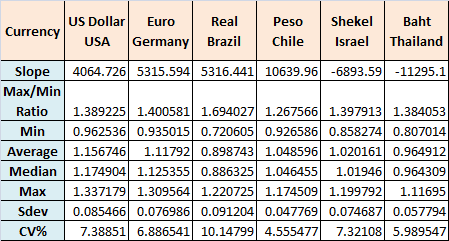
Figure 2:   Table of statistics for Foreign Currency Exchange rates with
Canadian $.  The Coefficient of Variation (CV%) varies between 4.6% (Chile),
to a high of 10.14% (Brazil).  This is remarkably stable over a 10 year period.
We suggest that this stability, and the excellent profitability derived by chicken
brokers keep them coming back for more.
The stability of these exchange rates over time means these are excellent trading partners.  When one goes up, likely one of the other 6 suppliers will go down.  By sending 6 emails asking your suppliers for their current prices, you are sure to find one of them significantly cheaper than the other five countries.  That is whom you place the order with this month.  Next month, you repeat the same process, and choose a different winner to ship you chicken.

Notice that China isn't in this list of chicken suppliers.  Isn't everything that China produces the cheapest in the world?  A broad assumption that may not be true for chicken.  China is the 5th largest exporter of chicken in the world.  So if China is a huge exporter of chicken, why isn't China one of the Top 6 for Canada?

Let's take a look at China's exchange rates with the Canadian $.

Figure 3:  China's Foreign currency exchange rate with Canadian $.
For the past 10 years, the Canadian $ has been losing ground against
the Chinese Yuan, meaning that chicken is becoming more and more
expensive.  Add to that China's questionable quality (real or perceived),
and China becomes a poor choice for supplying chicken to Canadians.

Based on Figure 3, China is a poor choice for supplying chicken to Canada.  I suggest this is a primary reason that China is not in the Top 6.

Canada's Top 6 chicken suppliers.  The choice is made based on maximum profits and minimum frustration for the millionaire Chicken Mafia.  It has little or nothing to do with protecting the Canadian public, or doing what's in the best interest of the public.  It's all about maximum profit and minimum frustration for the millionaire Chicken Mafia.


Friday, October 18, 2013

Tenderizing Spent Fowl

With the growing importation of #SpentFowl into Canada (16.9% of Canada's current domestic broiler production, rising to 100% on or about June 2016, see Blog posting here and here), I thought it would be important to learn about the impact on Canadian cuisine.

Spent fowl are tough and chewy.  About a year ago, my dear wife wanted a roast chicken dinner for Sunday.  I poked around in the freezer for one of our roasters, found one, and roasted it on the barbeque on one of those "beer can chicken" cooking stands.  It looked a little on the small side (compared to the usual monster size we grow on our farm), but golden brown and ready to eat.

When we went to eat it, it was tough and chewy; barely edible.  We both sat there with a mouth of chicken, unable to successfully chew it.  I put down the drumstick, went to the garbage, fished through the vegetable peelings and soggy coffee grounds, and found the vacuum-sealed plastic bag that the chicken had come in.  Sure enough, I had made a mistake when I went to the freezer, for I had grabbed one of our spent hens planned for chicken soup, not a broiler.  No wonder it looked a little on the thin side.  The spent fowl that I had mistakenly roasted ended up getting converted into chicken soup the next day, as it was inedible as a roaster.

Knowing this, what is happening with all this spent fowl meat that is being imported into Canada?  Surely, it's not all going to chicken soup, or minced canned chicken.

Looking on the Internet, I found some research from Poultry Science magazine on the tenderizing of spent fowl.  Apparently, if you inject spent fowl with a 0.1 wt. % concentration of a mixed salt brine (50% Calcium Chloride + 50% Sodium Chloride), using up to 10% of the meat's weight in brine, injected into the meat immediately after slaughter, then put the meat in a vacuum drum and tumble the chickens for an hour to mechanically soften the meat and allow the injected brine to do its magic, let it marinate for 24 hours while under refrigeration, then the meat becomes edible.  By adding a 50/50 mix of Calcium and Sodium salt (rather than 100% Calcium salt), the bitter taste of the calcium is avoided.

Even with this, I'm sure it's not as tasty as a young, plump roasters.  I hope they don't feed this spent fowl meat in the Nursing Homes as a cheaper alternative to real chicken, as I'm sure everybody with dentures would have an especially awful time.

In conclusion, make sure your brush and floss after every meal.  You're going to need your natural set of chompers to chew through the tough old spent hens that Canada is going to be receiving from now on as cheaper cheating chicken.

Those on low sodium diets may want to raise your own birds to avoid the high dosing of brine that will be in chicken from now on.  Perhaps this is why CBC's Marketplace found that Canadian chicken had such a high sodium level, even higher than chicken in the USA.  Watch out for your high blood pressure!

Thursday, March 7, 2013

Trafficking in Contraband Chicken ?

The Federal Government introduced legislation today to create a new crime, trafficking in contraband tobacco.

Agri007 reports that the Ontario Tobacco Marketing Board previously complained for a long time to both  Ontario and Federal governments that the trafficking in contraband tobacco was destroying their market supply and quota system.

With slow or no response for many years, the Tobacco Board eventually collapsed.  After the collapse, the government has finally gotten around to acting.

In July 2006, the Washington  Post reported the trafficking in contraband chicken from China to Viet Nam.  Bird flu caused the preventive slaughter of domestic chickens, resulting in a shortage of chicken meat, dramatically raising the price of locally available chicken.  The smugglers weren't long in filling the public's need for affordable chicken.  China is one of the world's largest producers of chicken.  The chicken traffickers played matchmakers between the producers and the neighbouring customers.

In Nov. 2010, the Canadian government warned everybody to be on the lookout for smuggled birds coming into Canada.  They were mainly worried about bird flu back then, but they acknowledged the risk of  bird smuggling.

On Feb. 5, 2011 Alberta Farmer paper reported that 1,800 lbs of smuggled chicken was found crossing from the US into Canada at Cornwall, believed destined for Quebec.

On Dec. 31, 2012 the International Herald Tribune reported a very profitable business smuggling chickens from Pakistan to Afghanistan, selling them for 4 times what they can get locally.

With a markup of 300% to 800% on the price of chicken between US and Canada, perhaps we had better prepare ourselves for the rising tide of trafficking in contraband chicken across our borders.  I'm sure it already occurs, but it may soon be one of our leading growth industries.

Since the government takes between 5 to 15 years to respond to urgent situations, I think we should put in our request early for action.  That means, feel free to send a copy of this post to your friendly neighbourhood Chicken Marketing Board, your Supervisory Supply Management Commission, and your provincial government.  Take a number, sit down, and patiently wait for action.

It shouldn't be any longer than the 15 years the Tobacco boys had to wait.