Google+
Showing posts with label illness. Show all posts

Wednesday, October 8, 2014

Deadly Canadian Chicken

Is Canadian chicken safe?  Seems like a simple question, but there is a huge debate about the correct answer to that simple question.

Better Farming posted a story in June 2014 on the increasing market share of chicken, consumer's desire to buy Canadian chicken, and the affordable chicken prices.  I found that posting recently, and added some comments about "affordable chicken" being #ChickenMafia propaganda.  An anonymous poster questioned my concerns about retail chicken prices, as they felt that CFO doesn't control retail prices.  I responded and again with some facts, trying to show that CFO had absolute power to ensure affordable chicken if they chose to exercise that power. Stephen Thompson jumped into the conversation in support of my position that Supply Management ("SM") regularly takes advantage of the Canadian consumer. I decided to add some objective evidence previously researched for this Blog on the unaffordability of chicken in Canada when compared to LICO (Low Income Cut-off poverty level) and Ontario's Minimum Wage. An anonymous poster complained about the use of minimum wage.  I responded with justification of the use of Minimum Wage as a benchmark, and reminded people that the unaffordable and poor quality chicken in Canada was causing or contributing to Canadians are dying every day.  Of course, those statements were jumped and resisted here and here, supported hereResponding to the Cost of Production ("COP") issue, I shared the secrecy that CFO uses for setting the farm gate price for chicken.  Raube Beuerman reminds the previous poster that the issue was chicken feed costs, not all costs nor all animals.  Then, the worm on the hook is dropped into the stream of questions, asking for me to justify my statement that poor quality, high priced chicken was causing and/or contributing to deaths in Canada.

With all these postings, it's a wonder any farming is getting done in Canada.

Having had the door opened, I shared the source of the disease and death from Canadian chicken.  I told them about the 4 million cases of foodborne illness in Canada, the chronic contamination of chicken with deadly pathogens, the chemical soup that is fed to the chickens so as to reduce the risk and costs of the #ChickenMafia, and the Frankenstein meat that results, with high Omega-6:Omega-3 ratios worse than slow grow and pastured poultry.

Stephen Thompson replied  that there was only weak, circumstantial, or no proven relation between Canadian chicken and disease or death.

In response to Stephen's doubt about cause-effect for deaths from Canadian chicken, I supplied the following (the central theme of this Blog posting):
The cause-effect data for Canada is not readily available at this time. CFIA has started  a Pathogen Reduction Initiative (PRI) for chicken, and is studying the baseline contamination level.
This Canadian program started in 2012, and follows the same format as what the USDA completed in 2008.  The USDA study showed a major problem for raw chicken, mainly from salmonella and campylobacter.  Unfortunately, Canada is 4 yrs behind times.

CDC estimates that 22% of all foodborne illness and 29% of foodborne deaths come from contaminated meats.

Chicken is chronically contaminated, while pork and beef are usually periodically contaminated.

CDC estimates that poultry caused somewhere between 5% to 20.6% of all foodborne illnesses in the USA between 1998 to 2008 (see Table 3 ).  That analysis is based on 4,589 illnesses during that period.

Poultry is blamed for 9.8% of all foodborne outbreaks and illnesses, 11.5% of all foodborne illnesses that required hospitalizations, and 19.1% of all foodborne diseases that resulted in death.

Until Canada catches up on solving the lousy Canadian chicken issue, I suggest that these US percentages are applicable for Canada, until proven otherwise.  Do you agree?  If not, why not?

Do you still insist that my previous posting was "overly dramatic"?

Is my previous posting so easily dismissed as exaggeration and hyperbole?

If you base your opinion on other data that conflicts with this data, please provide the links and explain further so we can all better understand the source and justification for your jaded doubts.

Have I convinced you that we have a problem with poor quality chicken in Canada?

Monday, November 11, 2013

Health Consequences of Food Monopolies

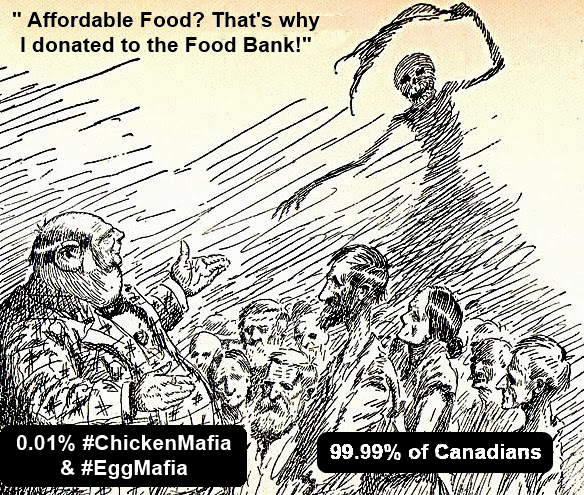
Obese man representing the 0.01% #ChickenMafia & #EggMafia tell the hungry 99.99% of Canadians, "Affordable Food?  That's why I donated to the Food Bank!"
The local food bank near my home reports that food bank usage by their clients has increased by 75% in the last 3 years.  This represents an average annual growth rate of 20.51% per year, or a doubling and then re-doubling every 3.5 years.

I'm sure your region has similar scary news.

Health Canada has reported that 7.6% of Canadian families can't afford the food they need to feed their families (ie. "food insecurity"); as high as 28% in Nunavut (ie. the Far North of Canada).

What are the consequences of this food bank trend for Canadians?

I wanted to get some hard facts, rather than just my intuition.

I had done linear programming in Engineering at University some 35 years ago.  I had used it time and again during my career to solve complex optimization problems.

I remember reading George Dantzig's historical review on the development of the Simplex method in the 1930's at the US Bureau of Labor Statistics, Urban Study of Consumer Purchases.  The US Army needed to know what was the cheapest meal they could feed to soldiers in the field while ensuring they were adequately nourished ("The Diet Problem").  The rest, as they say, is history.  The Simplex method of linear programming was born.

Solution for Diet Problem with between 0 to 300
grams of carbohydrate for a meal cost of US$0.956
Today, there is a web site that provides a simplified model of the Diet Problem.  The on-line Modified Simplex optimization engine simulator is available here for anybody to use.

The model uses a subset of foods and their nutrients from the USDA database here.  Many of the foods used here are typical of N. American diets, and are one of the causes or contributing factors to our rising tide of disease (eg. obesity, diabetes, cardiovascular disease, high blood pressure, rheumatoid arthritis, stroke, dementia, etc.).  I accepted and used this default subset database.

My intuition says, that when chicken and eggs are too expensive, people are forced to "dumb down" their food purchases, resulting in more and more carbohydrates in the shopping baskets.  I therefore ran a number of simulations to see the impact of more or less carbohydrates in the permitted diet.  A typical output is shown at the right.  Click on it for a bigger version.

The lowest possible carbohydrate diet I could find that met the RDA (Recommended Daily Amounts) was 243 grams of carbohydrates, with the minimum cost being US $8.3288 per day.  It is not clear when and where these default prices for the simulator database originate, but I assume the are a snapshot in time from somewhere in the USA, and are consistent within themselves.
Minimum cost of a nutritious meal vs.
the maximum permitted carbohydrates.

Any attempt to construct a lower carb. meal was impossible with the foods in this subset database.  With the whole USDA database, I'm sure other alternative menus will become available.  I leave that more comprehensive exercise to others, as I think what I have done here proves my intuition to be sufficiently accurate and useful..

I ran simulations from 243 gram/day, to as high as 10,000 grams of carbohydrate per day, seeking low cost meals.  The resulting series of minimum meal prices is in the graph to the right.

The lowest carbohydrate level with the same or lower $/day cost was found at 312 grams of carbohydrate with a meal cost of $0.9303 per day.  If you try to lower the carbohydrates below 312 grams, the meal cost goes exponentially higher in price from there on as you lower the carbohydrates.

Remember, this is US data, where chicken is 1/3 less expensive than in Canada, and eggs are 65.5% cheaper than in Canada.  That means chickens and eggs are not affordable choices for Canadians, and we are pushed harder and sooner toward high carb., unhealthy meals.

It should be noted that Dr. Jay Wortman, a physician in British Columbia, has successfully maintained himself symptom-free (ie. diabetes Type II remission) by a ketogenic diet of 10 grams carbohydrate per day for more than 12 years.  CBC TV did a documentary on his success, My Big Fat Diet.  Fortunately, as a medical doctor, the higher scale income he enjoys allows him to better afford the gouging prices imposed by the #ChickenMafia and #EggMafia.  For a quick summary, see a YouTube interview of Dr. Wortman here or watch it here:


By their monopolistic greed and uncaring actions, the #ChickenMafia and #EggMafia steal this cheap, effective, and healthy low carb. solution (ie. chicken and eggs) from most Canadians.

Meals with excessive carbs (ie. low carb is 10 to 60 grams of carb per day, the RDA is 130 g/day, while a typical North American diet has >300 g. carb. per day) usually cause or contribute to weight gain.  Most people become more sedentary when consuming more carbs as a portion of their diet, causing a lower energy expenditure; compounding the weight gain effect.  This high carb diet can partially explain the consistent increase in obesity in Canada, as reported by Health Canada.

Health Canada graph showing obesity rate (BMI >=30) rising from 14.9% to 17.2% for 2003 to 2009


The 243 g. carbohydrate daily intake menu at a cost of $8.3288 per day is as follows:

Optimum Meal Menu and servings for 243 g. of carbohydrate
at a cost of US $8.3288
 The 306 gram of carb. daily intake menu seems starvation to me, at a cost of $0.9303 per day is as follows:
Optimum Meal Menu and servings for 306 g. of carbohydrates
at a cost of US $0.9303
Remember, this is all you get for the entire day (breakfast, lunch, supper, & snacks).  Ouch!

Which daily meal menu would you and your family prefer if you didn't have to pick up the cheque?

Note that the food prices go up by 895.3% if we try to drop the carbohydrate consumption by 25.9%.

Can Canadians and the world now see clearly why we have a huge problem?  Canadians are forced, out of economic necessity, to eat more carbohydrates, rather that the astronomic prices we are charged for chicken and eggs.

Who will stand with Small Flockers to expose this crime against the Canadian people?

If you will not stand with us now, I suggest you lose the right to complain as hospital waiting rooms explode with sick people and taxes go through the roof to pay for all the sick people and the lost productivity.